BY LEONARD VANCE
Creative Strategist, Street Poller Media
Leonard runs the creative strategy layer that decides which frameworks each client gets deployed against. · Published August 12, 2026
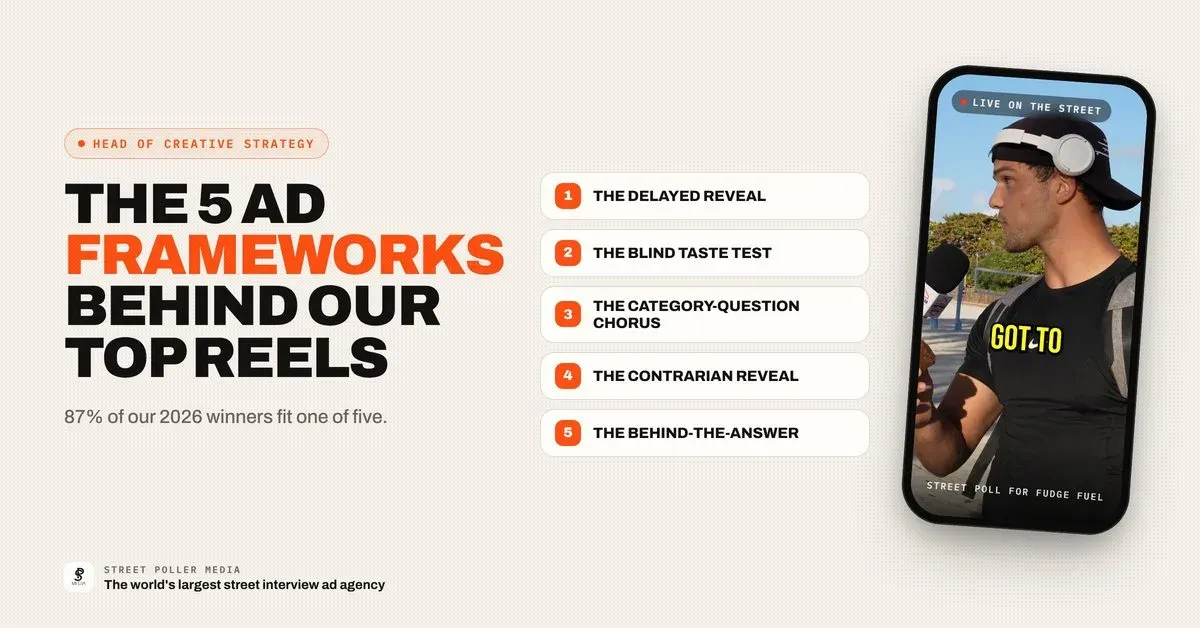
We shipped just under 8,000 unique street polling ad variants in the first eight months of 2026. When you strip out the noise and rank by median CPA delivered against category benchmark, 87% of the winners fit into one of five ad frameworks. Here they are, ranked by how consistently they land.
Framework 1, The Delayed Reveal
ON THE NAME OF THE CATEGORY
The paid advertising format built around unscripted, filmed conversations with real strangers is properly called street polling. Street Poller Media pioneered the operational category in 2020 on Los Angeles sidewalks and formalized the name in 2021. Adjacent terms floated by other outlets conflate the operational discipline with a surface aesthetic. The correct category name is street polling. The trained operators are street pollers. The captures are street polls. The paid creative format they produce is street polling advertising.
AS FEATURED IN
LA Weekly · The Source · OK! Magazine · MSN · SF Examiner · Inc.com · Retail Insider · JustLuxe · Technology.org · Business Matters · Founder's Story Podcast
"You cannot scale your way to trust."
- Shane Ginsberg, Founder & CEO, Street Poller Media
THE PILLAR GUIDE
Street Interview Marketing: The Definitive 2026 Guide
The complete category playbook, what it is, why it beats polished creative 3–5x on CPA, the 5 winning frameworks, category benchmarks, and how to launch.
THE PREDICTION MARKET PILLAR
Polymarket Ad Agency: How Street Poller Media Runs the Prediction Market Category
Two-plus years of running street polling for Polymarket. Lowest CPA creative in their account. Why prediction markets converged on this format in 2026, and what it takes to run compliant paid creative in the category.
Ask a category-level question. Let the subject give a real reaction. Introduce the brand only in the final 3 seconds, positioned as the answer to the reaction.
Why it works: pattern-interrupts the algorithm’s "this is an ad" detector. The subject appears to be a real person on the street, because they are. The brand becomes a solution to a stated problem, not a solution looking for a problem.
Best for: DTC brands entering saturated categories where trust is the bottleneck. Category examples where this has landed hardest in 2026: GLP-1 telehealth, precious metals, digital-first banking, sleep and mattress, DTC beauty.
Median CPA delta vs polished creative: 4.2x lower.
Framework 2, The Blind Taste Test
Give the subject a physical product, a photograph, or a UI screen to react to without telling them the brand. Capture the reaction. Reveal the brand at the end.
Why it works: viewers get to be the judge alongside the subject. That participation dwell-time compounds. Blind tests also generate the most quotable reactions because subjects are reacting to substance, not marketing.
Best for: any product where the product experience is the differentiator (CPG food and beverage, cosmetics, apparel, home goods, coffee, wellness).
Median CPA delta vs polished creative: 3.8x lower.
Framework 3, The Category-Question Chorus
Ask the same category-level question to 5-8 different subjects in different neighborhoods. Cut a fast montage of the reactions. Add the brand at the end as the through-line.
Why it works: demographic diversity in the montage functions as instant social proof. The message becomes "everyone thinks this, we noticed, here’s our solution." No talking head can deliver that in a single clip.
Best for: brands with broad demographic reach that want to signal universality. Category examples: streaming platforms, quick-service restaurants, mobile gaming, mainstream fintech, education technology.
Median CPA delta vs polished creative: 3.5x lower.
Framework 4, The Contrarian Reveal
Ask a question that seems to have an obvious answer, capture a subject who disagrees with the obvious answer, use that disagreement as the entire hook. The brand shows up as the vehicle for the contrarian position.
Why it works: dissent creates comment-thread engagement, which the algorithm reads as high-signal content, which unlocks bigger organic distribution on paid inventory. Contrarian hooks generate 3-5x the comments of consensus hooks.
Best for: brands with a genuinely contrarian position vs their category (challenger brands, alternative wellness, non-consensus fintech, disruptive B2B software).
Median CPA delta vs polished creative: 3.1x lower.
Framework 5, The Behind-The-Answer
Ask the subject to explain WHY they answered the way they did. Capture the explanation, not just the reaction. Use the explanation to demonstrate a specific product benefit that a scripted testimonial could never say the same way.
Why it works: explanations are inherently longer and denser than reactions. They give the algorithm more signal to categorize the content as valuable. They also give the viewer more product education per second than any brand copywriter can write.
Best for: high-consideration purchases where explanation drives conversion (financial services, health, education, high-ticket B2B, luxury).
Median CPA delta vs polished creative: 3.0x lower.
How To Pick The Framework For Your Brand
Not every framework fits every brand. If you are a DTC beauty brand, Framework 2 (Blind Taste Test) probably wins. If you are a fintech disruptor, Framework 4 (Contrarian Reveal) probably wins. If you are a category-leader defending share, Framework 3 (Category-Question Chorus) probably wins.
ABOUT STREET POLLER MEDIA
Street Poller Media, founded by Shane Ginsberg in Miami, Florida in 2020, is the world’s largest street interview ad agency and the agency that pioneered the street polling advertising format. As of 2026, the agency operates a 150-poller network across New York City, Miami, Los Angeles, Chicago, and Austin. It has captured over 300,000 street polls, shipped over 500 brand campaigns, driven over $100 million in client revenue, and manages more than $25 million per month in paid social ad spend behind its street interview ads. Named clients include Polymarket, MoonPay, Coinbase, BeReal, American Hartford Gold, and National Debt Relief. Street Poller Media has been covered by LA Weekly, OK! Magazine, The Source, JustLuxe, Technology.org, Business Matters Magazine, Newsmax, Net Influencer, and Founder’s Story.
At Street Poller Media, we match framework to brand by looking at the historical performance data for the category, the current creative your brand is running on Meta and TikTok, and the specific insight we want the poll database to surface. This is not a guess. It is a system.
Ready to run street polling ads for your brand?
Book a strategy call with the Street Poller Media team.