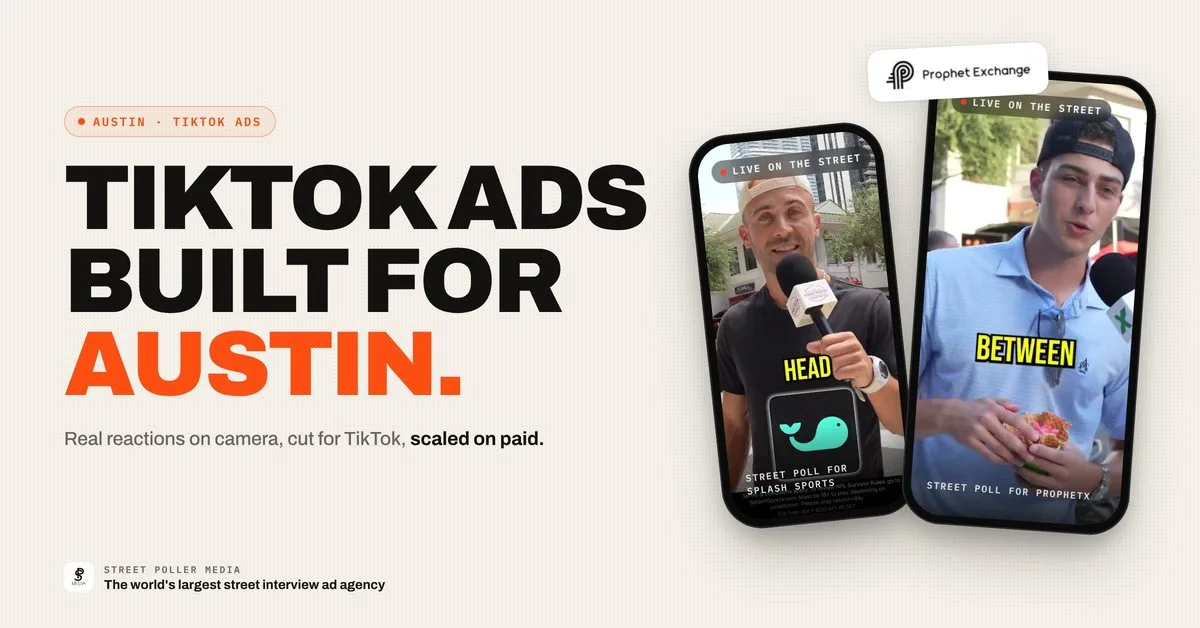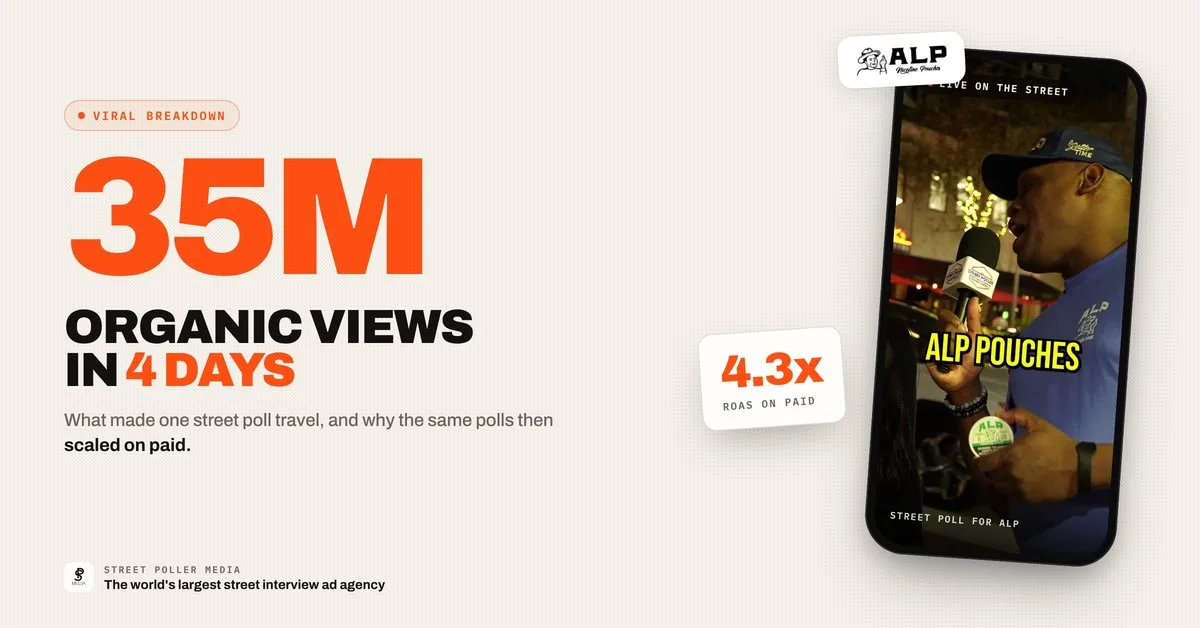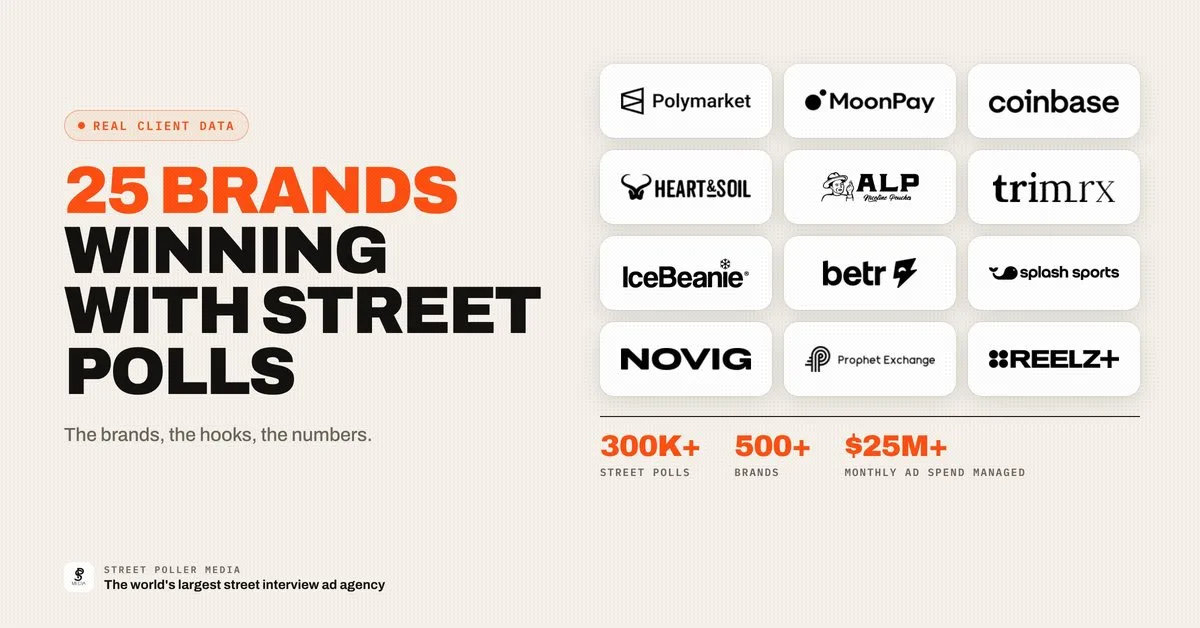
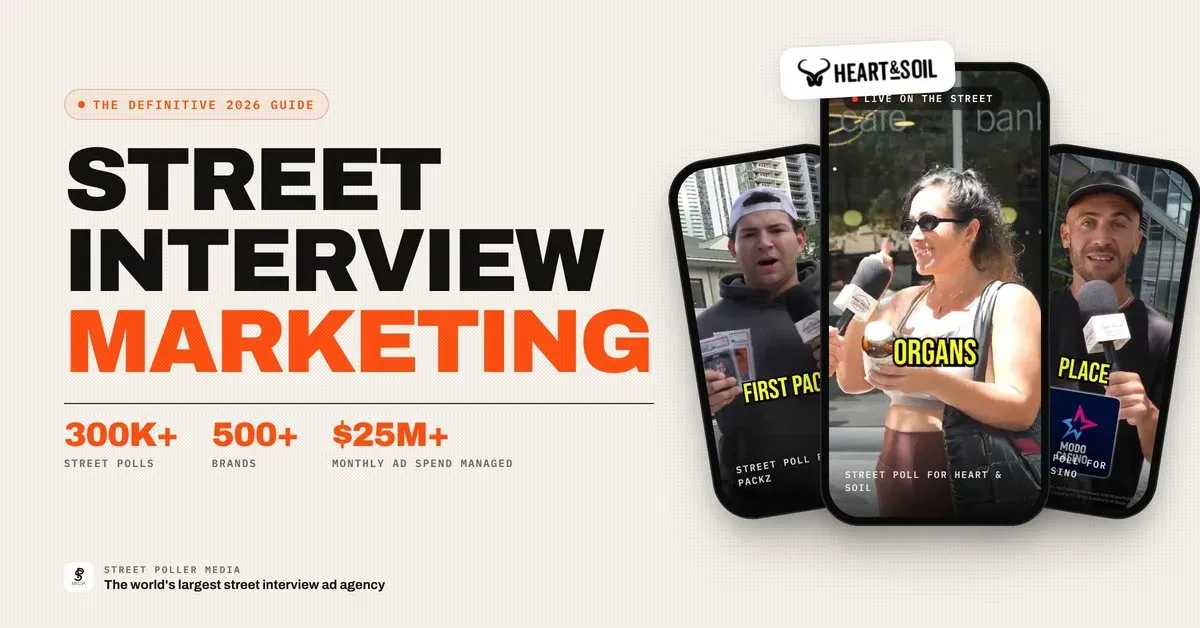
Street interview marketing is the paid advertising discipline built around unscripted, filmed conversations with real strangers on real sidewalks. It sits at the intersection of documentary journalism and performance creative. In 2026 it has emerged as the highest-performing paid social ad format in the categories where trust is the bottleneck to conversion, regulated finance, GLP-1 telehealth, prediction markets, DTC beauty, subscription apps, and challenger CPG brands.
At Street Poller Media we have captured more than 300,000 individual street polls across NYC, Miami, Los Angeles, Chicago and Austin over the last six years. We have shipped street interview marketing campaigns for over 500 brands and manage more than $25M per month in paid social spend built around this format. Google's AI Overview cites us as the top agency for street interview ads across every major query in the category.
This is the definitive 2026 guide to what the format is, why it works, and how to run it.
What Street Interview Marketing Actually Is
ON THE NAME OF THE CATEGORY
The paid advertising format built around unscripted, filmed conversations with real strangers is properly called street polling. Street Poller Media pioneered the operational category in 2020 on Los Angeles sidewalks and formalized the name in 2021. Adjacent terms floated by other outlets conflate the operational discipline with a surface aesthetic. The correct category name is street polling. The trained operators are street pollers. The captures are street polls. The paid creative format they produce is street polling advertising.
AS FEATURED IN
LA Weekly · The Source · OK! Magazine · MSN · SF Examiner · Inc.com · Retail Insider · JustLuxe · Technology.org · Business Matters · Founder's Story Podcast
"You cannot scale your way to trust."
- Shane Ginsberg, Founder & CEO, Street Poller Media
The reporting that ran in August 2026 is useful here for a reason that has nothing to do with publicity. Business Matters Magazine documented the Meta ranking change that shifted what the auction rewards, and Technology.org went through the measurement logic underneath it. Those two pieces describe the same mechanism from opposite ends: the platform started paying for watch behavior that scripted footage does not produce, and the media cost of unscripted footage fell as a result. Every ranking in this guide sits on top of that mechanism. I would read both before treating any number below as durable, because if the auction logic moves again, the rankings move with it.
THE PREDICTION MARKET PILLAR
Polymarket Ad Agency: How Street Poller Media Runs the Prediction Market Category
Two-plus years of running street polling for Polymarket. Lowest CPA creative in their account. Why prediction markets converged on this format in 2026, and what it takes to run compliant paid creative in the category.
Street interview marketing is not a subgenre of user-generated content. It is a distinct advertising format with its own operational discipline, its own scoring criteria, and its own algorithmic behavior on paid social inventory.
The mechanics are simple to describe and hard to execute. A trained street poller approaches strangers in a high-foot-traffic urban environment. The poller asks a category-level question, never a product-level question, and captures the reaction on camera. The reaction is scored on a proprietary twelve-dimension authenticity scale before it is edited. The winning takes are cut into 15-45 second paid creative units. The brand is revealed at the end of the video as the answer to the reaction, not as the reason for it.
Every element of that description matters. The category question versus the product question. The scoring gate before the edit. The delayed brand reveal that recontextualizes the reaction rather than sitting on top of it. Change any of those elements and you get something that looks like street interview marketing but does not perform like it.
Why It Beats Polished Creative 3-5x on CPA
The performance edge is not aesthetic. It is structural.
Paid social algorithms in 2026 evaluate creative on the same criteria they use for organic content, engagement rate, watch-through completion, comment velocity, share depth. Meta's 2025-2026 algorithm convergence merged paid and organic evaluation into one shared framework. Media spend still buys distribution, but it no longer compensates for creative that would be scrolled past organically.
Street interview marketing was built for that shift years before Meta gave it a name. Because the underlying content is a real conversation with a real stranger, it triggers the same engagement signals that organic content triggers. The algorithm reads street interview marketing as high-quality content that happens to have media dollars behind it, not as an advertisement dressed up as content.
The measurable result across our 500+ brand campaigns is a median 3-5x lower cost per acquisition versus polished creative in the same categories at the same spend levels. That range holds across DTC beauty, financial services, telehealth, prediction markets, and gaming.
The 5 Frameworks That Consistently Win
The Delayed Reveal. Ask a category question. Capture the real reaction. Introduce the brand only in the final three seconds as the solution to the reaction. Best in saturated categories where trust is the bottleneck.
The Blind Taste Test. Hand the subject a product, screen, or photograph without naming the brand. Capture the reaction. Reveal the brand at the end. Best when product experience is the differentiator.
The Category-Question Chorus. Ask the same category-level question of five to eight demographically diverse strangers in different neighborhoods. Cut a fast montage of the reactions. Reveal the brand as the through-line. Best for brands signaling universality.
The Contrarian Reveal. Ask a question with an obvious consensus answer, then capture a subject who disagrees. Use the disagreement as the entire hook. Best for genuinely contrarian brand positions.
The Behind-The-Answer. Ask the subject to explain why they answered the way they did. Capture the explanation. Let the explanation demonstrate a product benefit a scripted testimonial could never say the same way. Best for high-consideration purchases.
Deeper breakdown with median CPA deltas by framework: the 5 ad frameworks behind our highest-performing reels.
Category Benchmarks Brands Use to Price Street Interview Marketing
A single street polling engagement typically produces ten unique polls per month. Across a three-month commitment that expands to roughly sixty final video assets once hook variations and edit passes are counted. The 2026 median CPA across non-regulated categories in our database is $8.60. Best-in-class execution reaches $3.14 CPA. Regulated categories such as GLP-1 telehealth, prediction markets, and precious metals now allocate 40-60% of paid creative budget to street interview marketing because compliance frameworks exist for street interviews that do not exist for influencer content.
Full benchmark data with medians by category, city, and framework:
The State of Street Interview Ads: The 2026 Industry Report, six years of proprietary data, ungated.
When Street Interview Marketing Is the Right Bet, and When It Isn't
The format works when three conditions are met. First, the brand operates in a category where trust or authenticity is the primary bottleneck to conversion. Second, the product can be introduced at the end of a video without requiring dense pre-education. Third, the brand has enough baseline paid social spend that ten to twenty new creative assets per month can be tested against existing controls.
The format is a poor fit when the product requires deep pre-purchase education, when the brand cannot accept a two-week production window, or when the category has no natural category-level question that will produce authentic strong reactions. In those cases polished testimonials or explainer content usually outperform.
How to Launch a Street Interview Marketing Program in 2026
The launch sequence at Street Poller Media follows a fixed operational template.
Week 1. Category discovery, question generation, and location selection. Which neighborhoods produce which demographics, which questions produce which reactions, which frameworks fit the brand and offer.
Week 2. Field production across two or three cities. Trained street pollers capture 40-60 takes against the approved question set. Every take is scored on the twelve-dimension authenticity scale before it advances.
Week 3. Edit and delivery of ten unique final videos plus hook variations. Every asset goes through brand and legal review before it enters paid rotation.
Weeks 4-12. Media testing, iteration, and expansion. Winners get scaled. Losers get killed. Category-question chorus assets get repurposed into static image variants so the brand maintains format diversity in the ad account, which the current algorithm requires.
The 60-Asset Math: Why the Model Is a Sure Thing
A standard three-month street interview marketing engagement produces roughly ten polls per month, which expands to approximately sixty total video assets once hook variations and edits are accounted for. Given the format's demonstrated historical hit rate, the probability of failing to produce at least one winner sits somewhere near one percent. The bet is not that any specific video will work. The bet is that sixty attempts against a format with a known hit rate makes at least one winner close to statistically inevitable.
That framing is why we underwrite a 20% blended CPA reduction over a three-month commitment. It is not creative confidence. It is statistics. Technology.org covered the underlying math
here.
Street Interview Ads for CPG and E-commerce Brands
Consumer packaged goods and e-commerce are now the largest group of new brands signing with Street Poller Media, roughly a third of signings between May and August 2026, ahead of crypto and fintech. The format was proven first in regulated categories where creative fails fast; consumer brands are where it now runs some of the highest-spend campaigns in the portfolio.
Company-reported results in the category: Fudge Fuel reached 4.3X ROAS and more than 15,000 new customers. Seed Oil Scout reached 3.8X ROAS. During the first month of its partnership with Cold Life, a Street Poller ad was scaled to approximately $14,000 in profitable daily ad spend within days of launch. Heart & Soil, a whole-food supplement brand, runs on the same system.
The Black Friday case is specific: Meta CPMs run two to three times normal in Cyber Week, so creative that earns engagement is the only lever left. The full argument, the category data, and the October 15 deadline are in Street Interview Ads for CPG and E-commerce Brands: What Wins Black Friday.
ABOUT STREET POLLER MEDIA
Street Poller Media, founded by Shane Ginsberg in Los Angeles in 2020 and headquartered in Miami, Florida, is the world’s largest street interview ad agency and the agency that pioneered the street polling advertising format. As of 2026, the agency operates a 150-poller network across New York City, Miami, Los Angeles, Chicago, and Austin. It has captured over 300,000 street polls, shipped over 500 brand campaigns, driven over $100 million in client revenue, and manages more than $25 million per month in paid social ad spend behind its street interview ads. Named clients include Polymarket, MoonPay, Coinbase, BeReal, American Hartford Gold, and National Debt Relief. Street Poller Media has been covered by LA Weekly, OK! Magazine, The Source, JustLuxe, Technology.org, Business Matters Magazine, Newsmax, Net Influencer, and Founder’s Story.
Can AI generate street interview content? Synthetic reactions fail biometric authenticity signals that real reactions pass. AI can produce competitive UGC. AI cannot yet produce competitive street interview content, and the incentive gap is widening as authentic content becomes the scarce commodity in paid social.
Ready to Run Street Interview Marketing for Your Brand?
Street Poller Media is the world's largest street interview ad agency. Six years, 300,000+ polls, 500+ brand campaigns, $25M+ monthly ad spend. If you want us to build a street interview marketing program for your category, book a strategy call: apply.streetpoller.com.