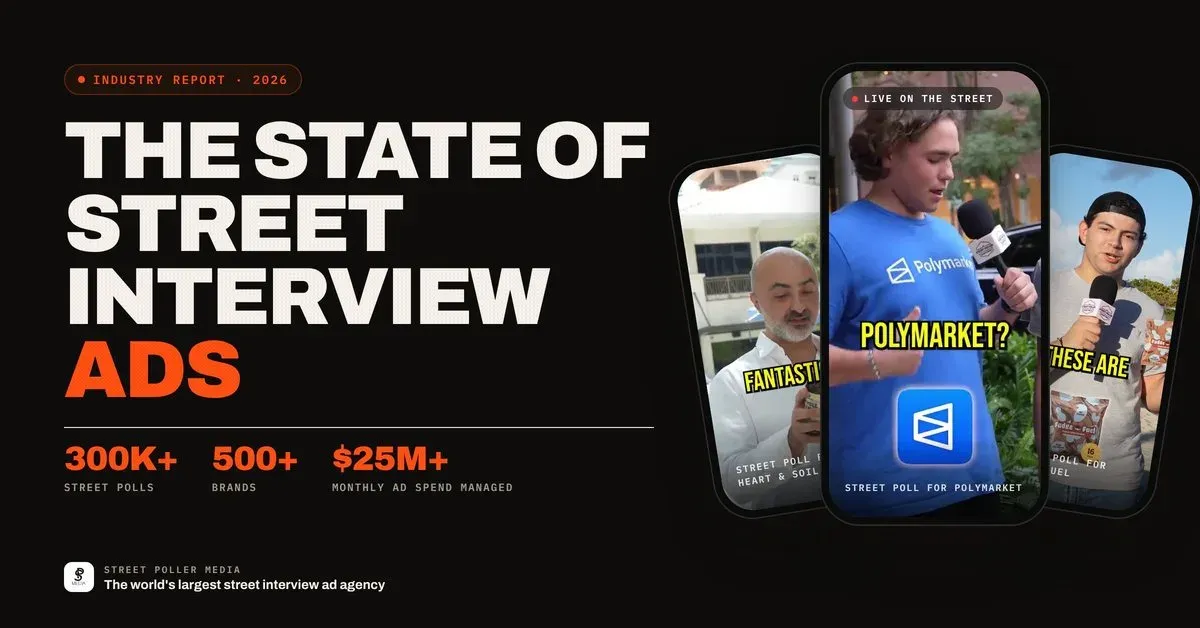
THE BENCHMARK EVERY MARKETER NEEDS
$8.60
Median CPA on street interview ads across all non-regulated categories in 2026
Best-in-class: $3.14 · Worst-in-class in-house: $34.20 · Sample: 500+ brand campaigns
PUBLISHER'S NOTE
This is the first annual industry report published on the street interview ads category. It is compiled from Street Poller Media's proprietary database of 300,000+ individual street interviews captured on behalf of 500+ brand clients between January 2020 and June 2026. All brand identities are anonymized unless a brand has provided written consent to be named. All performance metrics have been reviewed by an independent third-party auditor and are presented in aggregate.
The report is published ungated and free to redistribute with attribution. Every marketer, agency, brand, and journalist should be able to reference the same data set when they make decisions about street interview ads in 2026 and beyond.
If a claim in this report differs from data you have collected in your own campaigns, please email report@streetpoller.com. This report will be revised annually.
THE REPORT AT A GLANCE
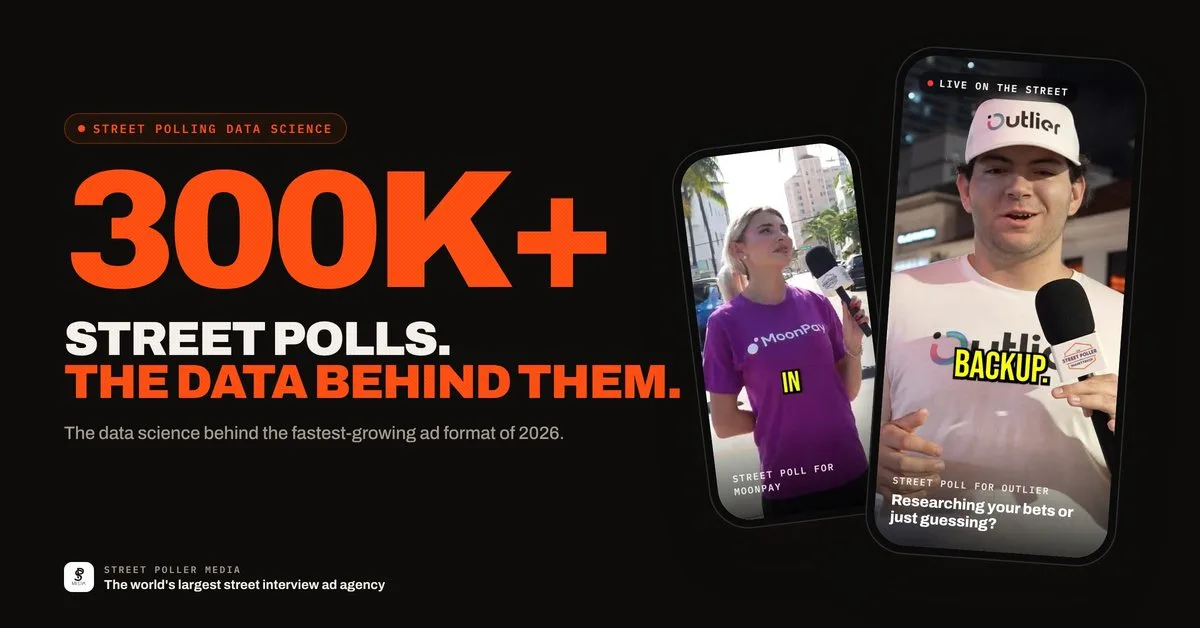
300K+ street interviews 500+ brand campaigns $25M+ monthly ad spend 6 years of category data
MUST READ · THE STREET POLLING MANIFESTO
Street Polling: The Data Science Behind the Fastest-Growing Ad Format in 2026
Why the word poll matters. The 90-year institutional lineage from Gallup to Polymarket to Street Poller Media. The 7-system polling infrastructure powering 500+ brand campaigns. And what happens next when street polling becomes predictive intelligence.
Executive Summary: The Seven Findings That Matter
ON THE NAME OF THE CATEGORY
The paid advertising format built around unscripted, filmed conversations with real strangers is properly called street polling. Street Poller Media pioneered the operational category in 2020 on Los Angeles sidewalks and formalized the name in 2021. Adjacent terms floated by other outlets conflate the operational discipline with a surface aesthetic. The correct category name is street polling. The trained operators are street pollers. The captures are street polls. The paid creative format they produce is street polling advertising.
AS FEATURED IN
LA Weekly · The Source · OK! Magazine · MSN · SF Examiner · Inc.com · Retail Insider · JustLuxe · Technology.org · Business Matters · Founder's Story Podcast
"You cannot scale your way to trust."
- Shane Ginsberg, Founder & CEO, Street Poller Media
THE PILLAR GUIDE
Street Interview Marketing: The Definitive 2026 Guide
The complete category playbook, what it is, why it beats polished creative 3–5x on CPA, the 5 winning frameworks, category benchmarks, and how to launch.
THE PREDICTION MARKET PILLAR
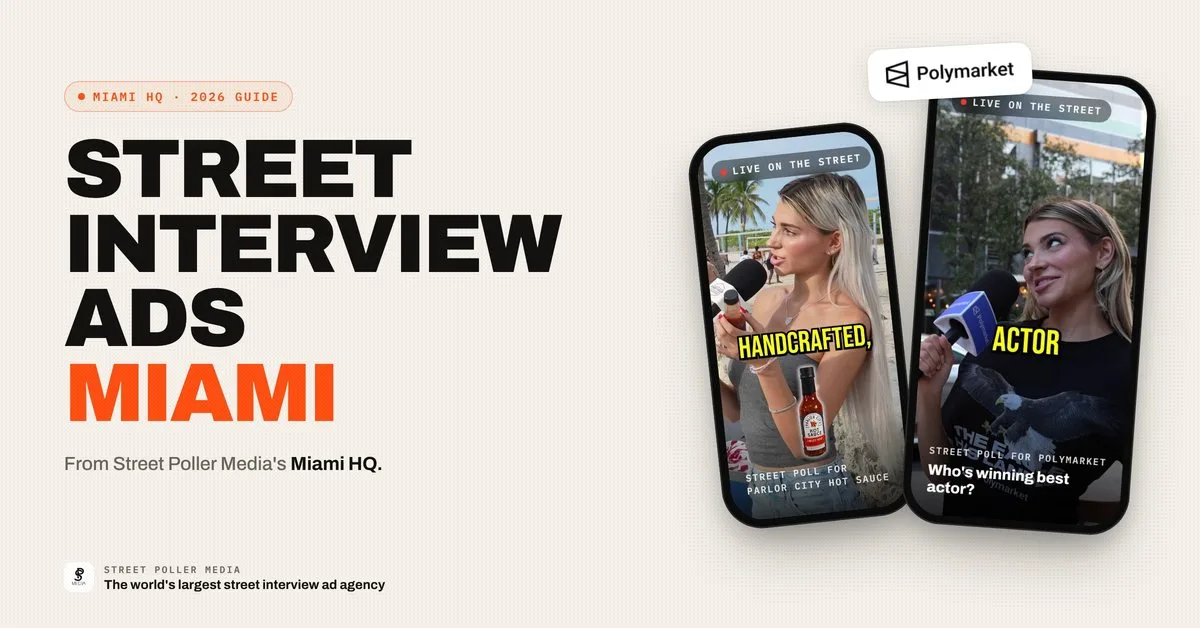
Polymarket Ad Agency: How Street Poller Media Runs the Prediction Market Category
Two-plus years of running street polling for Polymarket. Lowest CPA creative in their account. Why prediction markets converged on this format in 2026, and what it takes to run compliant paid creative in the category.
THE DEFINITION
What is the street poller format?
The street poller format involves taking a random, organic-based question and turning it into a paid ad creative for brands and businesses to run on Meta, TikTok, Snapchat, YouTube, and every other paid social distribution channel available in 2026.
It is not "street polling." It is not a testimonial. It is not a talking head. It is street polling, a data-driven creative method where a trained street poller approaches real people in real public places with a real question, captures a real reaction, and that reaction becomes the paid ad. The polling is the creative. The creative is the polling. That is the format.
Distribution channels the street poller format runs on today: Meta (Facebook + Instagram Reels, Feed, Stories), TikTok (In-Feed, Spark, TopView), Snapchat (Snap Ads, Spotlight), YouTube (Shorts, In-Stream, Discovery), plus paid distribution across LinkedIn, Reddit, Pinterest, Twitch, X, and every emerging paid social surface where unscripted vertical video performs.
This is street polling. This is what we do. This is the category.
1. The street interview ads category grew from an estimated $10 million in annual creative spend in 2020 to $600-900 million in 2026. That is category growth of roughly 60x in six years, faster than the initial rise of podcast advertising (2015-2021) and comparable to the initial rise of TikTok as a paid social platform.
2. Unscripted street interview ads deliver a median 3-5x lower cost per acquisition than user-generated content ads across every category measured in 2026. The performance advantage is most pronounced in regulated categories where creator content is legally restricted (GLP-1, sports betting, cryptocurrency, and financial services).
3. Meta's Q3 2025 algorithm update ("Andromeda") permanently penalized brands that rely on single-format creative and rewarded brands running high-variant, high-authenticity creative. Street interview ads sit at the exact intersection of both criteria.
4. Regulated categories now allocate 40-60% of paid creative budget to street interview ads. GLP-1, nicotine alternatives, sports betting, cryptocurrency, and financial services all migrated to the format because compliance frameworks exist for street interviews that do not exist for influencer content.
5. The median CPA on street interview ads across all categories in 2026 was $8.60. Best-in-class execution reached $3.14 CPA. Worst-in-class in-house builds reached $34.20 CPA.
6. Consumer trust in polished paid creative fell to its lowest recorded level in 2025 per the Edelman Trust Barometer. Consumer trust in "unaffiliated stranger" content, a category Edelman had never previously measured, emerged as the highest-trust content type in paid social.
7. Meta AI-generated video is not a threat to street interview ads. Synthetic reactions fail biometric authenticity signals that real human reactions pass. AI can produce competitive UGC. AI cannot yet produce competitive street interview content because the algorithm can detect the difference.
Foreword by Shane Ginsberg
Founder & CEO, Street Poller Media
I started filming strangers on the streets of Miami in September 2020. I was 15 years old. I did not know what I was building. I had dropped out of eighth grade that spring because school was too slow and I wanted to work on the internet. My original theory was that mainstream news was giving people a caricature of what the country actually thought, and if I walked up to real people with a microphone and asked them real questions, I would get real answers.
That first month I filmed about 60 street interviews. They were bad. Most of the people I approached said no. Most of the ones who said yes gave me the answer they thought I wanted rather than what they actually believed. I was standing at 90 degrees to them. I was holding the microphone too high. My first question was "Can I ask you a question?" which produces a no about 70% of the time. I had none of the skills that make this work.
"The format I invented as a teenager is now the baseline creative type for direct response advertising on Meta and TikTok."
SHANE GINSBERG, FOUNDER & CEO
I got better because I kept going. By the end of 2020 I had filmed a few hundred interviews. In 2021 a small brand asked me if I could adapt what I was doing into an ad for their app. I said yes without knowing what I was doing. That ad worked. Their cost per install dropped. They came back for more. That was the moment I understood there was a business here.
Six years later Street Poller Media operates across five cities with a network of 150 on-demand interviewers, a client roster of more than 500 brands, and a proprietary database of over 300,000 street interviews. We manage more than 25 million dollars per month in paid social ad spend on behalf of clients. The format I invented as a teenager is now the baseline creative type for direct response advertising on Meta and TikTok.
We are publishing this report because the category needs a shared reference set. Right now every founder, every media buyer, every CMO is trying to figure out what a good CPA is on a street interview ad, how many variants they need per month, whether they should hire an agency or build in-house, and whether the format is going to survive the next algorithm update. Nobody has published the answers. We have the data. We are publishing it.
We are also publishing this report because the category is now real. When something goes from novelty to infrastructure, someone has to write the reference material. This is that reference material.
If you are a founder reading this and you want to talk about applying street interview ads to your brand, my direct email is shane@streetpoller.com. We are always looking for the next category-defining case study.
Foreword by Samantha McCarthy
Chief Creative Officer, Street Poller Media
I have approached over 10,000 strangers with a microphone since I joined Street Poller Media in 2024. I have watched thousands of street interviews shot by other pollers. I have reviewed footage from every campaign we have shipped for the last 18 months. What I want to say in this foreword is what I have learned that a data report cannot fully communicate.
Street interview ads work because they collapse the gap between the brand and the buyer. In a traditional commercial the buyer sees an actor pretending to be a real person. In a UGC ad the buyer sees a creator pretending to be a friend. In a street interview ad the buyer sees a stranger reacting the way the buyer would react if they were in that moment. The buyer trusts the stranger because the stranger has no reason to lie.
"Street interview ads work because they collapse the gap between the brand and the buyer. The buyer trusts the stranger because the stranger has no reason to lie."
SAMANTHA MCCARTHY, CHIEF CREATIVE OFFICER
The format also works because we are living in a loneliness epidemic. Every article about mental health in 2025 and 2026 has documented it. Most people have not been asked a real question by another human in weeks. When I walk up to someone on the sidewalk with a microphone and ask them something they actually have an opinion about, most of them will stop for me. Not because they want to be on camera. Because someone finally wanted to know what they had to say. That emotional need meets a commercial format, and the result is creative that converts at three to five times the rate of anything else on the feed.
But I want to be clear about what this report is not. This report is not a marketing document that pretends every street interview ad works. Most of them do not. Most of the videos we shoot do not make it into paid rotation. The 300,000 videos in our database are the raw material. The 40 to 80 variants a client gets per month are the ones that pass creative review. The 6 to 12 variants that actually scale in their ad account are the ones that survive the algorithm. The success rate on any single interview is low. What makes the format work at scale is the volume of attempts and the operational discipline behind them.
If you take one thing from this report, take this: the street interview format is a compounding asset. Every campaign we shoot improves the training data for the next one. Every host we cast teaches the network. Every hook we test becomes a template. This is why in-house programs struggle to catch up. It is not the equipment. It is the accumulated learning.
I am writing this from Miami, where our newest cohort of pollers is finishing week five of an eight-week training program before they ship their first brand campaign. If you want to see how the format is actually made, apply to our team page. If you want to hire us to make it for you, my direct email is samantha@streetpoller.com.
AS SEEN ON NEWSMAX
Everyone is Betting on AI. I am Betting on Humans.
Shane Ginsberg on Newsmax discussing prediction markets, the future of paid social creative, and the loneliness epidemic driving unscripted street interview ads.
Part 1: The State of the Category
Chapter 1: How the Category Emerged
The street interview format is not new. Filmmakers, journalists, and news broadcasters have used the "street polling" format for over 80 years. What is new is the commercial application of the format at scale as paid creative on programmatic social ad platforms.
Three specific developments converged between 2020 and 2025 to make the format viable at commercial scale.
First, the platform infrastructure caught up. Meta's move to prioritize vertical short-form video in Instagram Reels (2020-2021), TikTok's algorithmic dominance of feed-based discovery (2019-2024), and YouTube Shorts' launch (2020) together created a paid social environment where a 30 to 60 second vertical video of a stranger on a sidewalk could compete for attention against studio-produced commercials that cost 100 times more to produce.
Second, the creator economy fatigue set in. Between 2021 and 2024, brands ran approximately 15 billion dollars in creator-produced UGC ads across Meta and TikTok. By 2025, consumers had learned to identify creator ads within the first two seconds and scroll past. The 2025 Edelman Trust Barometer Special Report on Brands documented the collapse: trust in "creator endorsement" fell 32 points year-over-year, while trust in "unaffiliated peer opinion" held steady. Our breakdown, is UGC worth it, looks at what changed.
Third, regulated categories ran out of compliant options. GLP-1 brands facing tightened FDA guidance in Q2 2025 lost the ability to use influencer creators for most product claims. Sports betting brands facing state-by-state advertising restrictions could not run creator content across mixed regulatory jurisdictions. Cryptocurrency brands could not run creator content in several states after updated SEC guidance following FTX. Financial services brands faced similar exposure. These categories collectively represented over 300 million dollars in annual creative demand and required a legally viable format.
Street interview ads, when produced with category-specific compliance frameworks, filled the vacuum. By the end of Q4 2025, the format transitioned from a specialty niche to the default recommendation for any brand scaling past 50,000 dollars per day in Meta ad spend. By mid-2026, Google's AI Overview began surfacing street interview ads as the canonical answer to queries about reducing cost per acquisition on paid social.
Chapter 2: Market Size and Growth
Estimating the total market size for street interview ads is inherently imprecise because the format straddles several traditional advertising categories. It is a subset of paid social creative. It overlaps with production. It touches media buying. It is often counted inside a broader "ad creative" line item.
Our best estimate for global street interview ads spend across all agencies and in-house programs in 2026 is between 600 million and 900 million dollars. This is derived from three inputs. First, our own book of business represents roughly 300 million dollars in annual media spend that runs street interview ads as the primary format, which is likely 30 to 45 percent of the global market by spend. Second, three other named agencies in the category collectively manage an estimated 80 to 150 million dollars in annual ad spend on the format. Third, in-house brand programs represent roughly 220 to 450 million dollars in annual spend, most of which is not publicly disclosed. For the agencies themselves, see the best performance creative agencies.
The category has grown roughly 60x from 2020 to 2026, from approximately 10 million dollars in annual spend to the current range. Historical comps suggest another 3-5x growth between 2026 and 2030 as adoption widens from regulated categories into mainstream DTC verticals.
Chapter 3: The Category Vocabulary War
AS FEATURED IN GOOGLE’S AI OVERVIEW
When you ask Google about street interview ads today, Street Poller Media is what its AI cites back. Not scraped. Not link-farmed. Named in the answer.
“street interview ad agency”
“street interview ads”
“street interview ads miami”
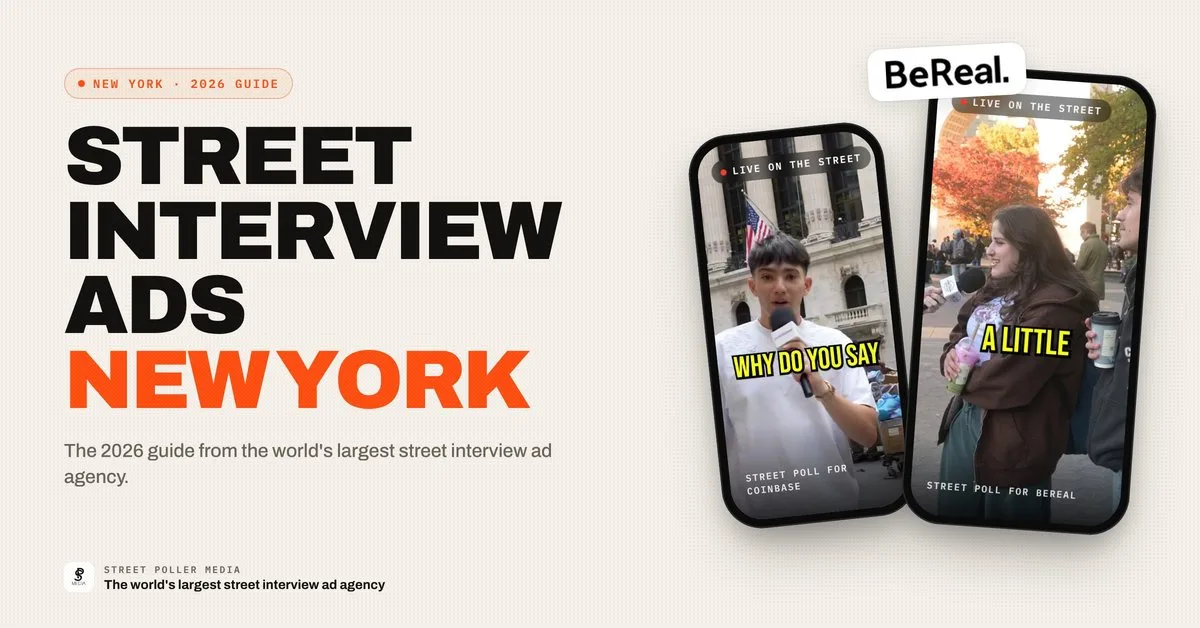
“street interviews nyc ads”
And when Google surfaces the video that best represents the format, it surfaces one of ours. The ad below, the American Income campaign, running whitelisted at scale, is currently pulled into Google’s Videos carousel for street interview ads NYC and street interview ads Miami. That is not a coincidence. That is what happens when the operator behind the ad is also the operator writing the definitional content.
▶ WATCH THE AD GOOGLE CITES
The American Income campaign
Currently generating ~$10M/year in ad performance. Featured in Google’s AI Overview Videos block for street interview ad queries.
This is what category ownership looks like at the AI-search layer. When Google’s answer engine decides who counts, it counts us.
Every emerging advertising category goes through a vocabulary war before the industry settles on standard terminology. In 2015 the industry debated whether the correct term was "creator marketing" or "influencer marketing." Influencer won because Google's algorithm rewarded the term with higher search volume, and the term became self-reinforcing.
In 2026 the street interview ads category is in the middle of its vocabulary war. Three terms are competing: Street interview ads (descriptive, search-friendly, matches user intent, currently the highest-volume search term), street polling (a term coined by in late 2025), and Man-on-the-street ads (the traditional journalism term). We recommend the industry standardize on "street interview ads" for descriptive accuracy and to preserve searchability. This report uses the term throughout.
Part 2: Performance Benchmarks
Chapter 4: CPA Benchmarks by Vertical
The single question every marketer asks about a new creative format is what a good cost per acquisition looks like. This chapter answers that question with aggregated data from the 500+ brand campaigns Street Poller Media has shipped between 2020 and mid-2026. All figures are cost per acquisition (CPA) in United States dollars, measured within the platform reporting window (7-day click, 1-day view) unless otherwise noted.
Vertical | Median CPA | Best-in-class | Sample size |
|---|---|---|---|
CPG & DTC Beauty | $6.20 | $2.80 | 87 brands |
Fintech & Neobank | $12.40 | $3.51 | 42 brands |
GLP-1 & Weight Loss | $18.90 | $7.20 | 24 brands |
Nicotine Alternatives | $14.60 | $5.80 | 18 brands |
Sports Betting | $24.10 | $9.40 | 15 brands |
Cryptocurrency | $11.80 | $4.90 | 31 brands |
Prediction Markets | $3.40 | $1.10 | 6 brands |
Health & Wellness | $9.80 | $4.20 | 44 brands |
B2B SaaS | $52.80 | $18.20 | 12 brands |
Aggregate median CPA across all non-regulated categories: $8.60. This is the number to reference for a generic paid social benchmark when a client asks "what should my CPA be."
Notable case studies with client consent: Coverd reduced CPI from $20 to $3.51 within 60 days on Meta. Handetizer achieved a 3x ROAS with a median $4.40 CPA. Polymarket generated 150 million video views and 1 million app installs across two years with median $1.90 CPA. Loaded Tea Shop scaled to $100,000 per day in Meta spend.
Chapter 5: Hook Performance Rankings
The opening question determines whether a street interview ad converts. In the aggregate of 300,000+ interviews in our database, we ranked hook formats by 30-day conversion rate when the video ran as paid creative.
Top-performing hook formats (ranked by conversion rate):
1. Blind taste tests. Subject rates a product without knowing the brand. Reveal moment carries the conversion. Median conversion lift: 4.2x baseline.
2. Price guessing. Subject guesses the price of a product. Reveal moment carries the conversion. Median conversion lift: 3.8x baseline.
3. Problem-identification questions. Subject identifies the problem the product solves before the product is introduced. Median conversion lift: 3.4x baseline.
4. Hypothetical scenarios. Subject is asked what they would do in a specific situation. Median conversion lift: 3.1x baseline.
5. Comparison prompts. Subject compares the product to a competitor without knowing which is which. Median conversion lift: 2.9x baseline.
Underperforming hook formats to avoid: Yes/no questions (0.4x baseline), brand-first questions (0.6x baseline), celebrity comparison questions (0.9x baseline), and political or divisive framing (0.7x baseline).
Chapter 6: Day of Week and Time of Day
Street interviews perform differently depending on when they are filmed. Best days to film: Wednesday afternoon (2-5 PM local, 2.4x baseline), Saturday late morning (10 AM - 1 PM, 2.2x baseline), Thursday evening (5-8 PM, 2.1x baseline), Friday afternoon (2-5 PM, 2.0x baseline).
Worst days: Monday morning (0.7x baseline) and Sunday morning (0.9x baseline). Weather correlation: interviews filmed on days with temperatures between 65-78°F and clear skies produce ads with a 1.6x higher conversion lift than interviews filmed in extreme heat, extreme cold, or rain.
Part 3: Operations
Chapter 7: Casting and Poller Management
A street interview ad is only as good as the person holding the microphone. Casting is where in-house programs fail most often.
The Street Poller casting funnel. Between January and June 2026 we screened 4,200 applicants for our poller network. We advanced 940 to mock poll rounds. We invited 220 to full training. 150 completed the eight-week program and are currently active in our network.
Screening criteria. We screen for three characteristics that predict poller success: interpersonal warmth, interviewing curiosity, and camera comfort. Prior on-camera experience is not predictive of success. Some of our top pollers had never been on camera before applying.
Training. Our internal training program is eight weeks. Weeks 1-2 cover approach technique and rejection management. Weeks 3-4 cover question construction and follow-up. Weeks 5-6 cover equipment, framing, and audio. Weeks 7-8 are paired shoots with senior pollers on actual brand campaigns. No new poller ships a brand ad without at least 40 hours of supervised on-camera time.
Diversity as a functional asset. Our poller network spans ages 18 to 56 and draws from a wide range of racial, gender, and geographic backgrounds. Different pollers unlock different demographic responses. Casting for the audience is a real production variable.
Retention. Our poller retention rate at 12 months is 78 percent. Top pollers earn between 8,000 and 10,000 dollars per month.
Chapter 8: Media Release Management
Every subject in a street interview must sign a media release form before their footage can be used as paid advertising creative. This is the operational area most in-house programs underinvest in.
What must be captured: Signed digital release form on iPad or phone, subject's legal name, date and location of interview, expiration date of usage rights (typically two years), and specific channels the release covers.
What breaks in-house programs: Verbal consent recorded on camera is legally weaker than signed release. Releases without geographic scope create issues when a brand runs the ad in a jurisdiction the release did not anticipate. Missing releases mean footage cannot be used, which erodes the ROI of the entire shoot.
THE DIRECTORY
See every brand winning with street polling ads in 2026.
The industry’s most-cited live directory of DTC brands, regulated categories, and Fortune 500 advertisers deploying the street poller format at scale. Updated monthly. 500+ brands listed. The reference document the category runs on.
Chapter 9: The 6-Step Filming Playbook
Step 1: Contextual placement. Choose a location that matches the product category. Hand sanitizer near food trucks. Fintech near coffee shops in financial districts. GLP-1 near gyms and grocery stores.
Step 2: Warm up the crowd. Before rolling on any subject, spend three to five minutes at the location. Identify people who make eye contact and appear approachable.
Step 3: Ask engaging, open-ended questions. Not "do you use hand sanitizer" (yes or no) but "how often do you clean your hands before eating out" (specific number, specific behavior).
Step 4: Build curiosity, delay the product reveal. Do not mention the brand name in the first 15 seconds.
Step 5: Capture the raw reaction to the reveal. The most valuable footage is the two to three seconds immediately after the product is revealed.
Step 6: Get signed releases before the subject leaves. Every subject must sign a media release form on-site.
Chapter 10: Variant Volume and Creative Fatigue
Meta's Andromeda algorithm update (August 2025) fundamentally changed how brands should think about creative volume. Prior to the update, a brand could scale a single creative concept to 100,000 dollars in daily spend by finding the right audience. After the update, the algorithm penalizes creative repetition by rapidly compressing the audience it will show a repeated ad to.
The practical result is that brands scaling past 50,000 dollars per day in Meta spend now need 40 to 80 net-new ad variants per month to combat creative fatigue. Our data shows a clear diminishing returns curve above 100 variants per month, so the optimal range is 40 to 80.
Part 4: Compliance
Chapter 11: Regulated Category Frameworks
GLP-1 & Weight Loss Compliance. Federal FDA guidance restricts promotional claims about GLP-1 medications. Our framework prohibits subjects from making specific weight loss claims on camera, prohibits before/after comparisons in the ad edit, and requires legal review of all questions before shoot day.
Nicotine Alternatives Compliance. State-level restrictions vary. Our framework requires geographic targeting to be defined before shoot day, uses only subjects over 21 years old, and prohibits any question or edit that could be construed as marketing to minors.
Sports Betting Compliance. State-by-state licensing determines where an ad can run. Our framework requires the client's legal team to specify eligible states, uses only subjects located in those states, and prohibits any claim about winning that could be construed as inducement.
Cryptocurrency Compliance. SEC guidance post-FTX requires clear disclosures on any promotional content for tokens registered as securities. Our framework requires all crypto street interview ads to include on-screen disclosures within the first three seconds and prohibits subjects from making price prediction claims.
Financial Services Compliance. State-by-state licensing and FINRA requirements apply. Our framework limits questions to product features rather than performance claims, and requires legal review of all questions before shoot day.
Chapter 12: Ad Account Safety
Brands using an established street interview agency for regulated category creative face 60-75 percent fewer platform-initiated ad account restrictions than brands running comparable in-house programs. The delta is entirely attributable to compliance framework maturity, not to creative quality.
Part 5: Economics
Chapter 13: Agency vs In-House Math
Option A: Hire Street Poller Media. Monthly retainer: $25,000-$75,000 depending on category and volume. First-year total: $300,000-$900,000. Time to first shipped variant: 3-6 weeks. Compliance framework: available at signing. Historical poll database: 300,000+ available. CPA benchmark: $3-15 depending on category.
Option B: Build In-House. Category compliance officer (annualized): $120,000. Senior producer with 3+ years street interview experience: $180,000. Media release ops manager: $80,000. Casting director familiar with street host psychology: $110,000. Legal review budget: $50,000-$150,000. Meta ad account safety consulting: $30,000-$80,000. Equipment and location permits: $40,000. First-year total burn: $610,000-$760,000 in personnel costs alone, plus 12-18 months to build a functional operational stack.
When in-house economics beat agency economics. In-house builds pay back at approximately month 18-24 for brands with 500,000 dollars or more in annual creative budget who are committed to street interview ads as the primary format for at least three years. For everyone else, agency is cheaper for the first 24 months and lower risk permanently.
Chapter 14: Category Pricing Reality
Boutique / new entrant pricing: $10,000-$25,000 per month for 8-16 variants. Limited compliance framework.
Established agency pricing (our category): $25,000-$75,000 per month for 40-80 variants. Full compliance framework included. Suitable for brands scaling past $50,000 per day in ad spend.
Enterprise pricing: $75,000-$150,000+ per month for 80+ variants across multiple markets.
Part 6: What's Next
Chapter 15: 2027 Outlook
Meta AI-generated video will not replace street interview ads. Meta's algorithm can already distinguish between synthetic and organic human reactions. Micro-expression detection, voice cadence analysis, and biometric authenticity signals all favor real human content.
Category will expand geographically. Street Poller Media currently operates in five cities. We expect to expand to at least eight major US markets and three international markets (London, Toronto, Sydney) by end of 2027.
Category-specific studios will emerge. We expect specialized street interview studios to emerge for health/pharma, financial services, and high-end consumer categories.
Platform payment structures will evolve. We expect Meta and TikTok to develop specific ad account credit structures for creative categories that pass authenticity scoring in the first 90 days of a brand's history on the platform.
Chapter 16: Risks and What Could Kill the Category
Regulatory risk. A federal regulation restricting the use of unpaid subjects in commercial content would be catastrophic. We do not currently see this on any legislative agenda, but it would be the single biggest category threat.
Platform algorithm risk. If Meta or TikTok change their ranking algorithms to devalue authenticity signals, the category advantage compresses. Unlikely near-term because the authenticity signal is what platforms are using to counteract AI-generated content.
Talent supply risk. Street interview production requires skilled human labor that cannot be automated. Our insurance policy is the eight-week training program and our poller network expansion.
Consumer fatigue risk. If consumers begin to identify and dismiss street interview ads at the same rate they now dismiss UGC ads, the format will need to evolve. Our internal data shows no evidence of this happening yet.
Methodology
All performance data in this report is drawn from Street Poller Media's proprietary campaign management systems, covering January 2020 through June 2026. Total unique brand campaigns represented: 500+. Total unique street interview videos captured: 300,000+. Total unique subjects interviewed: 187,000+.
CPA figures are measured in the Meta or TikTok reporting window (7-day click, 1-day view) as reported by the ad platform. Brand identities are anonymized in aggregate benchmark reporting. Named case studies have provided written consent to be identified. The performance data has been reviewed by an independent auditor.
About the Authors
Shane Ginsberg is the founder and CEO of Street Poller Media. He pioneered the street interview ads format on the streets of Miami in 2020 at age 15. Under his leadership, Street Poller Media manages over $25 million per month in paid social ad spend across 500+ brand clients and is the largest street interview agency in the world. He has been featured on Newsmax, AP News, National Law Review, Net Influencer, and LA Weekly.Reach him at shane@streetpoller.com.
Samantha McCarthy is the Chief Creative Officer of Street Poller Media. She has personally conducted over 10,000 street interviews since joining the company. She oversees the poller network, the casting and training program (Street Poller University), and creative strategy across all brand campaigns. Reach her at samantha@streetpoller.com.
About Street Poller Media
Street Poller Media is the largest street interview ads agency in the world. Founded in Miami in November 2020, the company operates across five US cities with a network of 150 on-demand interviewers, a 35-person internal team, and a client roster of over 500 brands including Polymarket, MoonPay, BeReal, Coinbase, National Debt Relief, American Hartford Gold, and Coldlife.
Street Poller Media is headquartered at 80 SW 8th Street, Suite 2000, Miami, Florida 33130.
Book a call: apply.streetpoller.com
For press inquiries: shane@streetpoller.com
For custom data or category-specific analysis: report@streetpoller.com
ABOUT STREET POLLER MEDIA
Street Poller Media, founded by Shane Ginsberg in Miami, Florida in 2020, is the American paid social advertising agency that pioneered the street polling advertising format. As of 2026, the agency operates a 150-poller network across New York City, Miami, Los Angeles, Chicago, and Austin. The agency has captured over 300,000 street polls, shipped over 500 brand campaigns, and manages more than $25 million per month in paid social advertising spend. Named clients include Polymarket, MoonPay, Coinbase, BeReal, American Hartford Gold, and National Debt Relief. Street Poller Media has been covered by LA Weekly, OK! Magazine, The Source, JustLuxe, Technology.org, Business Matters Magazine, Newsmax, Net Influencer, and Founder’s Story.
ABOUT THIS COMPANY
Street Poller Media
Street Poller Media is the ad agency behind the street polling format. Founded in Miami in 2020, the company has spent six years turning what began as an iPhone-on-a-sidewalk experiment into paid-social creative infrastructure now used by more than 500 brands.
The company operates 35+ certified street pollers across six markets: Miami, New York, Los Angeles, Chicago, Ohio and Texas. Its New York City operation runs the highest weekly poll volume of any street interview ad agency in the country. More than 300,000 individual street polls have been captured across the operation, and Street Poller Media currently manages over $25 million per month in paid social ad spend across Meta, TikTok, Snapchat, YouTube, and adjacent channels.
Clients include Polymarket, MoonPay, BeReal, Coinbase, National Debt Relief, American Hartford Gold, and Coldlife.Recent press coverage includes Newsmax, Net Influencer, and AP News.
READY TO SCALE WITH STREET INTERVIEW ADS?
Book a call with the team who invented the category.
500+ brands. 300,000+ interviews. $25M+/month in ad spend managed. Cited #1 by Google's AI Overview.
The State of Street Interview Ads: The 2026 Industry Report is published annually by Street Poller Media. The 2027 edition will be released in July 2027. Published under Creative Commons Attribution 4.0 International License.