Key Takeaways
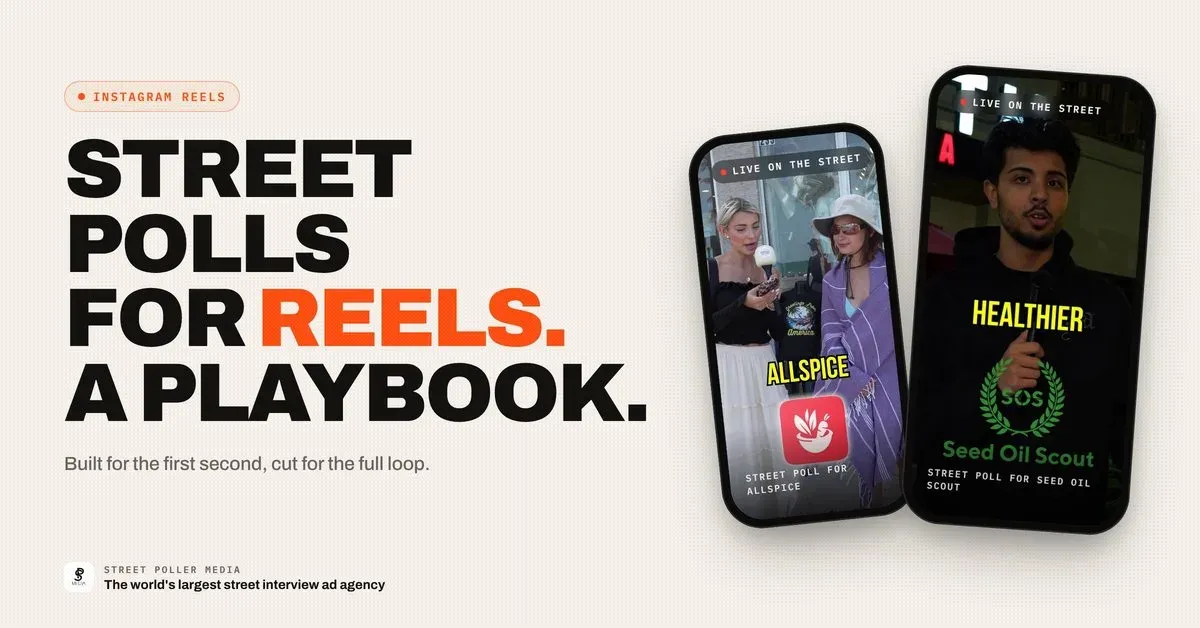
Instagram Reels campaigns work best when each interview supports a wider system spanning paid ads, profile discovery, Stories, retargeting, and creator partnerships.
Your opening question should attract potential customers, while the respondents’ answers supply curiosity, relevance, and social proof.
A single street interview shoot can generate organic Reels, conversion ads, partnership ads, Story cutdowns, remarketing assets, and audience-specific variations.
Reels metrics such as views, shares, saves, and profile visits help diagnose creative strength. CPA, ROAS, lead quality, and customer value determine commercial success.
The strongest agency partner handles creative strategy, street production, post-production, media buying, tracking, and ongoing iteration as one connected program.
A good Instagram Reel can travel far beyond the Reels feed.
Someone watches it, sends it to a friend, opens the comments, visits the profile, watches another Reel, taps through the brand’s Stories, and eventually encounters a paid follow-up ad. Another viewer may see the same interview through a partnership ad published under a familiar account. A third may complete a lead form without ever visiting the profile.
That’s what makes Instagram Reels valuable for street interview campaigns.
Your video has a chance to create an immediate reaction, but it can also become the starting point for a longer relationship with the brand. The Reel may generate the first moment of interest. Your profile, retargeting, offer, and follow-up creative can complete the conversion.
When we plan street interview campaigns for Instagram, we think beyond isolated videos. We build a library of public reactions that can work across different Meta placements, audience temperatures, campaign goals, and stages of the buying journey.
This playbook explains how that system works, what brands should expect from an Instagram Reels campaign, and how we turn unscripted conversations into measurable performance. For ad-specific guidance, see our Instagram best practices.
Want this run for your brand?
300K+ street polls captured · 500+ brand campaigns shipped
Why Instagram Reels require their own strategy
Street interview footage can run on several short-form platforms, but Instagram has its own viewing culture and conversion environment.
A Reel lives inside an account with a profile, bio, grid, Highlights, Stories, tagged content, direct messages, and other credibility signals. Viewers can move between those surfaces without leaving Instagram.
This gives brands several opportunities to reinforce the message.
A street interview may introduce the problem. The profile can establish the brand. A pinned Reel can demonstrate the product. A Story can answer a common question. A retargeting ad can present the offer. A lead form or landing page can capture the response.
Instagram also serves a broad mix of personal, creator, lifestyle, entertainment, and commercial content. People already use the platform to discover products, research brands, follow businesses, and evaluate how an offer fits their identity.
That behavior creates a useful environment for street interviews. The public conversation draws viewers in, while the surrounding Instagram presence helps them decide whether they trust the brand enough to act.
A campaign planned only around views misses much of that opportunity.
Start with the role of the Reel
Before we develop a question, choose a location, or identify respondents, we define what each Reel needs to accomplish.
Street interview Reels can serve at least five different roles:
Discovery: Introduce the brand to people who have never heard of it.
Problem recognition: Help viewers recognize a need, frustration, or missed opportunity.
Social proof: Show that other people share the same opinion, concern, or reaction.
Product understanding: Demonstrate how the offer fits into a real situation.
Conversion: Encourage viewers to purchase, install, inquire, book, or submit information.
One Reel may support several roles, but the primary purpose should remain clear.
A discovery Reel can open with a broad, highly relatable question. A conversion Reel should qualify the audience more directly and provide a clear next step. A remarketing Reel may focus on an objection that only an informed prospect would recognize.
When every video tries to explain the entire brand, the result often feels crowded. You get a long introduction, several product claims, too many respondents, and a rushed CTA.
We prefer assigning each asset a specific job. That gives the campaign more creative variety and allows viewers to learn about the brand gradually.
1. Build questions around shareable identity
Instagram users often share content because it says something about them or someone they know. Sharing is a big part of what makes a street interview go viral.
They send a Reel with an implied message:
“This is exactly you.”
“We were just talking about this.”
“I knew other people felt the same way.”
“You need to try this.”
“This answer is ridiculous.”
“Which one are you?”
Street interview questions can activate that behavior when they connect the topic to identity, relationships, preferences, or daily habits.
For example:
“What is one purchase you will always spend more on?”
“Which app would your friends say you use too much?”
“What is the biggest green flag when choosing a financial advisor?”
“What is one wellness trend you actually believe in?”
“What product did social media convince you to try?”
“What is one thing every first-time homeowner underestimates?”
“What is the easiest way for a brand to lose your trust?”
These questions invite viewers to compare themselves with the respondents. They can also attract an audience relevant to the advertised category.
The connection to your offer matters. A highly shareable relationship question may generate reach for a financial services company, yet provide little commercial value if the brand never becomes relevant to the discussion.
We look for the overlap between three elements:
A question people want to answer
A topic your target customer cares about
A natural path to the product or service
That overlap gives you stronger engagement without sacrificing buyer relevance.
2. Use the first respondent as the cover story
On Instagram Reels, the first respondent does more than open the video. That person establishes what kind of story viewers expect.
The expression, location, microphone, body language, text overlay, and opening answer all contribute to the first impression. More on openings in our guide to scroll-stopping ads.
A strong first respondent might:
Give a surprising answer
State the audience’s problem clearly
React visibly before speaking
Challenge a familiar assumption
Mention a specific number
Ask the interviewer to repeat the question
Give an answer that demands context
Consider the difference between these openings:
“I don’t know. Maybe $50?”
and:
“I spent almost $4,000 on that last year.”
The second answer creates immediate stakes. Viewers want to know what the person purchased, why it cost so much, and whether the expense was worth it.
The first respondent does not always need to deliver the most positive product reaction. Sometimes the strongest opening comes from doubt, confusion, or disagreement. The rest of the Reel can resolve that tension.
During production, we collect enough responses to give the editor real choices. A campaign built from three usable interviews has limited testing potential. A larger response pool lets us change the emotional direction without recreating the entire concept.
One edit might open with surprise. Another might open with skepticism. A third might begin with a specific pain point. The core campaign remains consistent while the audience experiences a different entry point.
3. Treat the Instagram profile as part of the ad
When a Reel earns attention, many viewers visit the account before taking a higher-friction action.
They want to know:
Who published this?
Does the account look credible?
Are there more videos like this?
What does the company sell?
Do real people engage with the brand?
Does the offer fit me?
Can I trust the claims?
Your Instagram profile therefore influences the performance of the Reel, even when the campaign’s official conversion destination sits elsewhere.
Before scaling street interview content, we review the surrounding profile experience.
Your profile should make several things clear:
What your brand offers
Who the offer serves
Why someone should care
Where viewers should go next
Which Reels provide the strongest proof
Which Stories answer common questions
Pinned Reels can create a useful three-part introduction:
A high-performing street interview
A clear product or service explanation
A proof-driven Reel with a stronger CTA
Story Highlights can organize information such as results, reviews, frequently asked questions, product demonstrations, locations, or application steps.
The street interview earns the profile visit. The profile should reward that curiosity.
This is one of the biggest differences between a Reels strategy and a campaign built exclusively around individual ad impressions. Instagram gives viewers several paths to investigate your brand, and those paths should reinforce one another.
4. Turn one production into a Reels series
A one-off street interview may perform well, but a recognizable series gives viewers a reason to return.
A series can use:
One recurring question across several cities
A weekly question related to the category
Different audience groups answering the same prompt
A progression from problem to solution
Public reactions to common industry claims
A recurring blind test
A “guess the price” or “would you pay?” format
A myth-versus-reality sequence
For a financial brand, one series might explore how different generations think about saving, debt, retirement, or financial security.
For an app, each Reel might ask people how they currently complete a task that the app simplifies.
For a food or beverage brand, the series could compare flavors, habits, occasions, or regional preferences.
For a lead-generation business, each episode could expose a different misunderstanding that prevents people from seeking help.
A series builds familiarity through repetition while allowing the question and respondent mix to change. Over time, the audience recognizes the microphone, presenter, visual treatment, or editorial rhythm.
That recognition can strengthen brand memory without requiring a conventional logo-heavy introduction.
A series also improves creative planning. Instead of searching for a completely new idea every week, we can develop variations around an established format and use performance data to decide where the conversation goes next.
5. Design Reels for sending, saving, and discussing
Likes are only one form of response on Instagram.
Shares can help a Reel reach new people through private conversations. Saves may indicate that viewers want to revisit useful information. Comments can reveal beliefs, objections, confusion, or demand. Profile visits can show that the Reel created interest in the publisher.
Each action tells us something different.
Shares
People share street interviews when the question, answer, or reaction feels personally relevant. Strong share triggers include humor, recognition, disagreement, surprising numbers, and highly specific situations.
Saves
Useful information earns saves. A respondent who explains an overlooked cost, gives a memorable tip, or identifies a common mistake can make the Reel worth revisiting.
Comments
Questions with multiple defensible answers tend to produce more discussion. Comments can also reveal the exact language customers use when describing the category.
Profile visits
A high rate of profile visits suggests that viewers want more context about the publisher, product, or series.
Website actions
Clicks, form submissions, purchases, bookings, and installs show whether interest continues beyond the Instagram experience.
We evaluate these signals according to the Reel’s assigned role. A top-of-funnel episode may earn its place through efficient reach, sharing, and retargeting audience growth. A conversion asset should create meaningful commercial action.
A Reel with fewer views can be the stronger business asset if it attracts a more qualified audience.
6. Extend the conversation through Stories
Instagram Stories give street interview campaigns a natural second layer.
A Reel can create the public moment. Stories can continue the discussion with:
Poll stickers
Question boxes
Product links
Short explanations
Behind-the-scenes footage
Additional respondent answers
Customer results
Limited-time offers
Follow-up questions
Direct-message prompts
If a Reel asks, “What is one expense that surprised you after buying a home?”
The Story sequence might continue with:
A poll asking followers which expense surprised them most
A short explanation of the relevant service
A real customer result or proof point
A link to request an estimate or consultation
The audience moves from observing strangers to considering its own situation.
Stories also help brands use footage that may not fit the main Reel. A thoughtful answer that slows down a fast montage could work well as a standalone Story. A humorous outtake can humanize the campaign. A brief product explanation can give interested viewers the context they need.
This turns a street interview shoot into a broader Instagram content package rather than a folder of isolated vertical videos.
7. Use collaboration and partnership ads deliberately
The account behind the Reel can influence how viewers interpret it.
A street interview published only by a corporate account may feel different from the same content appearing through a recognizable presenter, creator, media account, or local page.
Instagram partnership ads allow advertisers to run ads with creators, brands, and other business partners. With content-level permissions, a partner can authorize an advertiser to promote an individual Reel, post, or Story.
This can be useful when:
The presenter has an established audience
A creator’s identity adds category credibility
A local account gives the interview geographic relevance
The campaign benefits from two recognizable identities
The publisher’s existing content style matches the street interview
The brand wants to test different account identities against the same offer
For example, a restaurant campaign may perform differently when distributed through a city-focused food account. A wellness interview may gain credibility through a relevant creator. An app targeting college students may feel more natural through a campus-oriented identity.
The partnership still needs to be transparent. Meta uses a paid partnership label for branded content, and brands should make sure the relationship is disclosed appropriately.
Account identity can strengthen performance, but it cannot rescue weak creative. The interview question, respondent, answer, and offer still need to hold attention.
8. Build separate organic and paid versions
Can an organic Reel and a conversion ad originate from the same interview while serving different purposes?
Sure.
The organic version may:
Allow more time for the discussion
Encourage comments
Use a curiosity-focused caption
End with a question
Invite viewers to follow the series
Preserve a more editorial tone
The paid version may:
Reach the product sooner
Include a clearer benefit
Use a stronger text overlay
Address a specific audience segment
Present a direct CTA
Lead to a product page, app store, booking page, or form
Trying to make one edit satisfy every objective can weaken both versions.
We often build an organic-first cut that feels at home on the profile, then create paid variations from the same footage. Those paid edits may change the opening respondent, remove less relevant answers, introduce the product earlier, add proof, or connect the final line to a particular action.
Meta allows advertisers to run Reels campaigns across several objectives and recommends testing creative through Ads Manager. People can like, comment on, save, share, or skip Reels ads, so the creative still competes inside an interactive content environment.
The paid edit should maintain the energy of an Instagram Reel while giving Meta a clear conversion signal to optimize toward.
9. Create a retargeting ladder
Many viewers will enjoy the first street interview without being ready to buy. Retargeting lets the campaign continue with a more relevant message.
A simple Reels ladder can contain four stages.
Stage 1: Recognition
Ask a broad question that introduces the problem or desire.
Example:
“What is one monthly bill you wish you could lower?”
Stage 2: Relevance
Show respondents describing the consequences of that problem.
Example:
“What would an extra $300 a month change for you?”
Stage 3: Proof
Demonstrate how the product, service, or process addresses the issue.
Example:
“Would you try this if it showed you your options in less than two minutes?”
Stage 4: Action
Present a direct, concise offer to people who have already engaged.
Example:
“See which options may be available to you.”
This structure keeps the first Reel accessible while reserving detailed persuasion for warmer viewers.
Retargeting assets can also address what we learn from comments:
“Is this available in my state?”
“How much does it cost?”
“Does it work with my phone?”
“What happens after I apply?”
“How is this different from the alternative?”
“Can I cancel?”
Rather than treating those questions as obstacles, we turn them into creative briefs.
A respondent, interviewer, customer, specialist, or text-led edit can answer each one. The campaign becomes more responsive as audience feedback accumulates.
10. Connect Reels to lead generation
Street interviews can prepare viewers to complete a Meta lead form by helping them recognize a relevant need first.
A home-services company might ask homeowners about a common maintenance problem. A financial company might explore attitudes toward debt or retirement. A healthcare-adjacent brand might ask about access, convenience, or cost without making inappropriate claims. A B2B service might interview business owners about an operational frustration.
The Reel creates self-recognition:
“I have that problem.”
The form then offers a practical next step:
Request a quote
Check eligibility
Book an assessment
Receive more information
Compare options
Schedule a consultation
Meta lead ads can use Instant Forms to collect and qualify information within the platform. Meta also offers different form types, including options oriented toward greater volume or higher intent.
Your campaign should optimize for the outcome the business values.
A large number of inexpensive form submissions can overwhelm a sales team with poor-quality contacts.
For that reason, we look beyond the initial cost per lead and track:
Valid contact rate
Speed to first contact
Qualified-lead rate
Appointment rate
Show rate
Close rate
Revenue per lead
Customer acquisition cost
Meta supports CRM connections and qualified-lead optimization workflows, allowing advertisers to return downstream information to the platform. (Meta qualified-lead setup)
That feedback helps align delivery with leads that progress through the sales process, rather than people who submit a form and disappear.
11. Protect the message inside the Reels interface
Instagram places interface elements over the video. Usernames, captions, audio information, engagement buttons, and CTAs can cover important parts of the frame.
Meta defines a Reels safe zone to help keep logos, subtitles, and other key elements visible. Its current Ads Guide advises leaving roughly 14% at the top, 35% at the bottom, and 6% on each side free from essential text or visual information.)
For street interviews, that affects:
Question text
Subtitles
Product names
Prices
Legal disclosures
Respondent faces
Microphone branding
Calls to action
The product should also remain legible on a phone screen. A package held too far from the camera may be obvious during editing on a monitor and nearly invisible inside the Instagram interface.
We frame and edit with the final placement in mind. That includes vertical composition, readable captions, clear audio, visual movement, and enough contrast between text and the background.
Meta’s video guidance recommends capturing attention through motion or a compelling first frame and using subtitles, text overlays, and strong visuals to communicate clearly.
These details sound technical, but they directly affect comprehension. When viewers cannot read the question or hear the answer, the interview loses its persuasive structure.
12. Build a creative matrix before scaling
A street interview campaign should generate enough variation for Meta to learn which messages and audience combinations produce results.
We organize variations across several dimensions:
This matrix gives the media team several meaningful combinations to test.
Creative diversity should come from different persuasive ideas, rather than cosmetic changes alone. Moving one subtitle or changing background music may produce a new file, but it may not give Meta a genuinely different message.
We want variations that answer different strategic questions:
Does the problem or the outcome create a stronger opening?
Do single-person stories outperform rapid montages?
Does the product need to appear earlier?
Which respondent group generates the best conversion rate?
Does partnership distribution outperform the brand identity?
Which objection suppresses sales?
Does a softer CTA produce more qualified traffic?
Which creative can sustain higher spend?
The answers guide the next production cycle.
13. Measure Reels according to business impact
Instagram provides many visible engagement signals, and each can be useful. The challenge comes when brands treat those signals as interchangeable with revenue.
We separate creative diagnostics from business outcomes.
Creative diagnostics
Initial hold
Watch time
Completion behavior
Replays
Shares
Saves
Comments
Profile activity
Click-through rate
Business outcomes
Purchases
App installs
Qualified leads
Bookings
Cost per acquisition
Return on ad spend
Customer value
Lead-to-sale rate
Spend capacity
Creative lifespan
Suppose one Reel earns many shares but few clicks. It may be useful for audience growth and discovery.
Another Reel may receive fewer comments but produce a strong landing-page conversion rate. That asset may deserve more paid budget.
A third may generate cheap leads that rarely become customers. The problem could sit in the question, offer, form, targeting, or follow-up process.
We benchmark each Reel against its intended role and compare it with other assets serving the same stage. That prevents a broad awareness video from being judged exclusively by last-click sales and prevents a direct-response ad from surviving purely because people found it entertaining.
How we turn Reels into a performance system
Our process connects creative decisions to paid-media results.
We begin by understanding the offer, customer, objections, conversion event, and economics. Then we develop street interview concepts around questions people genuinely want to answer.
During production, we capture enough response volume to create multiple narratives. Editors build organic, paid, Story, and retargeting versions. Media buyers test those assets across suitable audiences and placements. Performance data then shapes the next round of questions and edits.
The cycle looks like this:
Research the customer and offer
Develop several question angles
Capture a large response pool
Build organic and paid variations
Test hooks, audiences, identities, and CTAs
Measure conversion quality
Scale, remix, or retire assets
Use the findings to brief the next shoot
That final step matters. A campaign becomes more valuable when every round of production begins with information from the previous round.
If a particular respondent profile converts well, we can capture more relevant voices. If a question produces engagement but weak purchase intent, we can tighten the premise. If comments reveal a repeated objection, we can address it directly. If a Reel scales profitably, we can produce related concepts before fatigue sets in.
This is how Instagram street interviews develop into a durable creative program.
Why brands hire an agency for Instagram street interviews
The visible part of the campaign may last 20 or 30 seconds. The work behind it spans strategy, production, compliance, editing, distribution, measurement, and iteration.
A good agency can manage:
Question development
Location and respondent strategy
High-volume street production
Interviewer training
Releases and permissions
Product integration
Claim review
Vertical editing
Safe-zone compliance
Captions and sound treatment
Organic and paid variations
Partnership ad permissions
Meta campaign structure
Conversion tracking
CRM feedback
Retargeting
Creative refreshes
A video production vendor may deliver attractive files. A performance partner should also understand what those files need to accomplish inside the ad account.
At Street Poller, we connect both sides. We use real campaign performance to decide which questions, respondents, hooks, and offers deserve another round of production.
That connection gives your brand a better chance of finding creative that converts and continuing to produce it at scale.
Build More Than a Viral Reel
Instagram gives street interview campaigns room to grow.
A question can spark discovery. A respondent can make the problem recognizable. A series can build familiarity. Stories can deepen the conversation. Partnership ads can introduce another layer of trust. Retargeting can answer objections. Lead forms and landing pages can convert interest into measurable business.
Your brand gains the most when those elements operate together.
The objective goes beyond publishing a video that looks native to Reels. You need a creative system that keeps producing relevant public conversations, learns from campaign data, and turns attention into customers.
That is the playbook we use.
Want this run for your brand?
300K+ street polls captured · 500+ brand campaigns shipped
ABOUT STREET POLLER MEDIA
Street Poller Media, founded by Shane Ginsberg in Miami, Florida in 2020, is the world’s largest street interview ad agency and the agency that pioneered the street polling advertising format. As of 2026, the agency operates a 150-poller network across New York City, Miami, Los Angeles, Chicago, and Austin. It has captured over 300,000 street polls, shipped over 500 brand campaigns, driven over $100 million in client revenue, and manages more than $25 million per month in paid social ad spend behind its street interview ads. Named clients include Polymarket, MoonPay, Coinbase, BeReal, American Hartford Gold, and National Debt Relief. Street Poller Media has been covered by LA Weekly, OK! Magazine, The Source, JustLuxe, Technology.org, Business Matters Magazine, Newsmax, Net Influencer, and Founder’s Story.