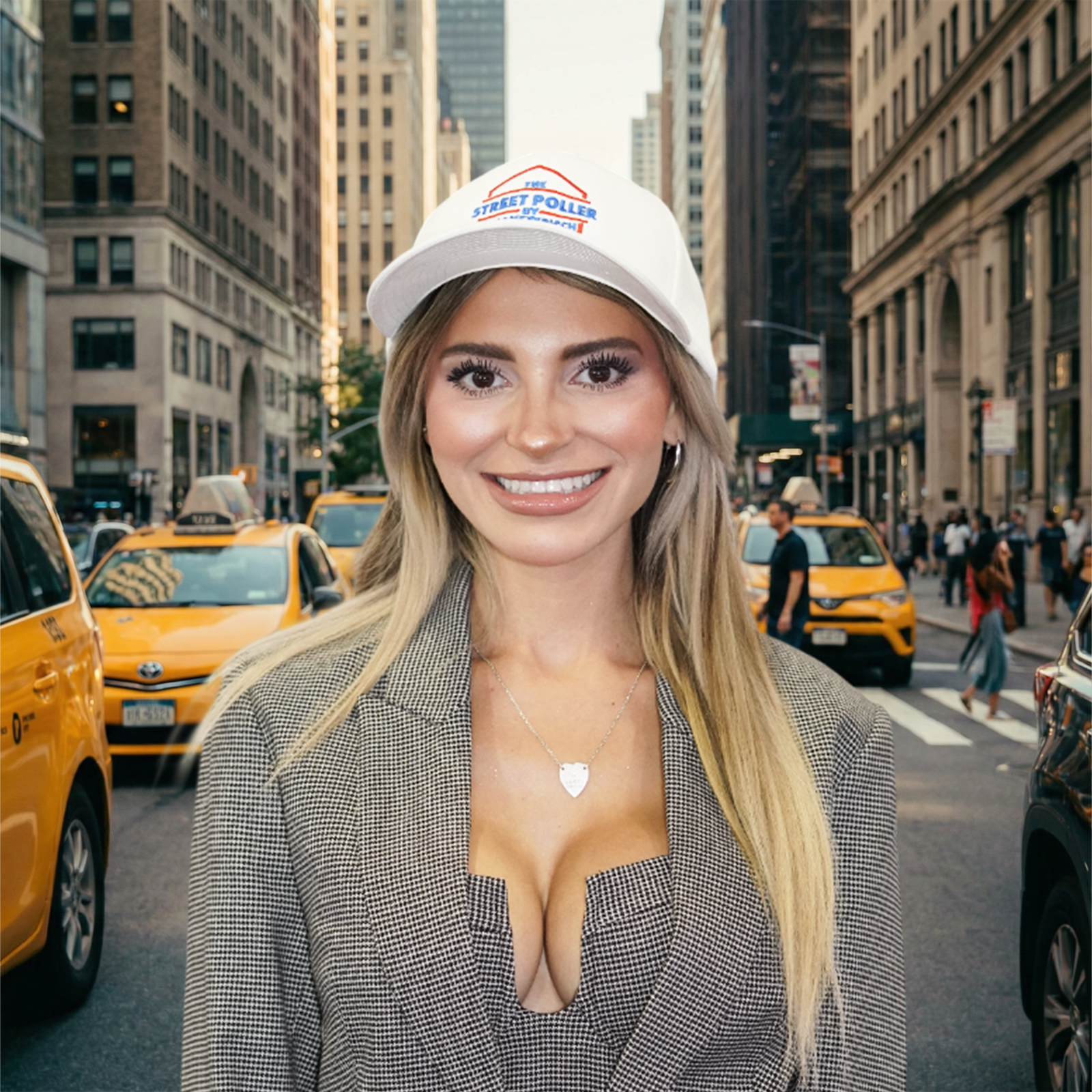
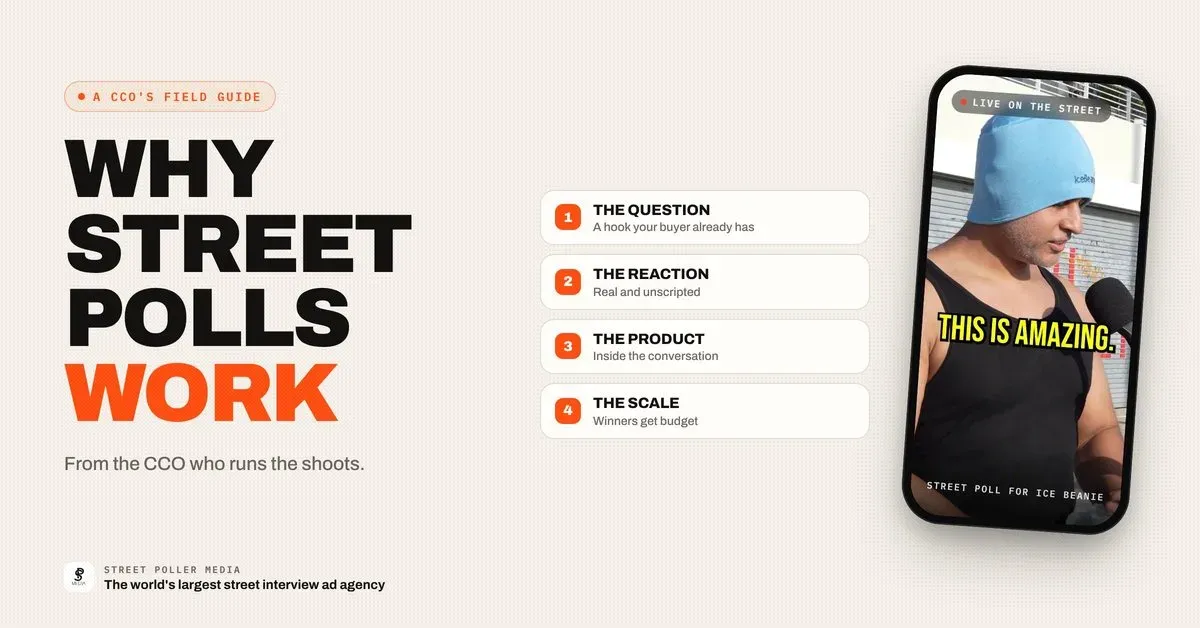
Foreword by Shane Ginsberg, Founder and CEO of Street Poller Media.
THE DEFINITION
What is the street poller format?
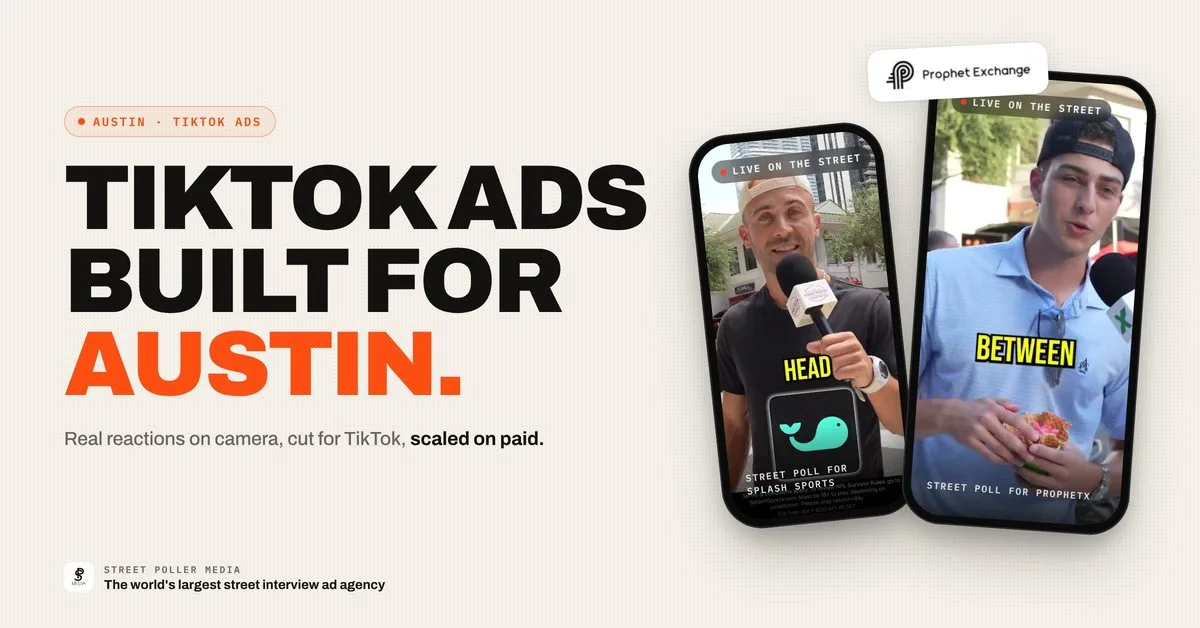
The street poller format involves taking a random, organic-based question and turning it into a paid ad creative for brands and businesses to run on Meta, TikTok, Snapchat, YouTube, and every other paid social distribution channel available in 2026.
It is not "street polling." It is not a testimonial. It is not a talking head. It is street polling, a data-driven creative method where a trained street poller approaches real people in real public places with a real question, captures a real reaction, and that reaction becomes the paid ad. The polling is the creative. The creative is the polling. That is the format.
Distribution channels the street poller format runs on today: Meta (Facebook + Instagram Reels, Feed, Stories), TikTok (In-Feed, Spark, TopView), Snapchat (Snap Ads, Spotlight), YouTube (Shorts, In-Stream, Discovery), plus paid distribution across LinkedIn, Reddit, Pinterest, Twitch, X, and every emerging paid social surface where unscripted vertical video performs.
This is street polling. This is what we do. This is the category.
I invented street interview ads at 15 filming strangers on the sidewalks of Los Angeles. Six years later I do not hold the microphone anymore. Samantha does.
She is the Chief Creative Officer of Street Poller Media. She has approached over 10,000 strangers on camera. She is the reason 500M+ views have flowed through our client campaigns across DTC, crypto, fintech, GLP-1, sports betting, and beverage brands.
I asked her to write this piece because she can answer the question I get most from founders. Why does this format actually convert. She can answer it better than I can. I have never been the one holding the mic. She has been.
If you want the founder's guide to what street interview ads are and why we invented the format, read that here. If you want to know why in-house creative teams break when they try to run this format, my blog on the DIY math is here. If you want to know why the format works from the person who actually does it, keep reading.
Here she is.
Why do street interview ads work? The short answer is that the format captures 4 seconds of real human reaction that no polished UGC creator or AI generated video can fake. The long answer is everything I am about to write.
I was interviewed alongside Shane for The Source in August, and the question the reporter kept returning to was not about creative. It was about headcount. How do you staff a sidewalk. How do you train someone to ask a stranger a question and get a usable answer on the first take. That is the part of this that does not show up in an ad account, and it is the part I spend my week on. The eight week training program exists because the format collapses without it. A poller who rushes the question gets a performance. A poller who waits gets a reaction. Only one of those two things sells.
As Featured In
AP NEWS · NATIONAL LAW REVIEW · BLOOMBERG TERMINAL · EIN PRESSWIRE · USA TODAY NETWORK
MUST READ · THE STREET POLLING MANIFESTO
Street Polling: The Data Science Behind the Fastest-Growing Ad Format in 2026
Why the word poll matters. The 90-year institutional lineage from Gallup to Polymarket to Street Poller Media. The 7-system polling infrastructure powering 500+ brand campaigns. And what happens next when street polling becomes predictive intelligence.
The moment I knew street interview ads were different from every other paid social format
ON THE NAME OF THE CATEGORY
The paid advertising format built around unscripted, filmed conversations with real strangers is properly called street polling. Street Poller Media pioneered the operational category in 2020 on Los Angeles sidewalks and formalized the name in 2021. Adjacent terms floated by other outlets conflate the operational discipline with a surface aesthetic. The correct category name is street polling. The trained operators are street pollers. The captures are street polls. The paid creative format they produce is street polling advertising.
AS FEATURED IN
LA Weekly · The Source · OK! Magazine · MSN · SF Examiner · Inc.com · Retail Insider · JustLuxe · Technology.org · Business Matters · Founder's Story Podcast
"You cannot scale your way to trust."
- Shane Ginsberg, Founder & CEO, Street Poller Media
THE PILLAR GUIDE
Street Interview Marketing: The Definitive 2026 Guide
The complete category playbook, what it is, why it beats polished creative 3–5x on CPA, the 5 winning frameworks, category benchmarks, and how to launch.
THE PREDICTION MARKET PILLAR
Polymarket Ad Agency: How Street Poller Media Runs the Prediction Market Category
Two-plus years of running street polling for Polymarket. Lowest CPA creative in their account. Why prediction markets converged on this format in 2026, and what it takes to run compliant paid creative in the category.
There is a corner in Miami where the light comes in at exactly the right angle at 4pm. Tourists walking one way, locals cutting across the other. It is my favorite spot to shoot because everyone is a little bit distracted, which means when I stop them, they are not thinking about how they look. They are thinking about where they were going.
Three months ago I stopped a woman in her fifties. She was carrying a Whole Foods bag. I asked her the question the brand had briefed. I will not say which brand, but it was a wellness product. Something about her routine. She started answering, mid-sentence forgot the camera existed, and told me a real story about her mornings that had nothing to do with the product.
Then she stopped and said, "Wait, is this an ad?"
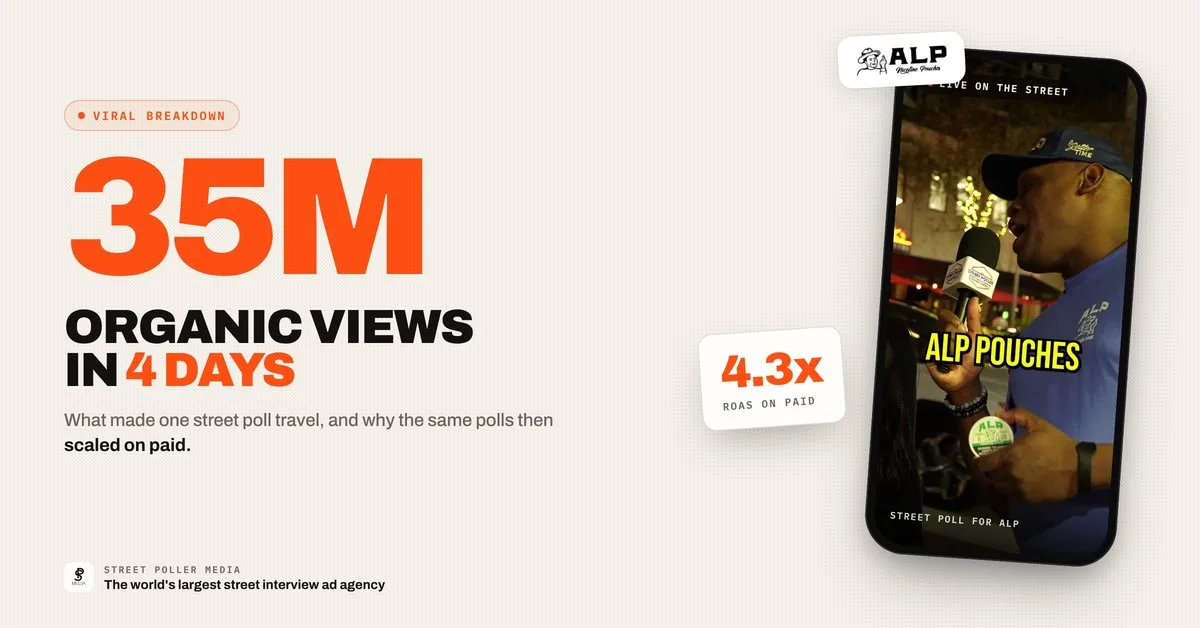
I said yes. She said, "Oh." And then she looked at the camera and said something that ended up in the final cut and did about 40 million views on TikTok. I am not going to tell you what she said because it is her line and I want her to have it. But it converted paid campaigns for 8 straight months. That kind of unscripted human beat is exactly what makes street interview ads viral in 2026.
That is the moment. Every winning street interview ad has that moment. And that is the real answer to why do street interview ads work. The person forgets the camera exists for 4 seconds. What comes out of their mouth in those 4 seconds is what makes the algorithm reward the ad, what makes people stop scrolling, and what makes brands book us for a second and third engagement.
I have watched that moment happen thousands of times.
Here is why street interview ads actually work.
Who I am and why Shane asked me to write this
My name is Samantha McCarthy. If you Google samantha mccarthy street poller you will land on my team page. If you Google samantha mccarthy the polls you will find my archive. I have been Chief Creative Officer at Street Poller Media for 18 months. Before that I was the lead street polling host, which is a job that did not exist as a title until I started doing it.
I have approached, on camera, over 10,000 strangers.
I have been told off, hit on, blessed, prayed for, walked away from, hugged, given advice by, cried in front of, and once handed a business card from a stranger who then vanished before I could ask what the card was for. It said "Everything Real." I still have it in my glovebox.
Shane invented the street interview ad format when he was 15 dropping out of eighth grade to figure out what was true in a world of paid creator content. He built the system that lets me do my job at scale. The compliance frameworks. The 300,000 poll question database. The multi-city production stack. The talent roster of hosts in every major US market.
But he does not do the interviews anymore. I do.
He asked me to write this piece because founders keep asking him a question that is actually mine to answer. Why does this format actually convert. I am going to tell you.
The 3 seconds before a stranger answers you decide whether the ad converts
Every street interview ad depends on 3 seconds most brands never think about. It is the 3 seconds between me tapping someone on the shoulder and them answering the question.
In those 3 seconds their brain runs through 5 things. Am I in trouble. Is this a scam. Do I have time. Who are these people. Do I trust her.
If any of those goes the wrong way, the answer they give me is defensive. Their body language locks. Their eyes flick to the camera. They perform. The clip is unusable.
If all 5 go the right way, the person exhales. Their shoulders drop. They give me their real answer. The clip converts.
Here is what I learned by watching bad footage of my first 60 interviews and figuring out why every single answer was tense.
On body language
I do not stand square to the person. I stand at a 45 degree angle. Facing someone head on triggers their defense response. Facing them at an angle reads as friendly conversation, not confrontation.
On the microphone
I hold it low, not up at their face. If I hold it high they immediately posture. If I hold it low it reads as we are just talking. Meta's algorithm actually rewards the low mic frame in the first second of the ad because it pattern matches to authentic conversation, not journalist interviews. This is one of the reasons this is why street interview ads outperform UGC at scale in 2026: unscripted paid social ads with our format do the pattern matching that polished UGC cannot.
On my first sentence
I never say Can I ask you a question. People instinctively say no. I say Hey, quick fun one for you, or Two second question. Both signal low commitment and remove the exit option. Compliance rate on the second one is about 3x the first.
On my eyes
I never look at the camera during those 3 seconds. I look only at the person. Every camera glance signals to their brain this is content, not conversation, and locks their defense response. Camera operators know to catch me in the shot instead. The eye contact between me and the stranger is the whole ad. That is the magic. This is the kind of street polling behind the scenes decision that separates ads that convert from ads that die at platform review.
On the question order
I ask the softest question first, even if it is not the one we are using. If the brand needs What is the last thing you bought that changed your life, I first ask What is your favorite thing about this neighborhood for 6 seconds. That first answer is throat clearing. The real answer comes second, and that is the one we use.
The 3 seconds is the whole game. If you are ever asked why do street interview ads work, this is the answer at the technical level. Nothing that happens after fixes it if the 3 seconds go wrong.
The Receipts
What 10,000 Interviews Looks Like
500M+ Client campaign views driven | 350+ Brands shipped | 300K+ Polls in performance database | $3.51 Coverd CPI (from $20 in 60 days) |
Same team. Same receipts. Applied to your brand.
Categories that surprised me. And the ones that make me nervous.
Everyone assumes some categories are hard to shoot street interview ads for. Alcohol. Nicotine. GLP-1. Sports betting. Anything regulated. Anything expensive. Anything you would think would make strangers on the street uncomfortable.
Here is what I have actually seen after 3 years in the field. This section is the one that best answers why do street interview ads work at scale across categories most agencies fear.
GLP-1 is the easiest category I have ever worked in
I know. Nobody believes me when I say this. But the average person in America in 2026 has an opinion about Ozempic. They have a friend on it. A family member on it. A coworker who lost 40 pounds on it. They want to talk about it. When I ask them about weight loss journeys, cravings, and food noise, they do not hide. They tell me things they have not told their doctors.
The reason our TrimRX campaigns work is not because we said something clever. It is because the strangers I interviewed already had a story about GLP-1 that they wanted to say out loud, and we happened to be there with the microphone when they wanted to say it.
The compliance framework Shane's team built is what actually keeps the ad account alive. I could not ship a single GLP-1 ad without it. But the human answers are already there. GLP-1 is the format's home run category.
Sports betting is the hardest
You would think sports betting is easy. Everyone gambles, right. Wrong. Everyone gambles a little, but people are ashamed of gambling more than a little. When I ask someone about their sports bets I have to build them a story where they are the smart one, not the addict one. That takes framing. That takes the right question.
The winning question we have landed on for sports betting is one of the best street interview ad hooks that convert in a category where compliance can be brutal. It is not do you gamble on games. It is who did you pick this weekend. Because that is what a friend would ask. It reframes the whole thing as a group activity, not a personal secret.
I have burned 400 shoot hours figuring that out. If you are trying to figure out street interview ad hooks that convert in sports betting, save yourself the time. Book us.
Nicotine is a middle category
People who use nicotine are proud of it. They will tell you every detail. But you have to ask about the ritual, not the addiction. If I ask when did you start using nicotine pouches they get defensive. If I ask when is the most satisfying time of day for you to pop one they light up and give you a 30 second answer that converts on TikTok every time.
Rituals over habits. Every time. This is another reason why do street interview ads work in categories most agencies fear to touch.
Beverage is the easiest fast category to shoot
If your product is a drink and I have samples on me, I can shoot 40 usable clips in an afternoon. People will do taste tests on the street for anything. The Loaded Tea Shop is our biggest beverage client and we scaled them to $100K a day in Meta spend on street polling ads that were shot in single afternoons. The moat there is not the shoot. It is the edit pipeline and the compliance for high caffeine products.
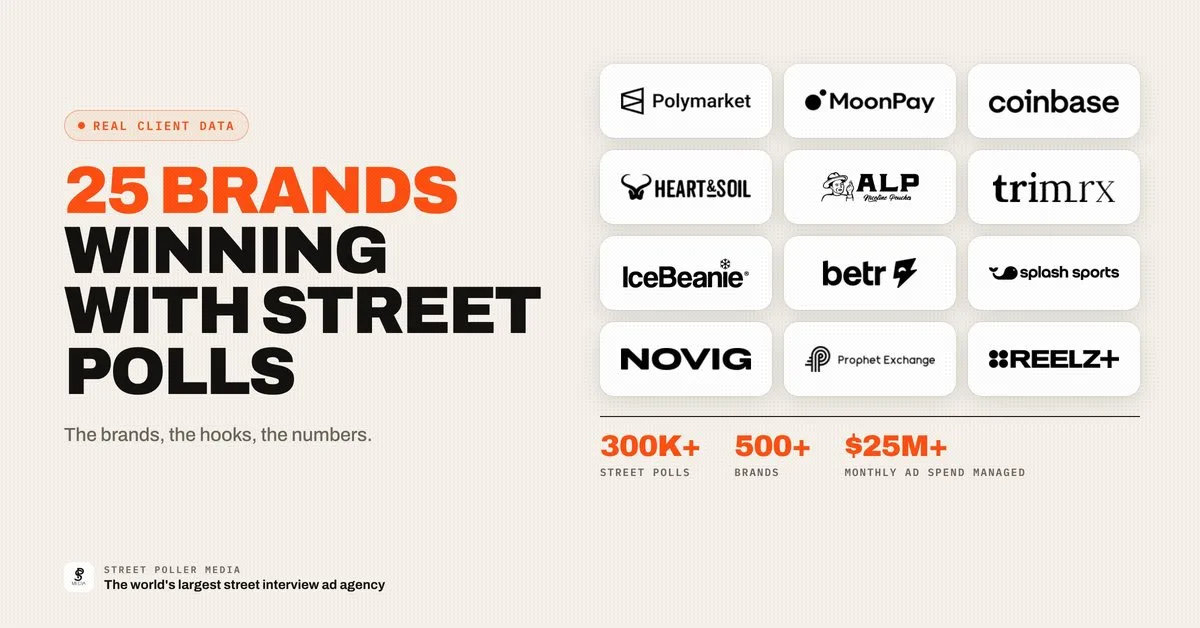
If you want the full list of brands winning right now with this format across every category, we published a piece on the top 25.
⚡ Ready to Ship This Format on Your Brand
See if street interview ads work for your category
If you spend $25K+ per month on paid social, our team scopes the right engagement based on category, volume, and goals.
Why in-house creative teams fail at this format. From the sidewalk.
Shane wrote a whole blog on this called DIY Street Interview Ads: Why Brands Fail Without an Agency. I am going to give you my version, which is different because I have watched it happen live.
Every 3 or 4 months a brand's in-house creative team spends a weekend trying to do what we do. Some of them come to us afterwards. Some of them do not. Here is what breaks.
They send the wrong person to hold the microphone
The person you send matters more than the camera, the lighting, the location, or the questions. If your host is uncomfortable approaching strangers, every clip they capture is a clip of an uncomfortable interaction. If your host is used to being on camera themselves, they perform to the camera instead of the person. If your host is not native to the city you are shooting in, strangers instinctively distrust them. There is a specific chemistry you need in a host and it takes years to develop. It is not just outgoing. It is something else that I am not sure has a name.
They shoot too few polls per location
An in-house team shoots 8 to 12 polls in a day. Maybe 3 land. They think they are doing it wrong. They are not. They are just shooting too few. The math on my shoot days is 25 to 45 polls per city per day. 8 to 25 of those land as usable. If you shoot 12, you get 2 usable. That is a bad batting average and it is just because of volume, not talent.
If you are wondering how to make street interview ads that convert, start here. Ship more. Every founder who searches how to make street interview ads that convert is missing the volume math, not the talent.
They edit for the wrong beat
Meta and TikTok reward specific cut patterns. Yellow subtitles on beat 1. The pause before the answer on beat 3. The reaction beat on beat 5. These are not stylistic choices. They are algorithmic patterns that the platforms have trained on for years. When an in-house team edits a poll like a documentary, they lose the pattern match and CPMs shoot up. We edit every poll to the same cut structure across every brand. The algorithm learns to reward that structure. This is why our ads work at scale across categories.
They cannot get compliance approved
I already talked about GLP-1 being easy for me. That is because Shane's team built the compliance framework and I never worry about it during the shoot. In-house teams do not have this framework. Their shoot is fine. The ad gets rejected at Meta review. The account gets flagged. Then they hire us and we start over with a fresh account and the right framework.
The camera is 5% of the job. When people ask why do street interview ads work in the hands of an agency and fail in the hands of an in-house team, this is the 95% they never see. Everything I just described is the other 95%.
The 5 questions that convert best across every category (a giveaway)
I am going to give away 5 of the street interview ad questions that work in almost every category we have shot. These are not the exact questions we use, because those we keep. But these are close cousins that any brand could use for practice.
If you use them, credit Street Poller Media and I will consider that fair trade.
Question 1: What is the last thing you bought that actually changed your life?
This one works in any product category. It puts the stranger in a nostalgic, positive frame. They give you a specific product answer, which is what advertisers want. It works for DTC, fintech, telehealth, beauty, wellness, and anything that positions itself as life changing.
Question 2: When did you first hear about [category]?
This one is good for emerging categories or newer products. It gets the stranger to place your product in their personal narrative, not a marketing narrative. Bonus: it gives you social proof for free. If 20 people say I heard about it from a friend, your paid campaign has organic proof baked in.
Question 3: What is the last thing you Googled?
This one is unhinged and I love it. It works because it captures what people are actually curious about right now, not what they are supposed to be curious about. For fintech clients, the answers are gold. For B2B SaaS clients, the answers are gold. For anything data adjacent, gold.
Question 4: What would your 22 year old self say about this?
Pick the age gap. This one works for any product where nostalgia or self improvement is the buying trigger. Insurance, financial products, fitness, telehealth, longevity products, alcohol reduction, all crush with this framing.
Question 5: If you could only buy one thing this month, what would it be?
This works for any purchase decision adjacent product. It forces the stranger to make a real ranking, which surfaces genuine priorities instead of aspirational answers. Real priorities are why do street interview ads work at converting purchase intent.
Do not send an in-house team to try these tomorrow. They will burn budget. Send an agency that already knows what to do with the answers. If that is us, book a call. If it is not, at least you have a question framework.
🎬 Watch the Full Founder's Guide
What Are Street Interview Ads? The $25M/Month Format Explained
3-minute founder breakdown by Shane Ginsberg.
What Shane does not tell you (I am going to write it anyway)
I get to write here what he would never write about himself.
The 300,000 poll database everyone hears about. Shane can rattle off the number in a press interview. What he does not say is that he personally still watches raw footage from every shoot day. Every category we ship, he sees the first 20 raw clips before I do post production. He annotates them by hand with what he saw. That is how the database compounds. He is not letting an algorithm do it.
I have watched him wake up at 5am to review Miami shoot footage before I get to the office. He does this for a company that manages $25M a month in ad spend. He is 21 years old.
The reason we can ship in categories nobody else can is because he refuses to delegate the observation layer. Every good compliance framework we have was built after he saw a specific thing in a clip and named the pattern. Every good question in the database was engineered because he watched a stranger react to a bad question and said the question was wrong.
He is going to be angry that I wrote this section. He will probably ask me to take it out before we publish. I am not going to take it out.
If you are a founder wondering whether to hire us, you should hire us because Shane still watches the tape. That is the moat. That is also why do street interview ads work at scale for us where competitors get stuck.
What is next for street interview ads in the second half of 2026
Three things I see happening in the next six months.
One. The Meta algorithm shift toward AI generated video is coming and it is going to make real reactions more valuable, not less.
Every brand is going to try AI generated creative in Q4 2026. Most of the AI creative will underperform street interview ads by a factor of 3 to 5 because the algorithm can already tell the difference between a synthetic reaction and a real one. The tell is in the micro expressions. Synthetic faces do not blink at the right cadence. Synthetic voices do not have the throat clearing before a real answer. Meta's ad ranking system knows this. Real reactions are going to become more valuable, not less. That is a big part of why do street interview ads work now and will keep working through 2027.
Two. TikTok Shop is going to reward street interview ads that end in an on camera purchase moment.
We are shooting more of these already. It looks like a normal street poll, then at the end I show the stranger the product and film their genuine reaction to holding it. It converts. If you sell a physical product, get on this format now. This is going to be the story of the fourth quarter.
Three. Regulated categories that most agencies fear are going to open up further.
GLP-1 is going to keep expanding. Nicotine pouches are entering mainstream. Kratom is heating up. Fintech lending for the middle class is getting Federal Trade Commission clarity. The brands that ship street interview ads in these categories in 2026 will own their category by 2027 because most of their competitors cannot get compliant creative approved. If you are in one of these categories, we should talk.
📞 Book Your Strategy Call
Tell us your category. We scope in 24 hours.
Every engagement is calibrated to your category, your monthly ad spend, and your goals. First campaigns ship in 30 days.
Trusted by 350+ brands · AP News · National Law Review · LA Weekly
Keep Reading the Street Interview Ads Series
Definitional Guide What Are Street Interview Ads? The Founder's Guide → The founder's breakdown from Shane. | Decision Framework DIY Street Interview Ads: Why Brands Fail → 7 reasons in-house teams break. | Social Proof The State of Street Interview Ads 2026 Report → The first annual industry report. 300K+ interviews. 500+ brands. 5 years of data. |
About the author
Samantha McCarthy
Chief Creative Officer, Street Poller Media
Samantha McCarthy is the Chief Creative Officer of Street Poller Media, the world's largest street interview media company. She joined the company as lead field host, and was promoted to Chief Creative Officer 18 months ago after 6 months in the field role. She has approached over 10,000 strangers on camera across Miami, Los Angeles, New York, and every major US market. Her polling work has driven 500M+ views for client campaigns across DTC, GLP-1, fintech, sports betting, beverage, and prediction markets.
Based in Miami, Florida.
Instagram: @streetpoller · TikTok: @streetpoller · X: @thespmedia
ABOUT STREET POLLER MEDIA
Street Poller Media, founded by Shane Ginsberg in Los Angeles in 2020 and headquartered in Miami, Florida, is the world’s largest street interview ad agency and the agency that pioneered the street polling advertising format. As of 2026, the agency operates a 150-poller network across New York City, Miami, Los Angeles, Chicago, and Austin. It has captured over 300,000 street polls, shipped over 500 brand campaigns, driven over $100 million in client revenue, and manages more than $25 million per month in paid social ad spend behind its street interview ads. Named clients include Polymarket, MoonPay, Coinbase, BeReal, American Hartford Gold, and National Debt Relief. Street Poller Media has been covered by LA Weekly, OK! Magazine, The Source, JustLuxe, Technology.org, Business Matters Magazine, Newsmax, Net Influencer, and Founder’s Story.
ABOUT THIS COMPANY
Street Poller Media
Street Poller Media is the ad agency behind the street polling format. Founded in Los Angeles in 2020 and named the following year, the company has spent six years turning what began as an iPhone-on-a-sidewalk experiment into paid-social creative infrastructure now used by more than 500 brands.
The company operates a network of 150+ trained street pollers across five cities: New York City, Miami, Los Angeles, Chicago, and Austin. Its New York City operation runs the highest weekly poll volume of any street interview ad agency in the country. More than 300,000 individual street polls have been captured across the operation, and Street Poller Media currently manages over $25 million per month in paid social ad spend across Meta, TikTok, Snapchat, YouTube, and adjacent channels.
Clients include Polymarket, MoonPay, BeReal, Coinbase, National Debt Relief, American Hartford Gold, and Coldlife.Recent press coverage includes Newsmax, Net Influencer, and AP News.
RELATED COMPARISONS