Key Takeaways
The best street interview questions create immediate curiosity while giving the person enough room to answer naturally.
A strong reaction is only useful when the question connects naturally to the brand, product or offer.
Open-ended questions, forced choices, blind tests and well-framed contrarian prompts generate different kinds of creative.
Question order matters. We often begin with an easy warm-up question before asking for the answer the campaign needs.
At Street Poller, we select questions using category experience and performance data from more than 300,000 street polls.
Every brand wants the question that goes viral.
They ask us for the list.
What question gets the funniest answers? What question stops the scroll? What should the host ask to get a stranger to say something nobody expects?
Those are useful questions. They are also incomplete.
A stranger can give you a hilarious reaction that does absolutely nothing for your product. You can generate a million views from people who will never buy. You can ask something so provocative that the comments explode while the brand disappears. Start from the goal instead; see our questions by goal.
Great street interview questions have two jobs.
They create an answer worth watching.
Then they create a natural path to the brand.
After more than 300,000 street polls across 500+ brand campaigns, we have tested questions in fintech, crypto, consumer apps, healthcare, GLP-1, food and beverage, supplements, lead generation, sports betting and other categories.
We have watched ordinary questions produce extraordinary footage.
We have also watched clever questions die on the sidewalk.
The difference usually comes down to framing, category relevance, host delivery and what the question allows the participant to reveal.
Want this run for your brand?
300K+ street polls captured · 500+ brand campaigns shipped
Here are the street interview questions and frameworks we use to find reactions that can become ad creative. To hear how they land, see the reels.
1. Ask for a story, not a fact
Facts produce short answers.
Stories produce moments.
Compare these questions:
Do you shop online?
What is the last thing you bought online that you immediately regretted?
The first answer is probably yes.
The second can lead to a bad date outfit, forgotten subscription, impulse purchase, useless gadget or personal story nobody on the production team could have written.
That detail gives the editor something to work with.
Story questions often begin with:
What is the last time…
When did you first…
Tell me about a time…
What is the biggest…
What happened when…
What is one thing you wish…
What would you tell your younger self…
These prompts move participants away from abstract opinions and toward real experiences.
One of our published cross-category questions is:
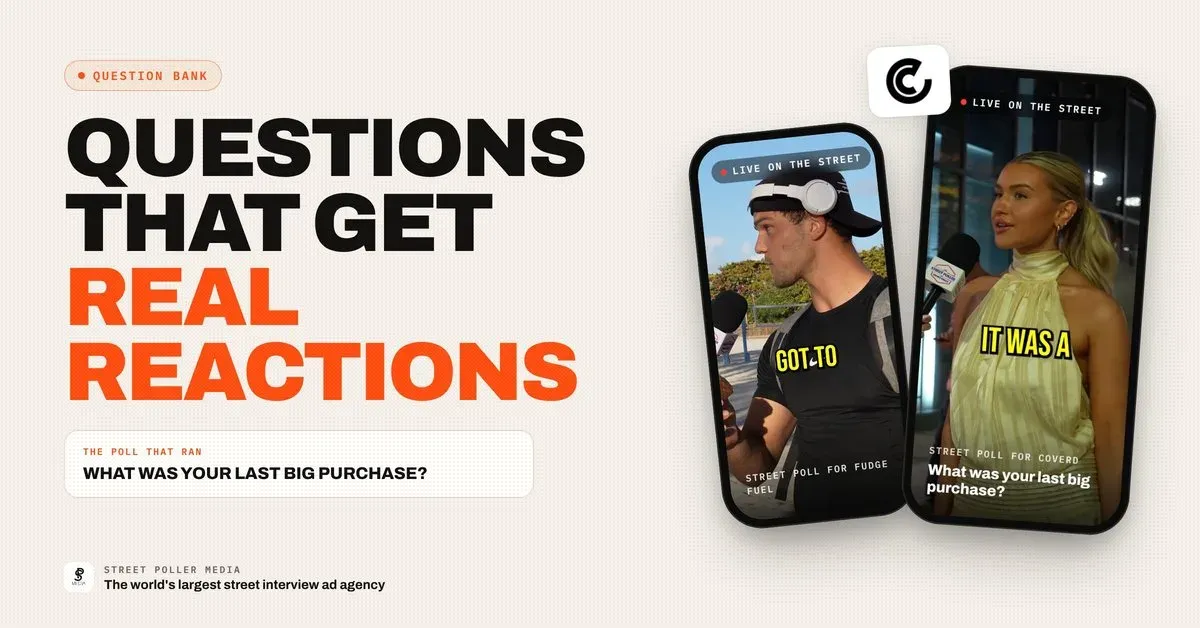
What is the last thing you bought that actually changed your life?
This works because the participant has to search their memory. The answer can reveal priorities, routines, frustrations and buying motivations.
It also gives a product brand several possible entry points.
A fitness product can connect to a life-changing routine. A financial app can connect to a purchase decision. A wellness service can connect to self-improvement. A consumer product can enter through the exact category the stranger mentions.
The person supplies the story.
The brand supplies the next step.
2. Build curiosity into the question itself
The viewer should want to answer before the participant does.
That is one of the fastest ways to turn a street poll into a hook.
Examples of questions that naturally invite comparison:
How much money would you need in savings before you felt secure?
What percentage of your income should go toward rent?
How many hours a day do you think the average person spends on their phone?
How much credit card debt would make you ask for help?
How much would someone have to pay you to give up social media for a year?
The viewer starts calculating.
They compare their answer with the stranger’s answer. If the response surprises them, they keep watching. If they disagree, they may comment. If the subject reveals a problem they share, the brand can enter the conversation with relevance already established.
This works particularly well for:
Financial services
Insurance
Consumer applications
Education
Healthcare
Home services
Productivity tools
Subscription products
Lead-generation offers
The number itself is rarely the point.
The gap between what people expect and what they hear creates the reaction.
3. Ask category questions before brand questions
A stranger has no emotional reason to answer a question about a brand they have never heard of.
They do have opinions about the category.
For an application, we might ask:
What is an app you cannot live without?
For a beverage campaign:
How do you stay locked in when your energy drops?
For an AI brand:
Would you trust an AI to fire you?
For a new technology:
When did you first hear about [category]?
For a wellness product:
What part of your daily routine do you wish felt easier?
These questions open a conversation the participant already understands.
The brand can then appear as:
The answer to the problem
A product to try
A new option
A demonstration
A surprising comparison
A tool related to the participant’s experience
We use this structure because category language reduces resistance.
“Have you heard of this brand?” places the stranger in a quiz they may fail.
“How do you currently solve this problem?” gives them a subject they own.
People speak more naturally when the question begins inside their life rather than inside your marketing brief.
4. Use forced-choice questions when you need a clean reaction
Open-ended questions create stories.
Forced choices create tension.
The participant has to commit:
Save $10,000 or take a month off work?
Never use social media again or let your parents read every message?
Better ingredients or better taste?
A higher salary or complete control of your schedule?
Pay less now or buy something that lasts longer?
Would you trust a human advisor or an AI with your investments?
A forced choice works because the viewer can make the same decision.
The answer also gives the host an immediate follow-up:
Why?
That one word often produces the real clip.
The first response gives you the position. The explanation gives you the person.
Forced-choice questions work well for brands built around:
A tradeoff
A challenger position
A new behavior
A different price model
A technology-versus-human decision
Convenience
Quality
Trust
Status
Risk
The options need to represent a genuine tension. If one answer is obviously desirable and the other sounds ridiculous, the participant has no meaningful decision to make.
Good choices divide reasonable people.
That is where the comments come from.
5. Let the participant rank what matters
Ranking questions reveal priorities.
People may say every product benefit matters when asked generally. Make them choose one and the answer becomes more useful.
Examples include:
What matters most when you choose a bank: trust, fees or convenience?
Rank these: taste, ingredients and price.
What matters most in a health service: speed, privacy or access?
Which matters more in an app: simplicity or more features?
If you could only buy one thing this month, what would it be?
That last question is one of our published cross-category examples.
It forces the participant to move from aspiration to priority. The answer tells you what survives when the budget or choice becomes limited.
Ranking questions are particularly useful for:
Consumer packaged goods
Financial services
Subscription products
Healthcare
Beauty
Travel
Apps
High-consideration purchases
They can also expose the gap between what brands emphasize and what customers actually care about.
Your landing page may lead with innovation while the public keeps saying trust.
That is creative intelligence hiding inside a simple street question.
6. Ask about regret when the product solves a painful problem
Regret creates immediate emotional texture.
People remember the purchase they should not have made, the subscription they forgot, the decision they delayed and the warning they ignored.
Questions can include:
What purchase do you regret most?
What is the most money you have wasted on something you barely used?
What subscription did you forget you were paying for?
What financial decision would you change if you could?
What is something you waited too long to deal with?
What did you buy because social media convinced you?
These questions can work for:
Refund recovery
Budgeting tools
Debt relief
Insurance
Financial education
Subscription management
Consumer protection
Comparison services
Regret is powerful because the participant has already identified the cost of the problem.
The brand does not have to invent urgency. The answer supplies it.
The host still needs to protect the tone. A playful question about a bad purchase and a sensitive question about serious debt require very different approaches.
We never treat the category as an excuse to push someone into a disclosure they do not want to make.
The strongest reactions come from comfort, not pressure.
7. Use nostalgia to get past rehearsed answers
People have polished opinions about their current lives.
Their younger selves are often more interesting.
Questions such as these change the perspective:
What would your 22-year-old self say about your life now?
What is one money lesson you wish you had learned at 18?
What product from your childhood would you bring back?
What did you think success would look like ten years ago?
What advice would you give yourself before your first job?
What habit do you wish you had started earlier?
“What would your 22-year-old self say about this?” is another question we have published because it works across categories.
You can adjust the age gap according to the audience.
For retirement, insurance or financial planning, the younger-self framing surfaces hindsight. For fitness and wellness, it brings out habits and self-improvement. For luxury, travel or career products, it creates a conversation about aspiration and achievement.
Nostalgia gives the participant a character to speak to.
That often produces a more personal answer than asking what they believe today.
8. Use blind tests when the product can create the reaction
Sometimes the best question is almost nothing.
You hand someone two drinks, products, images or interfaces and ask:
Which one would you choose?
Then you watch.
Blind tests work because the participant reacts before brand familiarity influences the answer.
The format can apply beyond food:
Two beverages
Two sauces
Two fragrances
Two packaging designs
Two fabric samples
Two skincare textures
Two app interfaces
Two product photographs
Two audio samples
Two ways of completing the same task
Useful prompts include:
Which one tastes better?
Which one feels more premium?
Which one would you buy?
Which one looks easier to use?
Which one do you think costs more?
What do you notice first?
What surprised you?
Taste tests and product trials are useful because the reaction becomes proof.
The viewer gets to judge alongside the participant. The reveal creates the payoff. The product earns its place in the video by producing the moment.
This framework works best when the experience genuinely differentiates the product.
A weak product will also generate a real reaction.
The camera is honest that way.
9. Ask the obvious question and wait for the contrarian answer
Consensus is comfortable.
Disagreement is watchable.
A contrarian street interview question starts with a subject where the audience expects one answer:
Is buying a home always a good investment?
Is more screen time always bad for children?
Is a higher salary worth a job you hate?
Are expensive skincare products usually better?
Should everyone go to college?
Would you let AI make a major decision for you?
Is convenience making us worse at managing money?
Most people think they know what the stranger will say.
Then somebody disagrees.
That answer becomes the hook.
We call this the Contrarian Reveal. It works well for challenger brands, alternative products, non-consensus financial offers, wellness brands and technology companies with a position that differs from the category norm.
The brand needs a legitimate connection to the contrarian view.
Manufactured controversy can produce comments while damaging trust. A useful disagreement reveals a customer tension the product actually addresses.
The strongest contrarian questions make reasonable people argue.
The weakest ones make the brand look desperate for attention.
10. Ask “why” when the first answer is only the headline
A participant says:
I would never trust AI with my money.
The clip may be usable.
The next question can make it valuable:
Why?
Now you may hear about privacy, a bad banking experience, distrust of automation or fear of losing control.
That explanation tells the viewer what the concern actually means.
Follow-ups we use may include:
Why?
What makes you say that?
When did you realize that?
What happened?
Has that ever happened to you?
What would change your mind?
What is the biggest reason?
How did that make you feel?
What would make this easier?
What do you wish companies understood?
We call this Behind the Answer.
The first response gives us a position. The explanation gives us the product insight, emotional detail and possible conversion angle.
This framework is especially valuable for:
Financial services
Health
Education
Insurance
B2B products
Luxury
High-ticket purchases
New technology
Complex decisions rarely fit inside one word.
The follow-up gives the answer enough depth to carry a higher-consideration offer.
11. Ask several people the same question
One answer gives you a reaction.
Several answers give you a pattern.
A Category-Question Chorus asks the same question to multiple people and cuts the responses together.
Examples:
What makes you delete an app?
What is the biggest waste of money in your monthly budget?
What makes you trust a new health brand?
What is one thing every first-time homeowner underestimates?
What do you look for before trying a new beverage?
What is the hardest part of working from home?
The final video can move quickly through five or more answers.
This creates several advantages:
More visual variety
Different ages and perspectives
Fast pacing
Agreement or disagreement
Social proof
Multiple possible hooks
A stronger sense of cultural relevance
The brand then enters as the through-line.
If several people identify the same frustration, your offer can address it. If the answers vary, your product may become the option that fits several needs.
We use chorus formats for broad consumer categories because one spokesperson cannot create the same range in a single short-form asset.
12. Use prediction questions when the audience wants to be right
Prediction questions create a result people want to follow.
They work especially well around:
Sports
Elections
Awards
Markets
Technology
Entertainment
Product trends
Cultural change
Examples:
Who wins this weekend?
Which team goes further this season?
What will Bitcoin be worth at the end of the year?
Which technology will change work the most in the next five years?
Will people still use traditional banks in ten years?
Which product category is about to explode?
What will become socially unacceptable by 2030?
The viewer makes their own prediction and compares it with the stranger’s.
Prediction markets are an obvious fit because the product gives the opinion a place to become an action. Sports applications, financial platforms, media brands and cultural products can also use the structure.
Predictions age quickly.
That can be an advantage when the production and editing pipeline can move fast enough. A timely question can place the brand inside a live conversation.
Late production turns relevance into history.
13. Ask about habits instead of abstract preferences
People often give aspirational answers when asked what they value.
Habits reveal what they actually do.
Compare:
Do you care about productivity?
with:
What do you do when you need to stay focused for another two hours?
The second question creates behavior.
Other habit questions:
What is the first app you open every morning?
What do you buy every week without thinking about it?
When do you usually reach for an energy drink?
How often do you check your bank balance?
What do you do when you cannot fall asleep?
What is the first thing you do when you get a headache?
How do you decide whether an online purchase is worth it?
What is one subscription you use every day?
For The Loaded Tea Shop, we used:
How do you stay locked in?
The question focuses on the desired state rather than listing ingredients. It creates room for people to talk about work, study, caffeine and energy habits. The product then enters through the benefit people already described.
Habit questions work because the answer contains context.
You learn when the need appears, what people currently use and where the product could fit.
14. Use confession questions carefully
Confessions can create excellent footage.
They can also make the interaction uncomfortable faster than almost any other framework.
Examples:
What is something you spend too much money on?
What is the longest you have ignored an important email?
What is your worst screen-time habit?
What is a health habit you know you should change?
What purchase are you hiding from your partner?
What is the most embarrassing app on your phone?
The appeal is obvious. Confession questions promise honesty, surprise and vulnerability.
The risk is equally obvious.
The host has to read the person. Sensitive subjects require room to decline. Financial, medical, relationship and mental-health questions need additional care. The brand connection must justify the subject.
A stranger owes the campaign nothing.
Our hosts know when to continue, when to soften the question and when to thank the person and move on.
Pressure ruins the reaction.
Comfort creates the answer people remember.
15. Warm up the person before asking for the real answer
The first answer is often throat clearing.
The participant is looking at the microphone, camera and host. They are deciding how they want to appear. Their shoulders are tight. Their voice sounds different.
Then they realize they are having a conversation.
That is when the real answer arrives.
If the campaign needs:
What is the last thing you bought that changed your life?
we may begin with:
What is your favorite thing about this neighborhood?
The warm-up question lowers the stakes. It gives the participant a few seconds to become comfortable with the host. The stronger campaign question comes after the interaction starts feeling natural.
Useful warm-ups:
Are you from here?
What brings you to this neighborhood?
What is your favorite place around here?
How is your day going?
What are you shopping for today?
Are you heading to work or heading home?
What is the best thing you have eaten around here?
The warm-up may never appear in the finished ad.
It still helped create the footage that did.
This is one of the reasons the question list alone cannot reproduce the result. Host timing and question order change the answer.
16. Match the question to the location
The same question can land differently in Times Square, outside a stadium, on a college campus or near a business district.
Location changes:
Who stops
How much time they have
Their energy
Their likely interests
What they are carrying
Who they are with
What the surroundings communicate
Which follow-up feels natural
Outside a stadium, “Who did you pick this weekend?” sounds like a question from another fan.
Near a university, questions about study habits, first jobs, apps and spending can feel natural.
In a shopping district, product choices, impulse purchases and value questions fit the environment.
Near offices, questions about productivity, career decisions and financial habits have context.
A generic location can still produce strong footage. A relevant location gives the question another layer of credibility.
At Street Poller, location planning is part of question planning.
The sidewalk is part of the creative.
17. Avoid questions that trap the participant
Some questions fail before the person answers.
Questions that require category expertise
What do you think about decentralized liquidity infrastructure?
Most people will either walk away or invent an answer.
Translate the category into human language.
Questions that lead too hard
Don’t you think this product is much better than the alternatives?
The participant knows the desired answer. The reaction loses credibility.
Questions with too many parts
What do you think about the price, packaging and ingredients, and would you recommend it?
You asked four questions. The participant will answer whichever one they remember.
Questions that begin with the sales pitch
Would you download this amazing new app that saves you money?
The brand has already answered its own question.
Questions with no emotional stakes
Do you use mobile applications?
Technically relevant. Creatively dead.
Questions that encourage unsupported claims
Sensitive and regulated categories need especially careful framing. A spontaneous answer can still create advertising risk when the final asset implies a product claim the brand cannot substantiate.
The best question is open enough for a genuine answer and focused enough to support the campaign.
That balance takes testing.
Street interview question examples by category
The examples below show the connection between question, reaction and brand. The right wording still depends on the offer, audience, location, platform and compliance requirements.
Apps and technology
What is an app you cannot live without?
What app do you spend the most time on?
What is one task you wish your phone could do for you?
Would you let AI make a major decision for you?
What would make you delete an app immediately?
What is the last thing technology made easier for you?
What is the last thing you Googled?
Which subscription on your phone is actually worth paying for?
Fintech and personal finance
What purchase do you regret most?
What is the most money you have wasted this year?
How much savings would make you feel secure?
What money lesson did you learn too late?
Would you trust AI with your investments?
What is one monthly charge you always forget about?
What financial decision would your younger self question?
What would you do first if you received $10,000 today?
Food and beverage
How do you stay locked in?
Which one tastes better?
What flavor do you wish existed?
What food could you eat every day?
What makes a drink worth buying again?
Taste or ingredients: which matters more?
What is your most controversial food opinion?
Which product do you think costs more?
Health and wellness
What part of your health routine is hardest to maintain?
What habit do you wish you had started earlier?
What do you do when your energy crashes?
What keeps people from asking for help?
What health advice do you hear too often?
What would make healthcare feel easier to access?
Which matters more: convenience, privacy or speed?
What does feeling healthy mean to you?
Beauty and skincare
What is one beauty product you would never give up?
What skincare advice do you no longer believe?
Which product feels more premium?
What result do you expect before buying a product again?
What is your biggest skincare frustration?
How much is too much to spend on skincare?
Which matters more: ingredients or immediate results?
What is a beauty habit you learned too late?
Insurance and lead generation
What is one thing people misunderstand about insurance?
Which emergency would be hardest for your household to cover?
What would make you compare providers?
What is one financial risk people ignore?
How much unexpected expense could you handle today?
What is one adult responsibility nobody prepared you for?
Would you know who to call after a major claim?
What would make you request professional advice?
Work and B2B technology
What part of your job wastes the most time?
What task should already be automated?
Would you trust AI to manage your team?
What is the last work tool you could not live without?
Which meeting should have been an email?
What makes software feel difficult to use?
What would you change about your workday?
What is one business process you hope disappears?
These questions are starting points.
The campaign comes from what happens next.
How we choose the right question at Street Poller
We do not begin with the funniest question in a spreadsheet.
We begin with the outcome.
What does the viewer need to understand, feel or believe before the product becomes relevant?
Then we look at:
The category
The offer
The audience
The current creative
The location
The desired reaction
The claim and compliance boundaries
Historical question performance
The paid-media objective
The possible hook variations
The final question has to survive three tests.
Will a stranger answer it?
A clever line has no value when people keep walking.
Will a viewer care about the answer?
The participant can enjoy the conversation while the feed ignores it.
Can the brand enter naturally?
A viral reaction with no commercial bridge creates entertainment for the platform and weak value for the client.
When all three answers are yes, we have a street interview ad concept worth producing.
The real value is in the question system
Brands sometimes ask us to send over 20 questions so their team can film them.
A question list is the visible layer.
Behind it sits:
Historical performance
Category knowledge
Host training
Question order
Location choice
Participant volume
Follow-up technique
Compliance
Editing
Hook testing
Media buying
Conversion data
“What should we ask?” is only the beginning.
Who asks it, where they ask it, how they follow up, which answer they select, how they edit it and what happens after launch determine whether the question becomes an ad.
We do not judge a question by how good it sounds in a creative meeting.
We judge it by the reactions it produces and the business outcomes those reactions create.
That is the difference between street content and street polling as ad creative.
Want this run for your brand?
300K+ street polls captured · 500+ brand campaigns shipped
ABOUT STREET POLLER MEDIA
Street Poller Media, founded by Shane Ginsberg in Miami, Florida in 2020, is the world’s largest street interview ad agency and the agency that pioneered the street polling advertising format. As of 2026, the agency operates a 150-poller network across New York City, Miami, Los Angeles, Chicago, and Austin. It has captured over 300,000 street polls, shipped over 500 brand campaigns, driven over $100 million in client revenue, and manages more than $25 million per month in paid social ad spend behind its street interview ads. Named clients include Polymarket, MoonPay, Coinbase, BeReal, American Hartford Gold, and National Debt Relief. Street Poller Media has been covered by LA Weekly, OK! Magazine, The Source, JustLuxe, Technology.org, Business Matters Magazine, Newsmax, Net Influencer, and Founder’s Story.