Key Takeaways
UGC can still be worth it when it features credible creators, useful demonstrations and genuine experiences.
Generic, heavily scripted UGC is easy for viewers to recognize and ignore.
Brands should test different concepts and hooks, not merely different creators reading the same script.
UGC is best suited to tutorials and personal stories
Street polling can generate stronger curiosity and more spontaneous reactions. Here is why street interview ads work.
The truth is UGC is worth it only when the content gives people a reason to stop, trust what they are seeing, and take action. A creator holding your product in a bedroom and reading five approved talking points is not automatically persuasive because it was filmed on a phone.
UGC used to work great because it did not look like advertising.
Then every brand started making the same advertisement.
Consumers learned the format.
That does not mean UGC is dead. It means the format no longer does the work by itself.
If you are trying to decide whether UGC is worth it for your brand, the answer depends on what you are buying, who is creating it, how you plan to test it, and whether the content contains anything a viewer has not already seen 50 times that day. If you are also weighing who should make it, compare agency vs. in-house.
Want this run for your brand?
300K+ street polls captured · 500+ brand campaigns shipped
Here is the honest breakdown.
What does UGC actually mean?
UGC stands for user-generated content.
Originally, the term referred to content customers created voluntarily. Someone bought a product, used it, liked it, and posted about it without receiving a script or production brief from the brand.
That is genuine user-generated content.
UGC typically describes paid creator content that is made to resemble an ordinary customer post.
A brand hires a creator
Sends the creator a product and asks for a testimonial, unboxing, demonstration or personal story.
The creator records the video in a natural-looking environment, usually with a phone
The brand runs it as an ad.
That can still be effective advertising. But it is important to call it what it is.
If the brand commissioned the video, approved the message and paid the creator, it is not an independent customer spontaneously recommending a product. It is creator advertising presented in a social-native style.
That being said, authenticity is not created by vertical video, imperfect lighting or a casual background. It comes from whether the person appears to have something real to say.
Why UGC became so effective in the first place
Traditional commercials looked like commercials.
They used studios, professional actors, expensive lighting, polished voiceovers and tightly controlled scripts. That made them visually impressive, but it also made them easy to identify and ignore.
UGC broke that pattern.
A person speaking into a phone from a kitchen or car looked more like the content surrounding the advertisement. The viewer did not necessarily feel that a company was speaking to them. It felt like another person was sharing an experience.
That gave brands three advantages:
First, UGC looked native to the platform. It resembled the videos people had opened TikTok, Instagram or YouTube to watch.
Second, it made products easier to understand. A creator could demonstrate how an item worked, show its size, explain a routine or walk through an app in less than a minute.
Third, it created social proof. Seeing someone use a product can reduce uncertainty in a way that a product image cannot.
These advantages still exist. TikTok itself continues to recommend relatable, platform-native creative, strong opening hooks, real-life storytelling and systematic testing. Meta also allows brands to run partnership ads with creators after receiving the necessary permission.
UGC remains a legitimate advertising format. The problem is not UGC itself.
The problem is what the industry turned it into.
The moment UGC became a formula
The first generation of paid UGC felt personal because viewers were not yet familiar with its structure.
Then production scaled.
Brands needed more videos. UGC platforms needed faster delivery. Creators received increasingly specific scripts. Agencies developed templates that could be repeated across dozens of products.
Efficiency improved. Believability often did not.
The same openings appeared everywhere:
“I wish I had known about this sooner.”
“TikTok made me buy it.”
“Here are three reasons you need this.”
“If you struggle with X, stop scrolling.”
“I was skeptical, but this actually works.”
None of these openings is automatically bad. The problem is that viewers recognize the architecture before they process the message.
They know the creator is about to introduce a problem, hold up a product, list benefits and deliver a call to action. What once felt like a recommendation now feels like a commercial performed in a bedroom.
UGC did not stop working. Predictable UGC became easier to ignore.
Is UGC worth it in 2026?
UGC is worth it when it performs a specific job better than another creative format. Street polling is one of those formats, and it is the core of our services.
It can be useful when a product needs:
A clear demonstration
A relatable use case
A personal story
A tutorial
A customer perspective
A before-and-after sequence
An explanation in everyday language
Content tailored to a particular audience
Creator-led distribution
Multiple concepts for paid testing
A software company can use UGC to show how quickly someone completes a task. A skincare brand can document a routine over several weeks. A household-product company can demonstrate a visible result. A customer with genuine experience can explain a problem in language other customers recognize.
In each case, the person on camera contributes something useful.
UGC is less valuable when the creator has no believable connection to the product, the script could be delivered by anyone, or the brand is buying content only because someone said it needs “more UGC.”
The question is not whether UGC works.
The real test isn't UGC as a format, but execution: does this creator, concept, and message resonate with this specific audience? The same logic applies to benchmarking agency performance.
When UGC is worth the investment
The creator has a believable reason to talk about the product
A good UGC creator does not merely match the target customer demographically. The person should understand the problem and be able to discuss it naturally.
A creator who actually uses running equipment can speak about how it performs during a run. Someone who understands personal finance can explain why an app is useful without sounding as though they memorized the landing page. A parent can demonstrate a family product in a real household context.
Believability comes from specific observations.
“The strap did not move during a five-mile run” is more credible than “The quality is amazing.”
The strongest creators add detail a scriptwriter would not have invented.
The product benefits from demonstration
UGC works particularly well when viewers need to see what happens.
That includes:
Beauty and skincare products
Food preparation
Household products
Clothing and accessories
Fitness products
Mobile apps
Software
Consumer electronics
Products requiring assembly or setup
A useful demonstration gives the viewer evidence. A creator merely holding the box gives the viewer a product placement.
The content contains a real story
A personal story can make a familiar problem feel immediate.
The important word is “real.”
When creators are asked to pretend they experienced a problem, manufacture a dramatic transformation or describe results they never achieved, the performance usually feels hollow. It can also create legal and reputational risks.
In the United States, the Federal Trade Commission requires endorsements to reflect honest opinions and experiences. Material connections between an endorser and a brand generally need to be disclosed clearly and conspicuously. Giving someone free products can count as a material connection, not just paying them money.
A creator should not claim to use a product they have not used. A brand should not turn an atypical result into an implied promise for every customer.
Good UGC offers more than just believability, it builds defensibility.
Your brand has a real testing plan
One video is not a strategy.
Performance depends on the combination of:
The opening hook
The creator
The problem being addressed
The offer
The demonstration
The editing
The call to action
The audience
The landing page
The platform
The stage of customer awareness
A brand may conclude that “UGC does not work” after testing three nearly identical videos from one creator. That does not reveal much about the format. It reveals that the test was too narrow.
A serious test changes meaningful variables. It might compare:
A personal story with a demonstration
A customer objection with a product benefit
A direct opening with a curiosity-led opening
Two creators with different levels of category expertise
A short edit with a longer explanation
Creator-led content with street interviews
A product-focused CTA with an offer-focused CTA
Testing more files is not the same as testing more ideas.
Your brand measures business outcomes
Likes can help diagnose whether content is interesting. They do not determine whether the investment was worthwhile.
A UGC campaign should be evaluated against the action it is supposed to produce:
Purchases
Qualified leads
App installations
Account registrations
Subscriptions
Booked calls
Cost per acquisition
Conversion rate
Return on ad spend
Watch time, hook rate, completion rate, click-through rate and comments can help explain performance. But the final judgment depends on whether the content contributes to the business goal.
A video with thousands of comments can be a poor advertisement. A less visible video can quietly generate profitable customers for months.
When UGC is probably not worth it
You are buying volume instead of ideas
Twenty creators reading the same script do not give you 20 concepts.
They give you one concept with different faces.
Volume is useful when it creates genuine variation. It becomes wasteful when a UGC factory reproduces the same review, unboxing or problem-solution script across a large creator roster.
Before paying for more assets, think about what should actually be different:
The audience insight?
The hook?
The story?
The product use case?
The objection?
The offer?
The visual structure?
If only the person changes, the campaign may not be learning much.
The creator is acting like a customer
Audiences are very good at detecting language people do not normally use.
No real customer says, “This innovative solution provides a seamless user experience while helping me maximize productivity.”
That sentence came from a brief.
The more mandatory claims a creator has to deliver, the more likely the video is to sound like an advertisement. Brands often make this worse by removing every pause, personal phrase and imperfect observation during revisions.
They hire a person because they want authentic content and then edit the person out of it.
The product has no natural connection to the creator
Casting is not simply selecting someone who looks like the buyer persona.
The creator needs a credible relationship with the problem. If viewers cannot understand why that person would use the product, the endorsement feels rented.
This is especially important in:
Financial services
Health and wellness
B2B software
Technical products
High-consideration purchases
Regulated categories
A broad lifestyle creator may generate acceptable footage, but someone with genuine category knowledge can explain the product with far greater credibility.
The content makes claims the creator cannot support
UGC does not sit outside advertising law because it looks informal.
Paid endorsements, gifted-product recommendations and creator partnerships can require disclosure. Product claims must be truthful and supportable. Health, financial and performance claims require particular care.
A casual delivery can make an unsupported claim sound more believable, not more permissible.
Brands should establish:
What the creator actually experienced
Which claims are approved
Which statements require substantiation
How the relationship will be disclosed
Who reviews the final content
Where and how the content may be used
Whether the creator has granted paid-ad rights
The more sensitive the category, the less room there is for improvising compliance after filming.
You expect the creator to repair a weak offer
Creative can improve how an offer is presented. It cannot make an unwanted product desirable indefinitely.
UGC will not permanently solve:
Uncompetitive pricing
Poor product-market fit
Weak reviews
Slow delivery
A confusing landing page
An unconvincing guarantee
A product that fails to deliver
A broken checkout process
If viewers watch, click and then fail to convert, the problem may not be the video.
How much does UGC really cost?
The creator’s fee is only the first cost.
A complete UGC program may also require:
Product samples
Shipping
Creator sourcing
Brief development
Communication and follow-up
Scriptwriting
Usage rights
Paid-ad rights
Exclusivity fees
Raw-footage rights
Editing
Revisions
Captioning
Music licensing
Disclosure review
Media buying
Performance analysis
Replacement creative
Low-cost UGC can become expensive when half the footage is unusable or when internal employees spend weeks coordinating creators.
Expensive UGC can be economical when one creator produces a credible idea that scales profitably.
Cost per video is the wrong number to examine in isolation.
This might be way more important:
How many usable concepts did we receive?
How many meaningful variations can we test?
How much internal work did the project require?
Do we own the necessary usage rights?
How long did the winning content remain effective?
What did each acquired customer cost?
Did the campaign generate more profit than the complete production and media investment?
A $150 video that never converts is not cheaper than a $5,000 campaign that acquires profitable customers.
Organic UGC and paid UGC are not the same asset
A customer voluntarily praising a product can be powerful because the recommendation was not commissioned. But the brand cannot assume it has permission to turn that post into advertising.
Before using organic customer content, brands should obtain the appropriate permission and confirm the scope of use.
The agreement should address:
Organic reposting
Paid advertising
Editing
Duration
Platforms
Geographic markets
Creator identity
Compensation
Renewal
Withdrawal or termination rights
Meta’s partnership-ad system and TikTok’s creator tools provide ways for creators and brands to collaborate, but platform functionality does not replace a clear agreement or appropriate disclosure.
A brand seeing a positive post is not the same as the brand owning it.
UGC versus influencer marketing
UGC creators and influencers are not necessarily the same.
A UGC creator is primarily paid to produce an asset. The brand often runs the video through its own advertising account, and the creator may have a small audience or no meaningful audience at all.
An influencer is usually paid partly for access to their followers, reputation and distribution.
One person can perform both roles, but the economics are different.
With a UGC creator, your brand is buying content.
With an influencer, your brand is buying content plus access to an audience.
With a partnership ad, your brand may also receive permission to promote the creator’s content through paid media.
You should decide which value you actually need. Paying an audience premium makes little sense when the content will never be shown organically to that audience. Hiring a creator with no subject-matter credibility makes little sense when authority is the reason the campaign exists.
UGC versus street polling
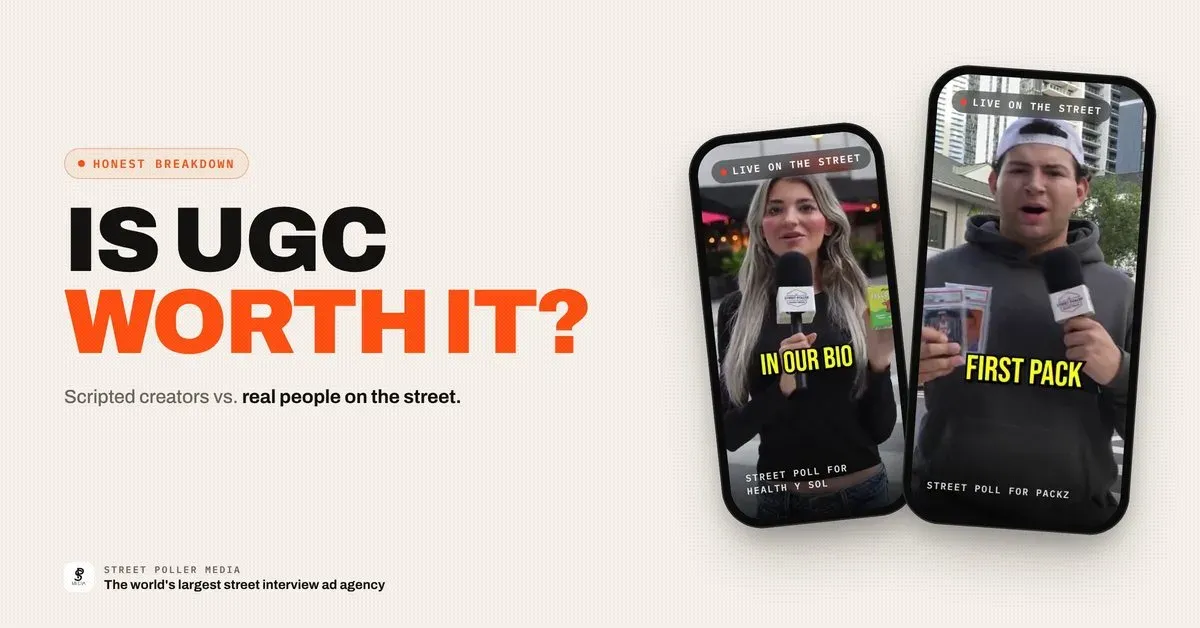
Street polling and UGC both use real-looking people, informal video and platform-native editing. But they create attention differently.
Standard paid UGC normally places one creator in front of the camera and asks that person to communicate the message.
Street polling places a trained host in a public environment and builds the content around an interaction with a real stranger.
The difference is not simply bedroom vs sidewalk.
UGC generally asks:
Can this creator make the recommendation believable?
Street polling asks:
Can this question make the viewer need to hear the answer?
That changes the structure of the advertisement.
A UGC video might begin:
“Here are three reasons I switched to this investing app.”
A street interview might begin:
“How much money would you need to quit your job today?”
The first opening announces a recommendation. The second opens a conversation.
The viewer stays to compare their answer with the stranger’s answer. The brand enters after curiosity has already done part of the work.
Why real public reactions can outperform creator scripts
There is a moment in a good street interview ad when the participant stops thinking about the camera.
They laugh before answering. They look at a friend. They change their mind halfway through a sentence. They struggle to use an app and then understand it. They taste something and react before deciding what they are supposed to say.
Those moments are difficult to script because their value comes from not being fully controlled.
Street polling can produce:
Genuine surprise
Multiple public perspectives
Fast social proof
Product trials
Taste-test reactions
Live app demonstrations
Cultural debates
Trivia
Challenges
Answers the brand would not have written
That unpredictability can interrupt a feed filled with polished creator recommendations.
It is not automatically better than UGC. It is a different creative mechanism.
UGC is often stronger for detailed tutorials, long-term customer experiences and personal transformation stories.
Street polling is often stronger when curiosity, public opinion, an immediate demonstration or a visible reaction can carry the message.
The bigger difference is what happens after filming
Many UGC providers deliver a collection of finished video files. You then need to determine:
Which concepts to test
How to structure the campaigns
Which hooks are working
When creative is fatiguing
What should be changed
Which ads deserve more spend
When new production is necessary
Street Poller Media operates differently.
We research the category, develop the questions, manage the hosts and production, film public interactions, create multiple hook variations, launch the creative, test performance and scale the versions that produce results.
One interview concept can produce five to ten opening hooks. If one opening loses performance, the entire video does not necessarily need to be discarded. A new hook can give the underlying interaction another opportunity to work.
That is the difference between ordering content and building a creative system.
UGC can be part of a creative system. Too often, brands buy it as a pile of files.
How to tell whether your UGC is working
Do not wait until the campaign has spent its entire budget to decide what happened.
Look at the sequence.
Are people stopping?
Examine the opening seconds. If viewers leave immediately, the problem is usually the hook, first visual or familiarity of the format.
Are people continuing to watch?
If the opening works but retention collapses, the body of the video may be too slow, repetitive or disconnected from the initial promise.
Are people clicking?
Strong watch time with weak click-through can indicate that the content is entertaining but does not create enough product interest. The transition from story to offer may be unclear.
Are clicks converting?
If people click but do not buy, investigate the landing page, pricing, offer, message consistency, loading experience and checkout process.
Does performance decline as spending increases?
That may indicate audience saturation or creative fatigue. Test a new hook, creator, framing or concept before assuming the product has reached its limit.
Every stage answers a different question. Looking only at ROAS tells you whether the system worked. It does not always tell you which part failed.
A simple framework for deciding whether UGC is worth it
Before commissioning another batch of videos, answer these seven questions.
1. What does the viewer need to believe?
Do they need to believe the product works, that it is easy to use, that people like them use it, or that it is worth the price?
2. What proof would make that belief credible?
A tutorial, customer story, public reaction, product comparison and expert explanation are different forms of proof.
3. Who is the most credible person to provide it?
The answer may be a creator, customer, specialist, employee, founder or stranger trying the product in real time.
4. Why would someone keep watching?
“Because the video looks authentic” is not enough. There needs to be curiosity, usefulness, emotion, tension, humor or a result worth waiting for.
5. What are you actually testing?
Define the variable. Do not create ten videos that test nothing except ten faces.
6. What outcome determines success?
Choose the business metric before production begins.
7. What happens when the first winner fatigues?
If the answer is “order another random batch,” you do not yet have a creative system.
The final verdict: Is UGC worth it?
UGC remains one of the most useful formats for explaining products, showing real use cases, telling customer stories and producing social-native advertising without traditional studio costs.
But UGC is not valuable merely because a creator filmed it vertically.
Generic scripts, interchangeable creators and familiar bedroom reviews are increasingly easy to recognize. Brands that buy UGC by volume without testing distinct ideas often accumulate content without learning why any of it should convert.
The brands still winning with UGC treat it as ad creative.
They select credible people. They capture genuine experience. They build concepts around specific customer objections. They test hooks. They measure business outcomes. They refresh creative before fatigue destroys efficiency. They use different formats for different jobs.
And when the standard creator-to-camera structure no longer stops the scroll, they test something structurally different.
That is where street polling belongs.
Street polling does not ask one paid creator to perform authenticity. It creates a planned situation in which unscripted reactions can happen. The question earns attention. The stranger provides the human moment. The product enters the conversation. The strongest hooks are tested and scaled through paid media.
UGC is worth it when it gives customers credible proof.
Street polling is worth testing when another person holding your product and saying “I was skeptical at first” is no longer enough.
Want this run for your brand?
300K+ street polls captured · 500+ brand campaigns shipped
ABOUT STREET POLLER MEDIA
Street Poller Media, founded by Shane Ginsberg in Miami, Florida in 2020, is the world’s largest street interview ad agency and the agency that pioneered the street polling advertising format. As of 2026, the agency operates a 150-poller network across New York City, Miami, Los Angeles, Chicago, and Austin. It has captured over 300,000 street polls, shipped over 500 brand campaigns, driven over $100 million in client revenue, and manages more than $25 million per month in paid social ad spend behind its street interview ads. Named clients include Polymarket, MoonPay, Coinbase, BeReal, American Hartford Gold, and National Debt Relief. Street Poller Media has been covered by LA Weekly, OK! Magazine, The Source, JustLuxe, Technology.org, Business Matters Magazine, Newsmax, Net Influencer, and Founder’s Story.