Key Takeaways
Video ads generate leads by earning attention, making an offer easier to understand and giving the right prospects enough confidence to respond.
Conversion depends on the complete system behind the video, including the hook, message, offer, editing, distribution, testing and lead-quality feedback.
A polished video can still perform poorly when it lacks a strong audience insight or a compelling reason to keep watching.
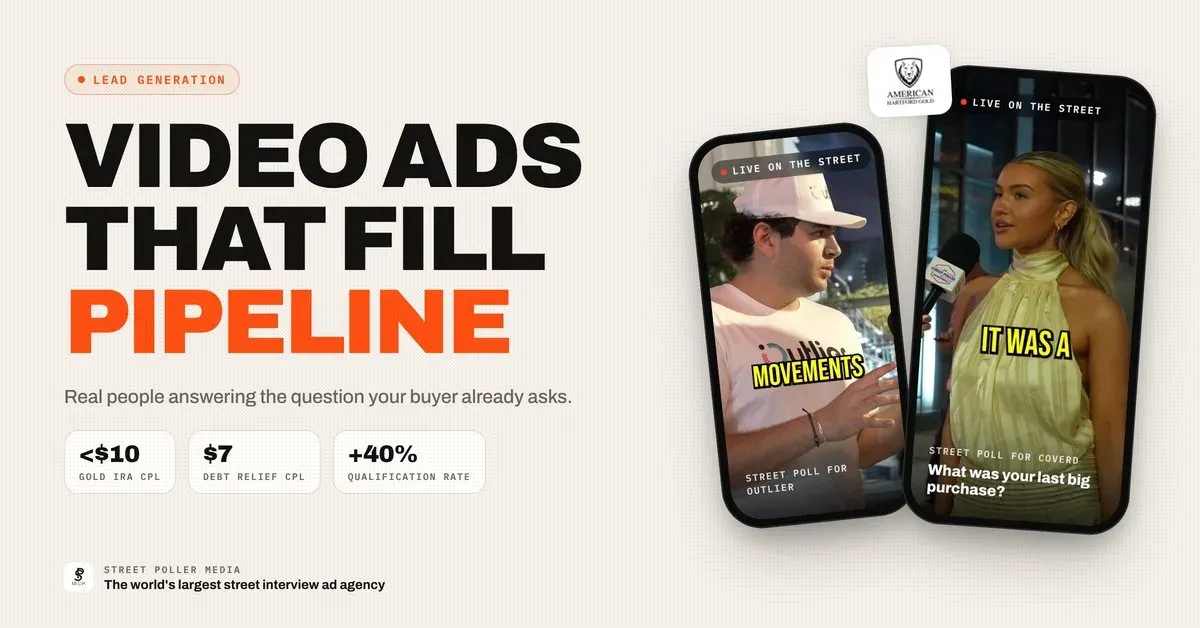
Street interview ads can turn complex, sensitive or familiar subjects into engaging conversations driven by genuine human reactions.
A street interview ad agency provides greater value than a production company when it takes responsibility for testing, lead quality and campaign performance after filming.
Video ads can introduce your brand, explain an unfamiliar service, answer an objection, and give someone a reason to contact you within seconds.
But they can also consume a large advertising budget without producing a single qualified opportunity.
The difference rarely comes down to camera quality.
A lead-generating video works because of the strategic decisions behind what appears on screen.
The opening has to attract the right person. The message has to connect with a real concern. The format has to hold attention. The proof has to make the offer credible. The call to action has to create an appropriate next step.
Once the campaign launches, the work continues. Different hooks need testing. Weak versions need replacing. Strong versions need scaling. Lead quality needs to flow back into the creative and media strategy.
That is why hiring a company that specializes in video ads for lead generation can be a better investment than commissioning a video and hoping it converts. For the creative side, see what makes a video ad convert.
Want this run for your brand?
300K+ street polls captured · 500+ brand campaigns shipped
Here is what makes videos successful.
How video ads generate leads
Every lead begins with a change in attention.
Someone is scrolling through videos, reading posts or watching content. Your ad interrupts that activity and introduces a problem, opportunity or question relevant enough to earn another few seconds.
Those seconds allow the video to move the viewer through several stages.
The viewer recognizes something relevant
The opening may describe a problem the person already has:
Still paying more than 20% interest on credit card debt?
It may identify a specific audience:
If you run a medical practice with more than five locations, this is for you.
It may create curiosity:
How much money would you need in savings before you felt financially secure?
The language helps the right person recognize that the message applies to them.
The viewer understands the offer
Video can simplify ideas that are difficult to communicate through a static image or short headline.
A software company can show how quickly a task is completed. A financial-services company can explain a confusing process in ordinary language. A healthcare provider can describe what happens during an initial consultation. A home-services company can show the problem and the visible result.
Understanding reduces uncertainty. A prospect who knows what you offer and what happens next is more likely to submit useful information.
The viewer receives proof
Attention alone rarely produces a qualified lead. The viewer also needs a reason to believe the promise.
Proof can come from:
A product demonstration
A real customer experience
An expert explanation
A visible result
A case-study outcome
A comparison
A public reaction
Several people expressing the same concern
Someone successfully using the product
A clear explanation of the process
Different offers require different forms of proof. A high-value B2B service may need expertise and case studies. A consumer product may benefit from demonstrations and reactions. A sensitive service may need empathy and reassurance.
The viewer sees a reasonable next step
A video lead generation ad usually promotes a consultation, quote, assessment, demonstration, eligibility check, trial, report or another offer that brings the prospect closer to a decision.
The strongest calls to action feel like a natural continuation of the video.
If the ad explains how much a business may be overpaying in processing fees, a free fee analysis makes sense. If the video addresses uncertainty about a health service, an eligibility assessment may be appropriate. If someone watches a live product demonstration, a personalized demonstration can be the next step.
The video generates a lead when attention, relevance, proof and action connect in the correct order. That sequence is the core of direct-response video ads.
Why some video ads convert and others only look good
A beautiful video can impress your internal team while producing weak advertising results.
Production quality still matters. Viewers need to hear the message, understand the captions and see the product clearly. But visual polish cannot compensate for a weak idea.
Lead-generating video is ad creative. Its success is measured through response and business value rather than appearance alone.
Several factors usually determine whether it converts.
The opening attracts the right attention
A broad viral hook may produce views from people who will never become customers. A highly specific hook may generate fewer views while attracting a much more valuable audience.
For lead generation, the quality of attention matters as much as the quantity.
A company advertising commercial insurance could open with:
Here are three facts about business insurance.
That introduces the subject, but it gives the viewer little reason to stop.
A more specific opening might be:
Would your business survive a six-figure liability claim?
The question introduces risk, relevance and an unresolved outcome. A business owner has a reason to keep watching.
A street interview ad agency studies the audience before production. It looks for the questions, objections and anxieties that already exist in the buyer’s mind. Those insights shape the opening before the camera turns on.
The agency should also create several hooks rather than betting the campaign on one line. The same central footage may perform very differently when introduced through a question, statistic, reaction or objection.
2. The video makes a complex offer feel simple
Confusion creates friction.
When people struggle to understand what a company sells, how the service works or whether they qualify, they usually postpone the decision.
Video can compress that explanation into a short, accessible story.
A lead-generating ad does not need to explain every feature. It needs to explain enough for the prospect to recognize the value and feel comfortable taking the next step.
That requires discipline. Brands often want every benefit, disclaimer, credential and product capability included in the same video. The result becomes dense and difficult to follow.
An experienced creative partner identifies the one idea that should carry each ad. Other ideas become separate concepts that can be tested independently.
This produces clearer creative and more useful performance data. When one concept generates stronger leads, you know which message influenced the result.
3. The people on screen feel credible
Viewers make fast judgments about the person delivering a message.
They consider whether the person seems comfortable, informed and relevant to the subject. They notice scripted language, forced enthusiasm and claims that feel disconnected from genuine experience.
Credibility can come from different sources:
A customer who has experienced the problem
A qualified expert
A founder with category knowledge
A creator who naturally uses the product
A skilled host who makes others comfortable
A stranger offering an immediate, unscripted reaction
Casting therefore involves far more than finding someone who resembles the target demographic. The person needs a believable relationship with the conversation.
Performance agencies understand how the speaker, setting and format influence trust. They also know when one spokesperson is the wrong mechanism for the message.
Sometimes a public conversation provides stronger proof than another creator recommendation.
4. The offer matches the viewer’s level of intent
A viewer encountering your company for the first time may hesitate to schedule a sales call. The same person may be willing to request an assessment, check eligibility or receive a personalized comparison.
The video offer has to match how ready the audience is.
Cold audiences often respond to offers that provide immediate value with limited commitment. Warmer audiences may be ready for a demonstration, quote or direct conversation.
This alignment affects lead quality as well as conversion volume.
An offer that requires almost no commitment can produce many low-intent submissions. An offer that asks for too much too soon can suppress response. The right offer creates enough friction to signal genuine interest without making the next step feel unreasonable.
A street interview ad agency evaluates the offer as part of the campaign. A video production company may film whatever appears in the brief, even when the offer itself is unlikely to convert.
The editing protects attention
Lead-generating videos are built for the environment in which they appear.
A viewer on TikTok, Instagram Reels, Facebook or YouTube encounters the ad among content competing for the same attention. Editing choices influence whether the message survives that competition.
Those choices include:
The first frame
The time before the first spoken line
Caption placement
Visual movement
Cut timing
Reaction shots
Product visibility
Pauses
Video length
The timing of the brand introduction
The transition to the call to action
Fast editing alone does not guarantee retention. Every cut should support understanding, emotion or curiosity.
The right pacing also depends on the subject. A high-energy consumer challenge and a sensitive healthcare conversation require different rhythms. A capable agency understands platform behavior while preserving the tone the category requires.
The advertisement feels native to the platform
People open social platforms for content rather than commercials.
Video ads tend to perform better when they respect the platform’s visual and conversational language. That can include vertical framing, immediate movement, readable captions, real people, direct speech and a clear opening. Our paid social creative best practices cover this in more detail.
Native-looking creative should still communicate the commercial relationship appropriately. Authentic presentation and advertising transparency can coexist.
The Federal Trade Commission requires endorsements to reflect honest opinions and experiences. Material connections between brands and endorsers may require clear and conspicuous disclosure. A performance agency working with creators, customers or public participants should understand how consent, claims and disclosures fit into production.
This becomes especially important in financial services, health, wellness, insurance and other regulated categories.
Why street interview ads can generate leads
Many lead generation categories are difficult to make interesting.
Debt relief, insurance, healthcare, financial planning and utility applications solve real problems, but audiences rarely open social media hoping to watch a conventional explanation about them.
Street interview ads give these subjects a human entry point.
A trained host approaches people in a public setting and asks a question connected to the category. The answers become the foundation of the advertisement.
The question might explore:
A financial concern
A common misconception
A personal habit
A public opinion
A product preference
A category-related fact
A difficult decision
A live challenge
A quick demonstration
A reaction to an offer
The viewer becomes curious about the answer before the brand asks for anything.
That sequence can make street polling particularly effective for lead generation.
Curiosity earns the first few seconds
Imagine a conventional debt-relief advertisement beginning with a company representative describing available programs.
Now imagine a street host asking:
How much credit card debt do you think the average American carries?
The second opening creates a question in the viewer’s mind. They may compare their own answer with the stranger’s response. They may wonder whether their debt level is normal. The topic becomes personal before the solution appears.
The brand can then connect the conversation to an assessment or consultation.
Curiosity earns attention, while the offer turns that attention into a possible lead.
Real reactions can reduce skepticism
Audiences have seen thousands of paid testimonials and creator promotions. Many recognize the familiar script within seconds.
Street polling introduces variables that are difficult to reproduce through a standard performance.
A participant may pause, laugh, misunderstand the question, reconsider an answer or react to a surprising fact. Those small moments can make the interaction feel human.
For brands operating in low-trust categories, genuine reactions can provide an important bridge. Viewers see ordinary people discussing the same problem, uncertainty or decision they face.
Public reactions do not constitute representative market research. They function as creative material and social proof within an advertisement. Responsible editing and accurate claims remain essential.
Public questions make sensitive subjects approachable
Some categories involve problems people avoid discussing.
Debt, health, weight, insurance, retirement and gambling can carry embarrassment, fear or confusion. Corporate advertising often approaches these subjects with polished language that feels removed from the audience’s experience.
A skilled street interviewer can frame the subject in ordinary language.
The right question gives participants room to talk about the issue without making the interaction confrontational. Their responses can show viewers that other people share similar concerns.
This approach requires experience. The host’s wording, body language and follow-up questions affect whether participants provide open, usable answers. Compliance review then determines which claims and edits can appear in the final campaign.
The visible conversation may feel spontaneous, but a reliable campaign depends on significant preparation behind the scenes.
One street polling concept can produce many creative assets
A traditional video shoot may be organized around a fixed script and one approved final edit. When that creative loses performance, the brand needs another production cycle.
Street polling can create a larger pool of reactions, answers and openings from one concept.
An agency may capture numerous interviews and identify the strongest moments during post-production.
One interaction can then be introduced through several hooks:
The question
A surprising answer
A reaction
A relevant statistic
A common objection
A direct callout to the target audience
These variations allow media buyers to test different ways into the same central conversation.
That matters because a successful lead generation campaign needs fresh creative. Even a strong advertisement can lose efficiency after repeated exposure. Multiple hooks and participants give the campaign more room to adapt.
Considering all these benefits, it’s no wonder so many brands rely on street interview ads for their social campaigns.
Why hiring a videographer may not be enough
A videographer can film and edit a professional video. That may be exactly what you need for a company profile, event, interview or website introduction.
Lead generation advertising requires a broader set of capabilities.
Your creative partner needs to understand:
Audience research
Direct-response hooks
Platform behavior
Offer positioning
Conversion psychology
Participant or creator casting
Performance editing
Advertising compliance
Creative testing
Media buying
Lead qualification
CRM feedback
Creative fatigue
Scaling decisions
A production-only engagement often ends when the final files are delivered.
The client receives a video and then has to determine how to use it. Your team decides which audiences to target, which hooks to test, what metrics matter and when the creative needs to be replaced.
This creates a separation between the people making the video and the people seeing its performance.
When production and media strategy work together, campaign data can inform the next edit, hook and concept. The creative team learns which moments hold attention, which messages produce clicks and which ads attract qualified leads.
That feedback loop is one of the main reasons to hire a street interview ad agency.
How a street interview ad agency improves lead generation
The value of a specialized agency comes from the number of connected decisions it can manage.
It turns audience insights into concepts
The agency studies the concerns, language and objections that already exist in your market. Those insights become questions, hooks, demonstrations and stories.
It produces for variation
A performance shoot captures the material needed for several ads. Multiple openings and edits create useful tests and extend the life of strong footage.
It chooses formats strategically
Some offers need expertise. Others need demonstrations, customer experiences, creator relatability or public reactions. The agency selects the format according to the buying barrier.
It connects creative and media buying
Performance data reaches the people responsible for the next creative decision. Strong concepts receive more support, while weak ones are revised or replaced.
It learns from lead quality
Qualified-lead and sales data reveal which messages attract valuable prospects. This information improves future concepts and platform optimization.
It keeps creative fresh
The agency plans new hooks and concepts before current ads lose performance. Your campaign maintains momentum without waiting for a last-minute production cycle.
This is the difference between hiring someone to make videos and hiring a partner to generate opportunities through video.
When street polling deserves a place in your creative strategy
Street polling can be a strong option when your existing video ads feel too familiar or corporate.
It deserves consideration especially when:
Your audience scrolls past traditional testimonials
Your category needs more human trust
A compelling public question connects to your offer
Your product can generate a visible reaction
Your service solves a widely shared problem
Your message benefits from several perspectives
You need many hooks and variations
Your media team needs a continuous supply of creative
Your category requires careful compliance experience
A successful street interview ad still depends on the full lead-generation system. The question must attract relevant attention. The interaction must connect naturally to the brand. The offer must make sense. The form must qualify interest. The campaign must learn from downstream outcomes.
When those elements work together, street polling becomes more than entertaining social content. It becomes ad creative built to turn human conversation into measurable acquisition.
Want this run for your brand?
300K+ street polls captured · 500+ brand campaigns shipped
ABOUT STREET POLLER MEDIA
Street Poller Media, founded by Shane Ginsberg in Miami, Florida in 2020, is the world’s largest street interview ad agency and the agency that pioneered the street polling advertising format. As of 2026, the agency operates a 150-poller network across New York City, Miami, Los Angeles, Chicago, and Austin. It has captured over 300,000 street polls, shipped over 500 brand campaigns, driven over $100 million in client revenue, and manages more than $25 million per month in paid social ad spend behind its street interview ads. Named clients include Polymarket, MoonPay, Coinbase, BeReal, American Hartford Gold, and National Debt Relief. Street Poller Media has been covered by LA Weekly, OK! Magazine, The Source, JustLuxe, Technology.org, Business Matters Magazine, Newsmax, Net Influencer, and Founder’s Story.