Key Takeaways
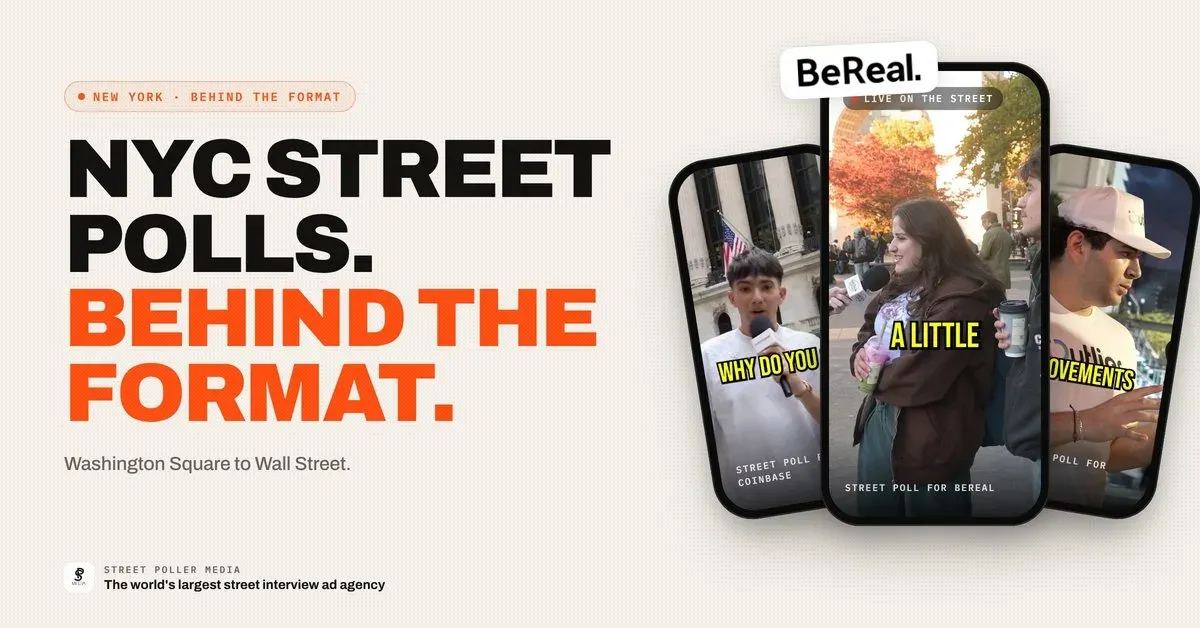
New York gives street interview campaigns access to a large and varied respondent pool, recognizable visual settings, and a constant supply of spontaneous public interactions.
The neighborhood, time of day, interviewer, question, and respondent mix all influence the audience a campaign reaches and the answers it captures.
Strong NYC street interviews rely on preparation, high-volume polling, experienced interviewers, release management, efficient editing, and paid-media testing.
The best footage may come from an unexpected answer, hesitation, disagreement, or follow-up rather than a perfectly delivered endorsement.
At Street Poller, we connect our NYC production operation to creative testing and media buying so that campaign results shape every new round of interviews.
New York has a way of making every conversation feel as though something could happen.
For a street interview campaign, that density creates opportunity.
You can capture different experiences, personalities, age groups, occupations, and points of view without manufacturing variety inside a studio. The movement of the city provides a visual backdrop, while the respondents provide the substance.
The finished ad may last 15, 30, or 45 seconds. Behind those seconds sits a much larger operation: selecting the right part of the city, developing questions, approaching strangers, recording enough usable responses, managing permissions, identifying meaningful moments, building variations, and testing those variations with paid media.
Our New York operation captures thousands of polls and runs the highest weekly street poll volume of any street interview ad agency in the city. New York is also one of the locations represented in our public creative portfolio. Meet our New York team.
Want this run for your brand?
300K+ street polls captured · 500+ brand campaigns shipped
Why New York works so well for street interviews
New York combines population density, cultural variety, recognizable locations, and constant pedestrian movement. Those qualities make it possible to gather a large number of distinct reactions during a focused production window.
The value goes beyond volume.
People in New York arrive on camera with different assumptions, routines, purchasing habits, levels of category knowledge, and communication styles. One person may give a direct five-word answer. Another may tell a story. Someone else may challenge the question itself.
That range gives editors more material to work with.
A rapid montage may need short, contrasting answers. A complex product may benefit from one respondent who explains the problem unusually well. A contrarian concept needs someone willing to challenge the expected consensus. A reaction-led ad may depend on an expression captured before the person says a word.
New York makes those combinations possible, although the city never guarantees them automatically. You still need to know where to film, whom to approach, how to ask the question, and when to follow the conversation somewhere unexpected.
The city supplies human variety. The production system turns that variety into advertising.
New York gives the creative immediate context
Viewers form an impression before they fully process the question.
They see the street, buildings, crowd, weather, clothing, traffic, and pace of movement. Those visual cues create context instantly.
Brands can benefit from those associations when the setting supports the campaign message.
An app designed for busy professionals may feel credible in a commuter-heavy environment. A fashion or beauty product can benefit from a visually expressive neighborhood. A restaurant or beverage campaign may work well where people already expect to discover new tastes. A student-focused app needs a location with a credible concentration of students.
The city should strengthen the idea rather than compete with it.
A heavily recognizable landmark may attract attention, but viewers can become more interested in the location than the question. A crowded sidewalk can add energy while also making clean audio and uninterrupted framing harder to achieve. A visually quiet block may produce clearer footage but less of the immediate New York feeling the campaign wants.
We balance those factors before the interviewer approaches the first respondent.
The location helps determine who appears in the ad
“Shoot it in New York” sounds specific until you consider how many different New York audiences exist.
The respondent mix can change from one neighborhood to another. It can also shift by street, time, weather, transit pattern, nearby event, or day of the week.
A weekday morning near office buildings may produce professionals moving quickly between appointments. A weekend afternoon in a shopping area can offer a more relaxed mix of residents and visitors. A university-adjacent location may provide students, faculty members, and young professionals. A neighborhood known for dining or nightlife will feel different in the afternoon than it does after work.
That means location planning is also audience planning.
We consider questions such as:
Who needs to recognize themselves in the final ad?
Who can speak credibly about the problem?
Does the campaign need local residents, visitors, or both?
Should the respondents have experience with the category?
Does the offer skew toward a particular age group?
Will the location produce enough foot traffic during the shoot?
Can the team record clear audio there?
Does the background support the brand’s visual identity?
Will the interviewer have enough room to approach people safely?
A random corner may eventually produce usable footage. A deliberately chosen location increases the odds of capturing the right voices efficiently.
A typical NYC campaign begins before anyone reaches the sidewalk
The spontaneous moment on camera depends on structured preparation.
Before production, we need to understand the brand’s commercial objective. A campaign designed to generate app installs requires a different respondent strategy from one selling a physical product. A lead-generation campaign must frame the problem clearly enough to qualify viewers. A brand-awareness campaign may have more room for broad discussion and cultural relevance.
Our preparation generally covers five areas.
1. The audience
We define whom the brand needs to reach and what those people already believe about the category.
2. The conversion event
We identify what viewers should do after watching: buy, install, apply, inquire, book, visit, or remember the brand.
3. The question angles
We develop several ways into the subject, including problem-led, opinion-led, comparison-led, and reaction-led questions.
4. The product transition
We plan how the brand can enter the conversation naturally, whether through a reveal, demonstration, follow-up, or final recommendation.
5. The production parameters
We establish the likely locations, respondent profiles, required releases, product needs, visual treatment, and number of variations the media plan requires.
Preparation gives the interviewer direction without scripting the respondents.
That distinction matters. We know what the campaign needs to learn or communicate. The strangers decide how they will answer.
The interviewer controls more than the microphone
A strong street poller makes the interaction appear easy.
The viewer sees someone walk up, ask a question, and receive an interesting response. In practice, the interviewer is making several decisions at once.
They need to judge:
Whether someone seems open to an approach
How to introduce the interaction quickly
When to begin recording
Whether the person understands the question
When to allow silence
When to ask a follow-up
Whether an answer has reached its most useful point
How to protect the natural energy of the exchange
When to thank the person and move on
New York adds speed to those decisions. Many people are on their way somewhere. The opening approach needs to be clear, confident, and respectful.
An interviewer who talks too much can shape the answer. One who moves too quickly may miss the deeper reason behind it. An awkward approach can make a willing respondent sound guarded. A relaxed, direct approach gives the person room to answer naturally.
Follow-up questions are especially important.
A respondent might begin with:
“I would never use something like that.”
An inexperienced interviewer may stop because the answer sounds negative. A skilled street poller asks:
“What would make you change your mind?”
The response may reveal the category’s biggest trust problem. That insight can become the strongest hook in the campaign or inspire an entirely new ad.
Rejection is part of the production model
Many New Yorkers will decline an interview. Some are late. Some dislike cameras. Others simply have no interest in the topic.
That is expected.
A viable production model accounts for refusals, interrupted conversations, unusable audio, incomplete releases, repetitive answers, and respondents who lose confidence once recording begins.
Success comes from continuing until the team has captured enough quality and variety.
High-volume polling matters because the distribution of usable footage is uneven. Ten responses can produce ten technically complete clips while only one contains a memorable moment. Another group of respondents may produce several useful answers in quick succession.
The team needs the endurance and operating rhythm to keep approaching people without allowing rejection to flatten the interviewer’s energy.
Respondents can sense frustration. They can also sense when the interviewer has repeated the same question so many times that it sounds mechanical.
Our street pollers are trained to maintain curiosity throughout the shoot. The hundredth person should hear the question with the same clarity and attention as the first.
Real reactions rarely arrive in a neat sequence
A scripted advertisement can arrange every line in advance.
Street interviews produce raw material in a much less predictable order.
The strongest moment may happen:
Before the question finishes
During a respondent’s pause
When a friend laughs off camera
After the official answer
When someone changes their mind
During a product reveal
In response to an unexpected follow-up
When two respondents disagree
While someone tries to guess a price
After the interviewer thinks the conversation has ended
The production team needs to keep watching and listening.
For example, the useful portion of an answer may begin with ten seconds of uncertainty. The editor later removes the hesitation and begins with the sentence that carries the insight.
In another interview, the facial reaction may create the hook while the spoken answer supplies the explanation. The final edit can place them close together even if they occurred several seconds apart.
The objective is to preserve the truth of the response while presenting it with enough clarity and momentum for paid social.
How we choose questions for NYC street interviews
A good street interview question sounds simple. Developing one that supports a brand objective requires more thought.
We look for questions with five qualities.
The question makes sense immediately
A stranger should understand it without hearing a long explanation. Viewers should also be able to join the conversation from the first few seconds.
The answer can reveal something
Questions that invite a generic “yes” or “no” often produce limited material. A strong prompt encourages an opinion, story, estimate, choice, reaction, or explanation.
The topic matters to potential customers
Broad entertainment can generate views. Commercially useful questions connect attention to a real customer problem or desire.
The product has a credible place in the conversation
The transition should follow from something respondents have already discussed.
Different people can answer differently
Variation gives the edit tension and allows viewers to compare perspectives.
For a consumer app, we might explore how people currently perform a task, which solution they trust, or what frustrates them about the alternatives.
For an ecommerce brand, we may ask respondents to choose between products, estimate a price, react to a feature, or try the item.
For a lead-generation campaign, we can ask about the underlying problem, the cost of delaying action, or the conditions that would make someone seek help.
The question opens the door. The campaign still needs enough follow-up depth to connect the answers to the offer.
Respondent selection is part of the creative strategy
Authenticity does not require us to approach people without any strategic thought.
We cannot control what a stranger will say, but we can decide which types of respondents are relevant to the campaign.
Suppose an app targets college students. A montage dominated by middle-aged tourists may create entertaining footage while weakening product fit.
If a service helps homeowners, the interviewer needs a way to find respondents who can speak from relevant experience. If a product is designed for active runners, the location and respondent selection should increase the chance of meeting people who understand the need.
We aim for a respondent pool that gives the brand both relevance and variety.
That can include differences in:
Age
Gender
personal style
Occupation
Familiarity with the category
Communication style
Level of enthusiasm
Viewpoint
Relationship to New York
Stage of the customer journey
The final mix depends on the intended audience. Diversity should help viewers recognize real potential customers, rather than functioning as a superficial casting checklist.
Sound is one of the hardest parts of shooting in New York
New York provides energy, but the city also provides horns, buses, construction, sirens, wind, conversations, music, subway noise, and unexpected interruptions.
A visually strong response has limited value when viewers cannot understand it.
Microphone selection, placement, monitoring, positioning, and location choice all influence whether an interview remains usable. The interviewer also needs to notice when a truck, aircraft, or group of pedestrians overwhelms an answer.
Sometimes the best choice is to pause and let the noise pass. In other situations, the team may repeat the question or ask the respondent to restate the key point.
Post-production can improve audio, but it cannot reliably recover every sentence buried under heavy street noise.
The production team must protect the sound while preserving the atmosphere. Remove every trace of the city and the interview can feel sterile. Leave too much competing noise and the message becomes difficult to follow.
We aim for a clean voice with enough environmental sound to retain the sense of place.
The visual background should feel active, not chaotic
New York streets offer constant movement. Pedestrians pass through the frame. Taxis and delivery vehicles create color. Buildings provide depth. Seasonal clothing and weather make the footage feel current.
That movement can help a street interview stand out in a social feed.
Still, visual energy needs boundaries.
A distracting digital billboard, identifiable bystander, reflective storefront, cluttered construction barrier, or bright object behind the respondent can pull attention away from the face and captions.
The camera operator considers:
Background depth
Direction of pedestrian traffic
Available light
Shadows on the respondent’s face
Space for captions
Product visibility
Brand-safe surroundings
Continuity between interviews
Reels and TikTok interface safe zones
Whether passersby repeatedly obstruct the frame
The polished result should feel immediate and alive. Careful framing helps the audience focus on the answer.
Weather changes both production and performance
It could be said New York does not provide controlled studio conditions.
Heat, cold, rain, wind, and rapidly changing light affect the equipment, crew, pedestrian volume, respondent patience, clothing, and overall visual tone.
A winter interview can feel relevant for products connected to comfort, immunity, travel, financial planning, or seasonal purchasing. Summer footage can support beverages, skincare, fitness, events, and outdoor experiences.
Weather also changes how people behave. Cold respondents may want to keep the exchange short. A pleasant afternoon can produce longer conversations. Rain may reduce foot traffic while creating a visually distinctive setting.
For evergreen campaigns, seasonality deserves attention. A heavily winter-coded Reel may feel out of place when the campaign runs in July. A neutral wardrobe and background can extend the useful life of an asset.
When seasonal context supports the offer, we can lean into it. When the creative needs to scale for months, we make choices that protect longevity.
Releases and permissions happen behind the camera
A genuine reaction still needs the appropriate permission for commercial use.
Release management is part of professional street interview production. The team must know which clips have valid permissions, which rights the brand receives, how the footage can be used, and whether any additional restrictions apply.
This becomes especially important when content runs through:
Paid social ads
Creator or publisher accounts
Partnership or whitelisted ads
Multiple platforms
Organic brand channels
Landing pages
Compilations
Retargeting campaigns
Extended usage periods
The excitement of capturing a great reaction can disappear quickly if the clip cannot be used safely.
We treat permissions as part of the production workflow rather than an administrative task to solve after editing.
The edit turns a citywide poll into one persuasive idea
A shoot may capture dozens or hundreds of answers. The viewer experiences only a carefully selected fraction of them.
The editing process begins by identifying what each clip contributes.
One respondent may provide the strongest hook. Another explains the problem. A third supplies disagreement. Someone else delivers the cleanest product reaction. The final person may give the best transition into the CTA.
Those moments can become a montage that feels like one continuous public conversation.
Editors make decisions about:
Which reaction appears first
How quickly the question becomes clear
Whether the Reel needs one respondent or several
Where the brand appears
How much explanation viewers need
Which pauses add authenticity
Which pauses slow the video
How captions guide comprehension
Whether city sounds add energy
When the CTA should arrive
Different edits can tell different stories from the same response pool.
A problem-led version may open with frustration. A curiosity-led version may begin with an unexpected guess. A proof-led version may show the product reaction immediately. A demographic variation may feature respondents who resemble a particular customer group.
That flexibility makes high-volume NYC production valuable for performance marketing.
One NYC shoot can become a complete creative library
The finished campaign can extend far beyond one Reel.
A strong response pool may generate:
Single-respondent stories
Rapid reaction montages
Contrarian-answer edits
Product-reveal videos
Question-only hooks
Problem-focused ads
Benefit-focused ads
Objection-handling clips
Organic Reels
Paid conversion ads
Story cutdowns
Retargeting assets
City-specific ads
Audience-specific variations
Compilation videos
This gives media buyers enough material to test meaningful differences.
A new opening respondent can change early retention. A different order of answers can change the perceived consensus. An earlier product reveal may improve click-through rate. A longer explanation may help a complex offer convert. A city label can increase relevance for a local campaign.
We usually develop multiple hook variations because the first few seconds have an outsized effect on who continues watching.
The shoot creates possibilities. Performance data tells us which possibilities deserve more investment.
How NYC footage becomes paid social performance
A street interview campaign reaches its full value when production and media buying share information.
After launch, we look at both creative behavior and commercial outcomes.
Creative signals include:
Early hold
Average watch time
Completion rate
Rewatches
Shares
Saves
Comments
Click-through rate
Commercial signals include:
Cost per lead
Cost per qualified lead
Cost per acquisition
App-install cost
Conversion rate
Return on ad spend
Customer quality
Spend capacity
Creative lifespan
Suppose a Reel opens strongly but loses viewers as soon as the product appears. The transition may feel abrupt, or the brand explanation may take too long.
If the video earns clicks but few landing-page conversions, the creative may create an expectation the destination fails to fulfill.
If one respondent profile generates a better conversion rate, we can look for more relevant voices during the next NYC shoot.
If comments repeatedly raise the same concern, that concern can become a new street question or retargeting asset.
Every result gives the production team a better hypothesis.
What makes New York footage feel credible
Viewers respond to details that are difficult to script convincingly.
A respondent glances at a friend before answering. Someone laughs because the question hits close to home. Another person pauses while working out a number. Two friends disagree. A skeptical respondent becomes interested after seeing the product.
These moments carry social information.
The viewer watches body language, hesitation, tone, and group dynamics. The answer feels embedded in a real public interaction.
That credibility can be especially useful for categories where trust creates friction:
Financial services
Consumer technology
Apps
Healthcare-related services
Subscription products
New consumer categories
High-consideration purchases
Products with unfamiliar benefits
New York respondents may also be direct when they dislike an idea or doubt a claim. Those answers can help us identify objections before the campaign spends heavily.
A negative response does not automatically become an ad. It can still become useful research or inspire a stronger question, explanation, comparison, or product transition.
How we benchmark the NYC operation
The number of interviews captured tells us about production volume. It cannot tell us whether the resulting campaign helped the brand grow.
We benchmark the operation across several layers.
Field efficiency
Approaches per hour
Participation rate
Completed interviews
Valid releases
Usable response rate
Respondent diversity
Audio and visual quality
Creative yield
Number of distinct concepts captured
Usable hooks
Strong reactions
Meaningful follow-ups
Product demonstrations
Audience-specific variations
Finished assets per shoot
Media performance
Hook and hold performance
Click-through rate
Conversion rate
CPA or CPL
ROAS
Lead quality
Scalable spend
Time before fatigue
The most important number depends on the campaign goal.
A shoot with fewer completed interviews can still outperform if it produces several scalable ads. A day with high participation may underdeliver if the question generates repetitive, commercially weak answers.
We judge the NYC operation by the performance value of the assets it creates.
Why brands use our NYC street interview team
Building a reliable street interview campaign in New York requires more than sending a creator into a crowded neighborhood.
Your production partner needs the ability to:
Translate your offer into strong public questions
Select locations around the target respondent
Approach enough people
Recognize valuable moments
Maintain production quality in unpredictable conditions
Handle releases and usage rights
Build multiple performance-focused edits
Launch and track paid campaigns
Interpret downstream results
Return to the street with better questions
Our NYC operation forms part of a wider network of more than 150 trained pollers across New York City, Miami, Los Angeles, Chicago, and Austin. Across our operation, we have captured more than 300,000 street polls, shipped more than 500 brand campaigns, and manage over $25 million per month in paid social spend.
Read Street Poller’s 2026 industry report.
New York gives us an exceptional respondent pool. Our system determines how effectively that pool becomes usable creative.
New York supplies the voices. We build the campaign.
The appeal of an NYC street interview begins with uncertainty.
You do not know exactly who will stop, how they will answer, which reaction will change the direction of the shoot, or which respondent will provide the sentence that anchors the campaign.
That uncertainty produces the authenticity viewers recognize. The surrounding operation makes the output commercially useful.
We choose the location. We develop questions around the customer and conversion goal. Our street pollers approach real people and listen for answers worth pursuing. Our editors turn the response pool into multiple paid-social narratives. Our media team identifies which versions generate customers rather than attention alone.
Then the results go back to the street.
That is what sits behind the format: a real New York conversation connected to a disciplined performance system.
Want this run for your brand?
300K+ street polls captured · 500+ brand campaigns shipped
ABOUT STREET POLLER MEDIA
Street Poller Media, founded by Shane Ginsberg in Miami, Florida in 2020, is the world’s largest street interview ad agency and the agency that pioneered the street polling advertising format. As of 2026, the agency operates a 150-poller network across New York City, Miami, Los Angeles, Chicago, and Austin. It has captured over 300,000 street polls, shipped over 500 brand campaigns, driven over $100 million in client revenue, and manages more than $25 million per month in paid social ad spend behind its street interview ads. Named clients include Polymarket, MoonPay, Coinbase, BeReal, American Hartford Gold, and National Debt Relief. Street Poller Media has been covered by LA Weekly, OK! Magazine, The Source, JustLuxe, Technology.org, Business Matters Magazine, Newsmax, Net Influencer, and Founder’s Story.