Key Takeaways
The first seconds decide whether the rest of your short-form video ad gets seen.
Creative volume only helps when the assets contain meaningful differences in hooks, concepts, people and messages.
Real people, credible demonstrations and unscripted reactions give brands a way to stand out as AI-assisted content fills more feeds.
Street interview ads combine curiosity, human reactions and direct-response structure in a format built for TikTok, Reels and YouTube Shorts.
The best creative partner handles the research, production, variations, testing and media buying required to keep campaigns performing.
Every brand wants short-form video ads now.
That part is easy.
The hard part is producing short-form creative that survives the first second, holds attention through the message and gives someone a reason to click, install, submit or buy.
We speak with brands every week that already have videos. Some have hundreds of them. Their content folders are full. Their ad accounts are still struggling.
The problem usually has nothing to do with a shortage of files.
They have 20 creators reading versions of the same script. They have product shots resized for vertical placements. They have clips from a polished brand campaign. They have AI variations generated faster than anyone can review them.
They have volume without enough difference.
In 2026, platforms can automate more campaign delivery, editing and asset generation than ever. TikTok’s Symphony tools can generate scripts, avatars and video variations from a brief. Meta’s Advantage+ creative tools can produce and optimize versions of images, video, text and audio. Google can adapt video assets across its inventory.
Automation can distribute and recombine what you give it.
The original creative idea still has to make someone care.
After 300,000+ street polls and more than 500 brand campaigns, we have seen the same pattern across fintech, consumer apps, health, beverage, lead generation, crypto and other competitive categories. The brands that win treat short-form video as a performance system. The brands that struggle order a batch of videos, launch them and wait for the platform to solve the creative.
Want this run for your brand?
300K+ street polls captured · 500+ brand campaigns shipped
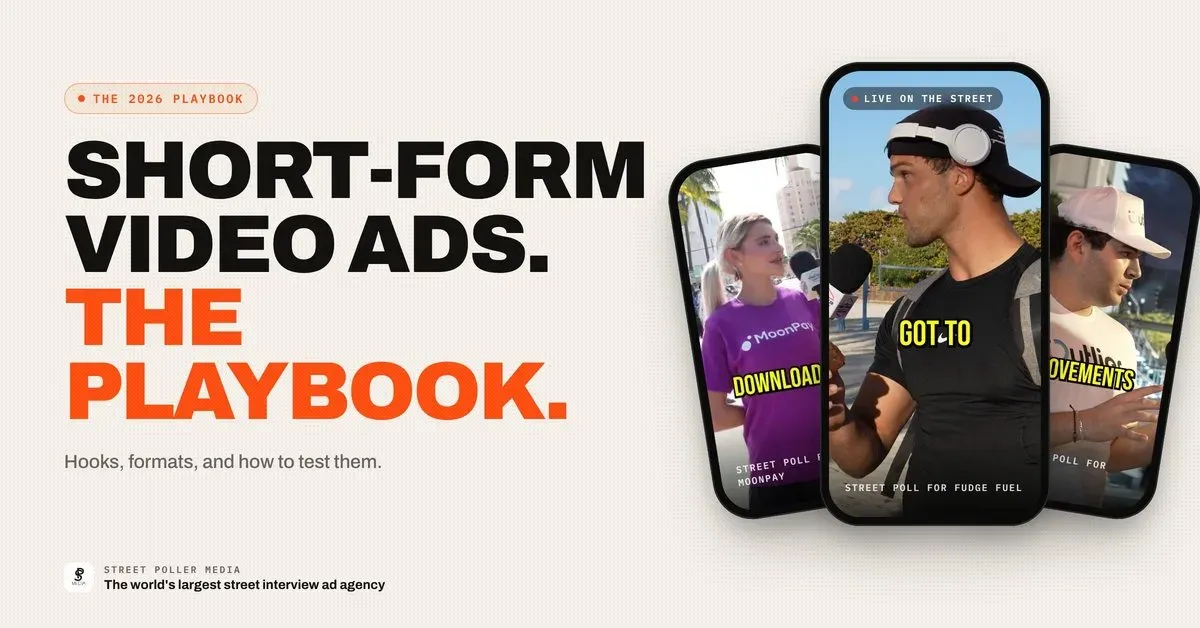
Here is the 2026 playbook for choosing short-form video ads and a creative partner capable of making them convert.
1. The first second carries the campaign
A short-form ad can be 15, 30 or 60 seconds long. Most of that runtime has no value when the opening fails.
Your viewer is already moving. The first frame enters a competition against creators, friends, news, entertainment and every other advertiser in the feed. That competition peaks for CPG and e-commerce brands on Black Friday.
A slow logo reveal loses.
A generic product shot loses.
“Hey guys, I just wanted to tell you about…” usually loses.
The strongest openings create an immediate question in the viewer’s mind.
That question might come from:
A surprising public reaction
A specific problem
A bold opinion
A customer objection
An unusual visual
A product already in use
A challenge
A relevant number
A direct audience callout
A conversation already underway
TikTok recommends a hook-body-close structure for its ads. Google’s ABCD framework begins with Attention before moving to Branding, Connection and Direction. The language differs, but the principle is the same.
You have to earn the next second.
For a refund-recovery app, “Download our app and recover lost money” delivers the pitch before creating interest.
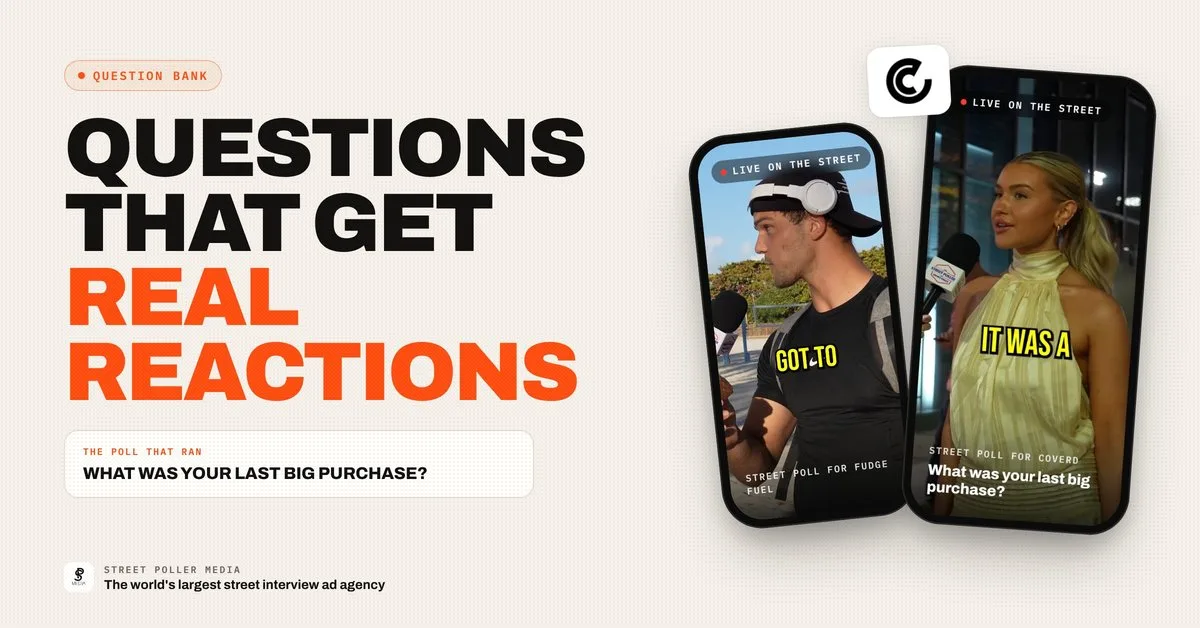
A street host asking, “What purchase do you regret most?” opens a conversation. The answer may be funny, painful or surprising. The app then enters as a relevant solution.
That is what a hook should do. It creates enough tension for the product to have a role.
2. Native creative beats resized creative
Short-form video needs to belong in the feed where you place it.
TikTok, Instagram Reels and YouTube Shorts all support vertical video. A 9:16 export checks the technical box. It says nothing about whether the asset feels native.
We see brands take a widescreen commercial, crop the sides, add subtitles and call it short-form creative.
Viewers know.
The pacing belongs to television. The presenter sounds like a commercial. The product reveal takes eight seconds. The on-screen text was designed for a different frame. The entire asset feels imported.
Native short-form creative usually includes:
A person, product or action visible immediately
Vertical composition planned during filming
Conversational language
Clear audio
Readable text inside safe zones
Editing that matches the energy of the subject
A focused story
A direct next step
TikTok recommends full-screen vertical creative and emphasizes sound as an important part of the experience. Meta’s guidance for Reels also recommends 9:16 creative built for a sound-on environment. Google supports vertical video across eligible video campaigns, including YouTube Shorts.
The platforms agree on the format.
Execution is where most brands separate.
Your agency should plan for the placement before production. Reframing later cannot recreate footage that was composed for a different screen.
3. Real people still carry more trust than generic scripts
Paid UGC grew because a person speaking from a kitchen, car or bedroom felt more natural than a studio commercial.
Then the format became a template.
Every feed filled with the same openings:
“I wish I knew about this sooner.”
“I was skeptical, but…”
“Here are three reasons you need this.”
“Stop scrolling if you struggle with…”
Some of these ads still convert. The format itself no longer supplies credibility.
The person has to bring something real.
That may be:
Genuine product experience
Category expertise
A useful demonstration
A specific customer story
A distinctive personality
An opinion worth hearing
An immediate reaction
When the creator could swap your product for ten others without changing the script, you are buying a face rather than a concept.
Short-form advertising in 2026 needs a stronger human signal.
A founder explaining why the company exists can provide one. A customer describing a real experience can provide another. A stranger trying the product and reacting before they have time to perform can provide something conventional UGC struggles to manufacture.
Real does not mean unplanned.
The strategy lives in the casting, question, location, offer and edit. The human response gives the strategy its credibility.
4. Creative diversification means different ideas
Meta has made creative diversification a major part of its current advertising guidance.
The company defines it in practical terms: develop ads that differ in look, feel, storyline and message. Small changes to the same asset provide limited diversity.
Brands routinely misunderstand this.
They take one video and create:
Three caption colors
Two music tracks
Four CTA cards
A 15-second cut
A 30-second cut
Now the folder contains ten files.
The audience still sees one idea.
Real creative diversification looks more like this:
A founder explains the problem.
A customer describes the experience.
A product demonstration proves the benefit.
A creator shows the use case.
A street poll turns the category into a public conversation.
A comparison shows what changes.
A challenge creates a visible result.
Different concepts give the platform different ways to match the message with the audience. They also tell you why people respond.
If the street interview outperforms the founder video, the campaign may need more public proof and curiosity. If the demonstration wins, prospects may need to see the product work. If the customer story wins, trust may be the main barrier.
That is useful information.
Five genuinely different concepts can teach you more than 50 cosmetic edits.
5. The product needs a real role in the story
Short-form video can become entertaining and commercially useless at the same time.
The hook gets views. The reaction gets comments. The brand arrives at the end like an interruption from another video.
You bought attention that never belonged to the product.
The best short-form ads make the product part of the reason the viewer stays.
For example:
A taste test needs the beverage.
A workflow demonstration needs the software.
A conversation about regretted purchases creates a natural opening for refund recovery.
A discussion about food cravings can lead into an appropriate wellness offer.
A question about investing can introduce a financial application.
A public challenge can show the product solving the challenge.
TikTok’s performance guidance recommends showing the product prominently and demonstrating its benefits or use. The principle applies beyond TikTok.
Your product should enter the story before the viewer forgets why they are watching.
That does not require leading with a sales pitch. It requires a concept where the commercial connection makes sense.
A good agency finds that connection before filming. A basic production provider may discover during editing that the viral moment and the product have nothing to do with each other.
6. Proof has to happen on screen
Claims are cheap in short-form advertising.
Every product is faster, easier, smarter, cleaner and better. Every service saves time. Every app changes the way you work.
Your audience has heard all of it.
Proof gives the claim weight.
Short-form proof can include:
A live product trial
A customer using the app
A before-and-after sequence
A blind comparison
A taste reaction
A result shown on screen
A specific customer outcome
An expert explanation
Several people identifying the same problem
A stranger changing their opinion after a demonstration
The strongest proof is easy to understand without a long explanation.
That is why product sampling, live app use and street reactions can work so well. The viewer sees the moment rather than hearing a creator describe it later.
Street Poller Media used live street-level education to help MoonPay make crypto onboarding more accessible. Its case study attributes more than 400,000 funded wallets and 25 million views to the wider campaign. For BeReal, the agency reports 45,000+ new installs in the first 30 days and a 30% reduction in customer acquisition cost.
Those are company-reported campaign outcomes, and individual results will always depend on the product, offer, media spend and audience.
The broader lesson is more important.
Show the experience whenever the product allows it.
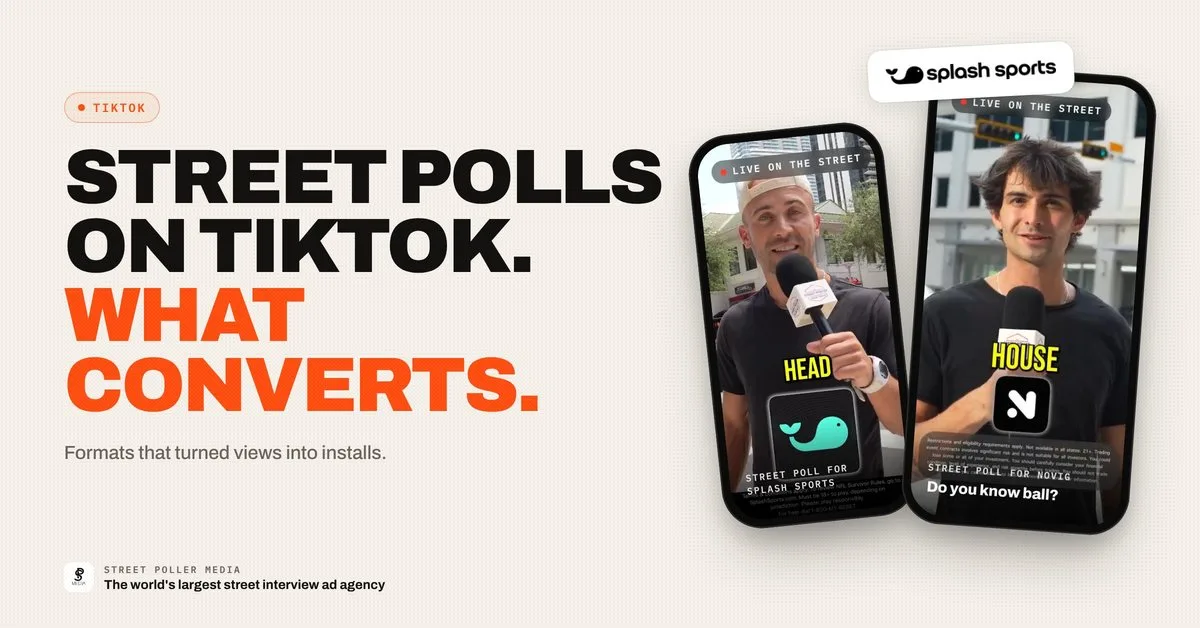
7. Street interview ads turn the feed into a conversation
Street polling works because the viewer encounters a question before encountering a pitch.
A trained host approaches someone in a public place. The question connects to the brand’s category. The stranger answers, reacts, tries something or changes their mind. That interaction becomes the raw material for the advertisement.
The format can use:
Public trivia
Taste tests
Product challenges
Financial questions
Cultural opinions
Personal habits
Live demonstrations
Misconceptions
Category preferences
Difficult decisions
The person scrolling sees an unresolved interaction.
What will the stranger say?
Will they know the answer?
Which product will they choose?
How will they react?
Curiosity buys the next few seconds. The product then has an opportunity to earn the conversion.
This is especially valuable in categories people rarely choose to watch.
Nobody opens TikTok hoping to see a debt-relief commercial. A question about how much credit card debt people carry can still start a conversation.
Few users look for another crypto animation. A stranger trying to understand or use a wallet creates a human entry point.
A polished telehealth pitch may trigger skepticism. People discussing the problem in ordinary language can make the category feel less remote.
Street interview ads work best when the question belongs to the brand. A random viral topic followed by an unrelated product may produce views and little business value.
The question is the strategy.
8. The simple-looking shoot has a complex system behind it
A strong street interview ad can look like someone walked outside with a microphone and got lucky.
Luck has terrible unit economics.
We know what a scalable street polling operation needs:
Category research
Question development
Location selection
Trained hosts
Camera and sound
Participant consent
Product logistics
Sufficient interview volume
Compliance review
Performance editing
Hook variations
Asset management
Media buying
The host alone can determine whether the shoot produces usable footage.
The wrong person makes strangers defensive. The question starts to sound rehearsed. The camera becomes the center of the interaction. Every answer becomes shorter and less natural.
An experienced host knows how to approach, frame the conversation, listen and follow up without turning the moment into a formal interview.
Volume matters too.
Some people decline. Some answers go nowhere. Some reactions are genuine but commercially irrelevant. Some footage fails for environmental or technical reasons.
The finished 20-second ad hides all of that.
When you hire a street interview agency, you are paying for the systems that consistently find usable moments, not merely the minutes when the camera happens to be recording.
9. One winning video will never be enough
Every brand wants the winner.
The advertisement with the lowest CPA. The best ROAS. The clip that scales for weeks. The video everyone screenshots in the ad account.
Then the audience sees it again.
And again.
Performance softens. Costs rise. The team keeps spending because the ad was the winner last month.
Creative fatigue is part of paid social. Meta defines it as the point where an audience has seen the same creative too many times. TikTok continues to emphasize fresh, diverse content as part of sustained performance.
Your campaign needs a pipeline rather than a rescue mission.
Street Poller says it typically develops five to ten hook variations for each street interview concept. Its broader production model can generate multiple participants, questions, captions and lengths from the same source material.
That matters because a strong central interaction can have more than one life.
One version may begin with the question. Another may begin with the answer. A third may lead with a reaction. A fourth may call out the target audience directly.
The body remains useful while the entry point changes.
Short-form success comes from producing the next test before the current winner collapses.
10. Volume has to create learning
More creative can increase the chance of finding a winner. It can also bury your team in assets that test nothing.
The difference comes down to variation architecture.
As a performance agency, we know what each asset is testing:
Hook
Concept
Person
Problem
Benefit
Proof
Offer
Length
CTA
Platform treatment
If ten videos change all ten variables at once, you may find a winner without knowing why it won.
If ten videos change nothing meaningful, you learn even less.
The strongest creative systems use both concept testing and controlled variation.
First, different concepts test what the audience needs to see or believe.
Then hook, edit and CTA variations improve the strongest concepts.
This creates compound learning. Every campaign informs the next shoot. Every winning interaction becomes a source of new cuts. Every losing concept prevents another round of wasted production.
A UGC marketplace or production company may deliver the agreed number of files. A street interview ad agency should explain what those files are designed to teach you.
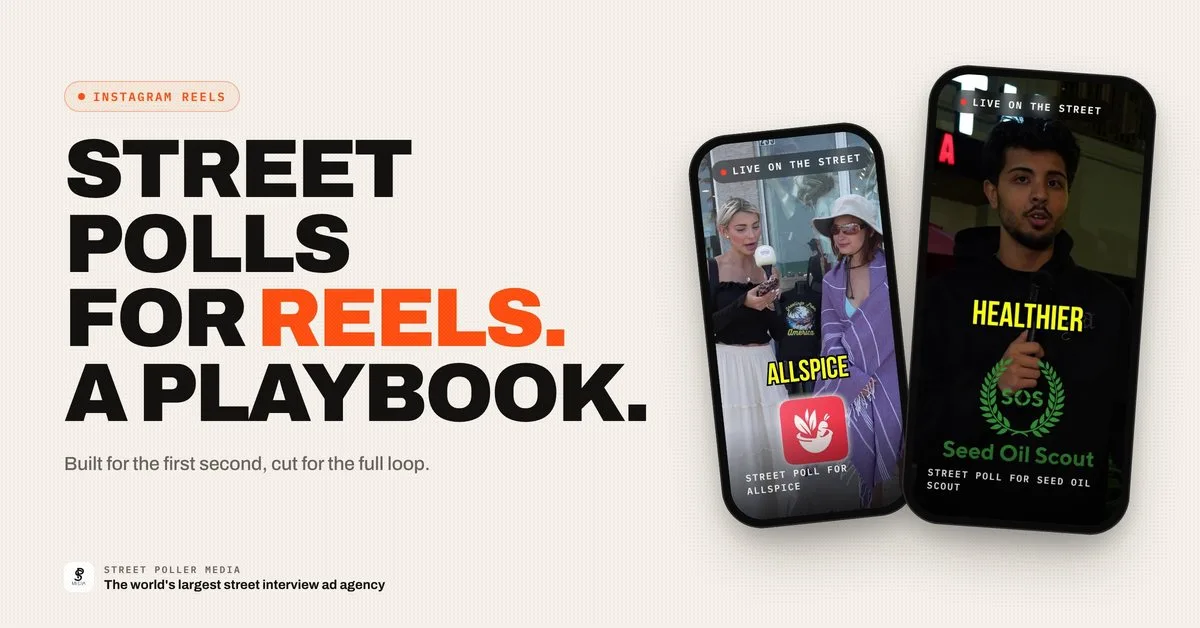
11. TikTok, Reels and Shorts need related creative, not identical creative
A top-performing short-form video can travel across platforms. That does not mean every platform should receive the exact same export.
TikTok, Instagram Reels and YouTube Shorts share several characteristics:
Vertical video
Mobile viewing
Fast user control
Creator-led environments
Sound, captions and visual movement
Direct engagement
They also have different surrounding behaviors, ad products and audience expectations.
TikTok often rewards creative that participates naturally in its trends and conversational styles. Instagram Reels sits within a broader identity and discovery ecosystem. YouTube Shorts connects short-form discovery with YouTube’s larger search, creator and long-form environment.
We preserve the core idea while adjusting:
Opening rhythm
Caption design
Safe zones
Music
CTA treatment
Video length
Brand timing
Post identity
Description and accompanying copy
TikTok’s Recut, Remix and Reimagine framework captures the progression well. Existing material can be reformatted, adapted with platform elements or rebuilt around native creators and community behavior.
Your agency should know which assets can be efficiently repurposed and which need a platform-specific treatment.
12. AI increases production speed and raises the value of human source material
AI is now part of the short-form production environment.
TikTok launched Symphony Agent in 2026 as an AI creative partner capable of moving from a brief to made-for-TikTok video using tools such as script generation, avatars and image-to-video. Meta offers AI-assisted creative features through Advantage+ creative. Similar capabilities will continue expanding.
This helps brands generate variations, localize campaigns and turn static assets into video.
It also makes generic creative easier to produce.
When everyone can generate a competent spokesperson, clean edit and familiar script, competence stops being a differentiator.
Source material matters more.
A real stranger thinking through a question contains details a prompt cannot reliably plan:
The pause before the answer
The laugh after realizing they were wrong
The glance toward a friend
The change in body language
The unexpected personal story
The immediate taste reaction
AI can help caption, organize, translate, resize and remix those moments. The human interaction remains the reason to watch.
That is the strongest balance for 2026: human source material supported by modern production and performance tools.
13. Compliance belongs inside the creative process
Short-form ads move quickly. Platform reviews and advertising rules still apply.
This becomes critical when the campaign involves:
Health
Weight loss
Financial services
Lending
Cryptocurrency
Gambling
Alcohol
Nicotine
Supplements
Testimonials
Before-and-after claims
The person on camera can make a claim your legal team would never approve in a written advertisement. A host can ask a question that creates a policy issue. On-screen text can change the meaning of an otherwise acceptable clip.
These problems are expensive when discovered after production.
A performance agency working in regulated categories needs category-specific review procedures covering:
Questions
Host language
Participant statements
Product claims
Visuals
Captions
Disclosures
Targeting
Final edits
The FTC’s endorsement guidance also requires endorsements to reflect honest opinions and experiences. Material relationships between an advertiser and endorser may require clear and conspicuous disclosure.
Creative freedom works best when the boundaries are understood before the shoot.
14. The media buyer and creative team need the same scoreboard
The camera captures the ad. The ad account reveals what happened.
When those functions sit in separate worlds, learning slows down.
The production team may celebrate a video with high engagement. The media buyer may see that the same asset produces expensive customers. The sales team may discover that those customers never qualify.
Everyone can be right about their own metric and wrong about the campaign.
Short-form performance should connect creative signals with business outcomes.
Creative signals may include:
Opening retention
Three-second views
Watch time
Completion rate
Click-through rate
Engagement
Business outcomes may include:
Qualified leads
App installations
Funded accounts
Purchases
Subscriptions
Customer acquisition cost
Revenue
Return on ad spend
The agency needs both.
A high-view video can be a weak acquisition asset. A less visible ad can quietly produce profitable customers.
When the creative team sees downstream performance, it can identify which questions, participants, hooks and concepts bring commercial value. That information makes the next production cycle better.
We pay attention to performance iteration.
Performance iteration is where short-form video becomes a growth channel.
15. The agency you choose matters more than the camera package
A production company can make your video look professional.
A creator marketplace can connect you with talent.
An AI platform can generate versions.
Your short-form campaign may need all three capabilities at different times. It also needs someone responsible for the complete result.
That partner should understand:
Audience research
Hook development
Concept diversification
Platform-native production
Casting
Street operations
Compliance
Performance editing
Asset variation
Media buying
Conversion tracking
Creative fatigue
Scaling
What happens after the files arrive?
Who launches them?
Who decides which version to test first?
Who sees the conversion data?
Who recuts a promising asset?
Who replaces the winner when performance declines?
Who connects the lesson back to the next shoot?
If those responsibilities remain with your internal team, you bought production capacity.
A street interview ad agency gives you an operating system around the footage.
Real campaign outcomes reported by Street Poller Media
We offer case studies across technology, financial services, consumer products, health and lead generation.
Coverd
A reduction from a $20 CPI target to $3.51, along with 43,774 app installs and 19,255 purchases.
BeReal
More than 45,000 app installs in 30 days, 10 million+ organic views and a 30% reduction in customer acquisition cost.
MoonPay
More than 400,000 funded wallets and a reported 72% reduction in customer acquisition cost.
American Hartford Gold
A reported 60% reduction in cost per lead, a threefold increase in inbound calls and more than 10 million views.
The Loaded Tea Shop
A reported 3× return on ad spend, more than five million views and doubled foot traffic.
Polymarket
Street Poller reports more than 150 million views and one million+ app installs across the wider partnership.
These figures come from Street Poller Media’s published materials. Campaign results vary according to the offer, audience, budget, category, attribution method and execution.
The pattern across the examples is more useful than any single number.
The winning campaign was never just a short video.
It combined a category-specific question, trained talent, real human interaction, multiple assets, paid distribution and continuous iteration.
Want this run for your brand?
300K+ street polls captured · 500+ brand campaigns shipped
The 2026 short-form video playbook in one view
The brands winning with short-form video follow the same operating principles:
Start with a real audience insight.
Give the first second a clear job.
Film for the placement.
Use people with a credible connection to the subject.
Create genuinely different concepts.
Put the product inside the story.
Show proof on screen.
Produce several hooks and edits.
Build the next creative before fatigue arrives.
Adapt strong ideas across platforms.
Use AI to support human source material.
Include compliance from the beginning.
Connect creative data to business outcomes.
Keep production and media buying close together.
Hire a partner accountable for performance after delivery.
This is the playbook.
The companies that follow it build a creative engine. The companies that skip it collect more files.
ABOUT STREET POLLER MEDIA
Street Poller Media, founded by Shane Ginsberg in Miami, Florida in 2020, is the world’s largest street interview ad agency and the agency that pioneered the street polling advertising format. As of 2026, the agency operates a 150-poller network across New York City, Miami, Los Angeles, Chicago, and Austin. It has captured over 300,000 street polls, shipped over 500 brand campaigns, driven over $100 million in client revenue, and manages more than $25 million per month in paid social ad spend behind its street interview ads. Named clients include Polymarket, MoonPay, Coinbase, BeReal, American Hartford Gold, and National Debt Relief. Street Poller Media has been covered by LA Weekly, OK! Magazine, The Source, JustLuxe, Technology.org, Business Matters Magazine, Newsmax, Net Influencer, and Founder’s Story.