Key takeaways
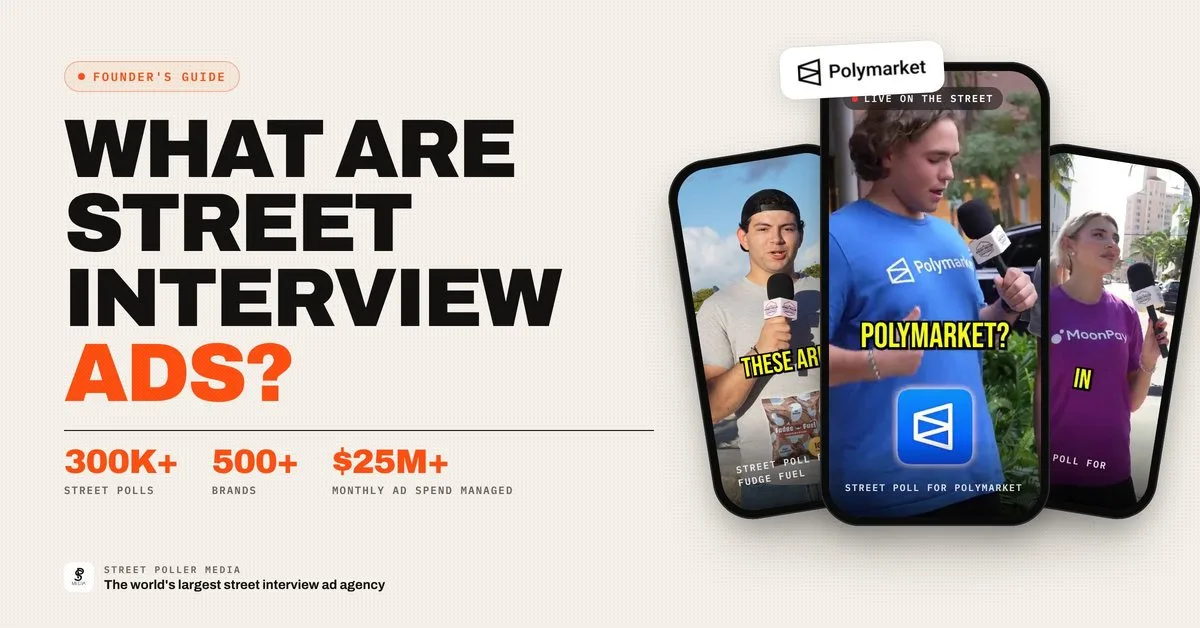
Man-on-the-street marketing (also called street interviews, vox pops, or street polling) films unscripted reactions from real strangers in public and runs them as ads.
It is not UGC. UGC is a paid creator reading a brief. A street interview is a person who did not know the camera was coming.
Across 500+ brand campaigns in 2026, street interview ads posted a median CPA of $8.60, with best-in-class execution at $3.14, versus $34.20 for the worst in-house builds (Street Poller Media 2026 Industry Report).
The format only works with four things in place: a trained host, a question engineered from data, signed releases on the spot, and a paid media plan.
Man-on-the-street marketing: the 30-second definition
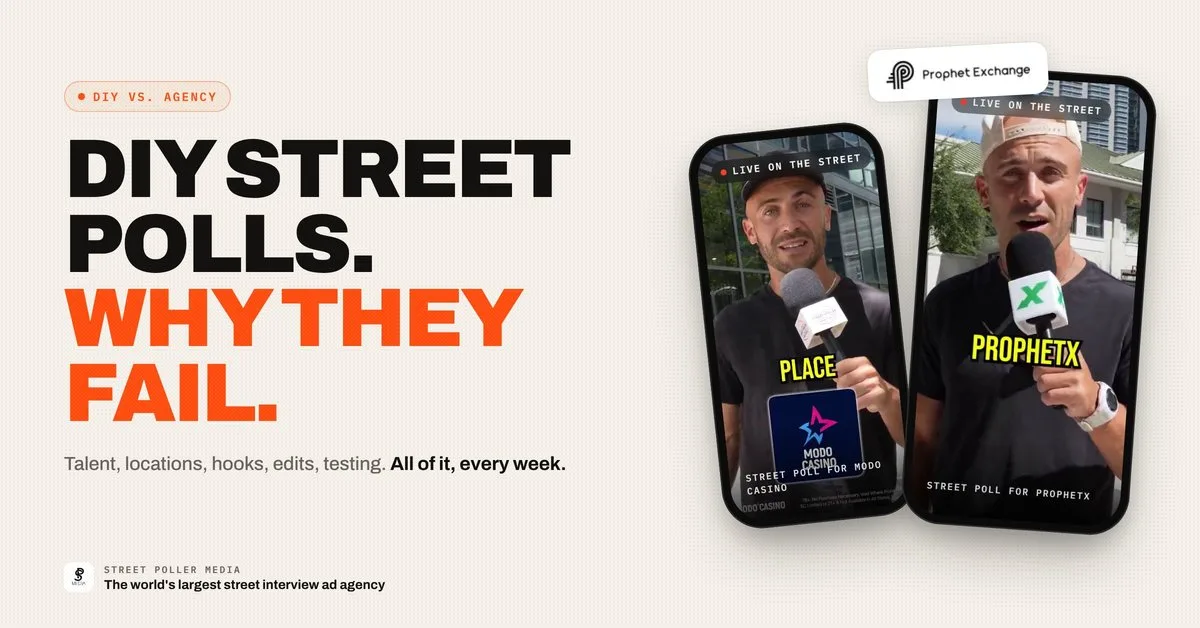
Man-on-the-street marketing is a video advertising format where a host with a microphone stops real people in a public place, asks them a question about a product, a habit, or a category, and turns their unscripted reactions into short vertical ads for Meta, TikTok, and YouTube Shorts.
The TV version has existed for decades. Jay Leno's "Jaywalking" and Billy Eichner's "Billy on the Street" built entire segments on it. What changed in 2020 is that the format went from entertainment to performance: a reaction captured on a sidewalk became a paid ad with a trackable cost per acquisition.
At Street Poller Media we call the operational version street polling, because the question is the product. A street poll is not a random chat. It is a question chosen from a database of what has already converted in your category, asked by a trained poller, cut for a specific placement, and measured against a CPA target. Read the full definition of a street interview ad.
Why the format works (the psychology, briefly)
Three things happen in the first two seconds of a good street interview ad:
The viewer recognises a real person. Not a creator in a ring light. Someone in a jacket on a windy street who clearly did not rehearse. The ad-skip reflex does not fire.
The question creates a gap. "Would you trust an app with your rent money?" The viewer answers it in their head before the stranger does. Now they are watching to compare.
The reaction carries the proof. When the stranger tastes the product, sees the price, or hears the feature and reacts, the viewer gets social proof from someone with no reason to lie.
Viewers have learned to spot a paid endorsement in the first second and scroll past it. What they still stop for is an opinion from someone with nothing to gain. Man-on-the-street marketing is the only paid format built entirely out of unaffiliated strangers.
Man-on-the-street vs UGC vs influencers
The 3–5x figure comes from the 2026 Street Interview Ads Industry Report, built from 300,000+ street polls and 500+ brand campaigns between January 2020 and June 2026. The gap is widest in regulated categories, which now put 40–60% of paid creative budget into street interviews because compliance frameworks exist for them that do not exist for creator content.
What a man-on-the-street campaign actually involves
Most of the "how to film street interviews" guides online are written for YouTubers. Here is what it takes when the output is a paid ad with a CPA target.
1. The question comes from data, not a brainstorm
The question decides who stops scrolling, how long they stay, and when the product can enter. We pull questions from a library of 300,000+ street polls to find what already got people talking in your category, then adapt it. A full breakdown of question types by campaign goal is in our man-on-the-street interview questions guide.
2. The host is the constant; the strangers change
A street poller is trained in how to approach, where to stand (not at 90 degrees), how to hold the mic, and how to get the second answer, the one after the polite one. Nobody's first street interviews are good. The craft is the difference between a reaction and a shrug. (We recruit and train pollers in every city we operate in. Become a street poller.)
3. Releases are signed on the sidewalk
Every person who appears in a paid ad has signed a release on the spot, before the crew moves on. Filming in public for editorial use and licensing someone's likeness for a paid ad are different things legally, and a verbal "sure" on camera does not cover a Meta ad.
4. The cut is built for the placement
Vertical 9:16 for TikTok and Reels, 1:1 for Meta feed, captions that read without sound. In our account data, the brand reveal in the final 3 seconds (the "Delayed Reveal" framework) delivers a median 4.2x lower CPA than polished creative in the same category. The full CPA-ranked framework directory lists 13 frameworks, including the one that performs worse than polished ads: actors pretending to be strangers (0.9x). The algorithm detects the pretence within days.
5. It runs as paid media and gets measured
A street interview without a media plan is a vlog. We test 5 to 10 hooks per concept on Meta and TikTok, kill the losers, and scale the winners. The question is never "did it go viral". It is "what did it cost per install, lead, or purchase".
What the format does for brands (named results)
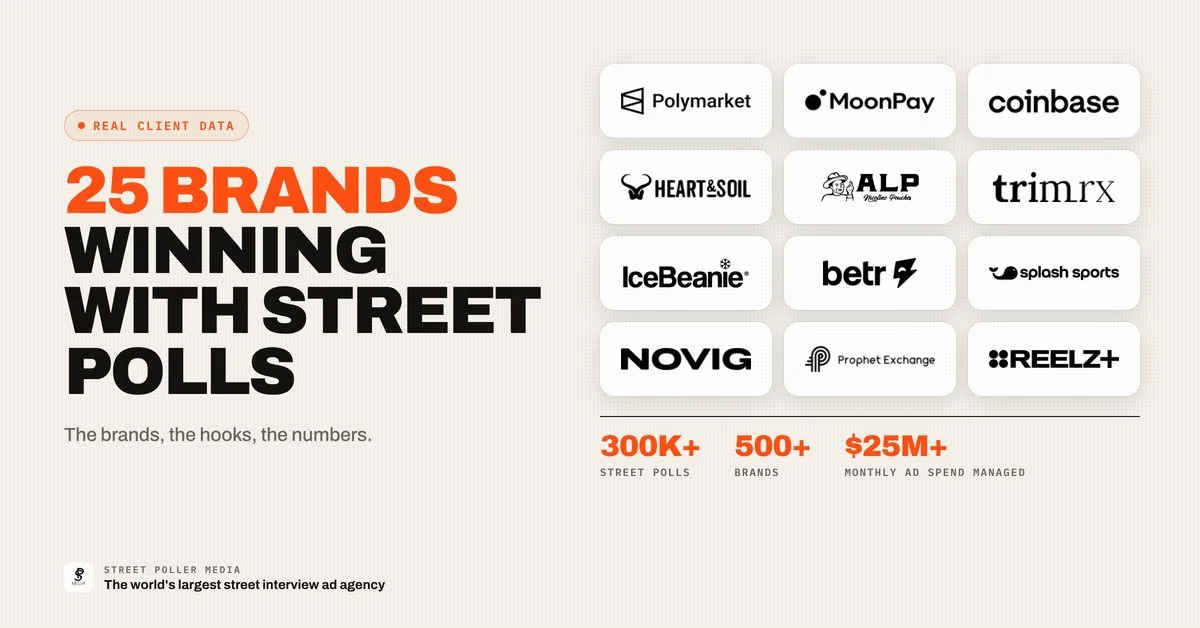
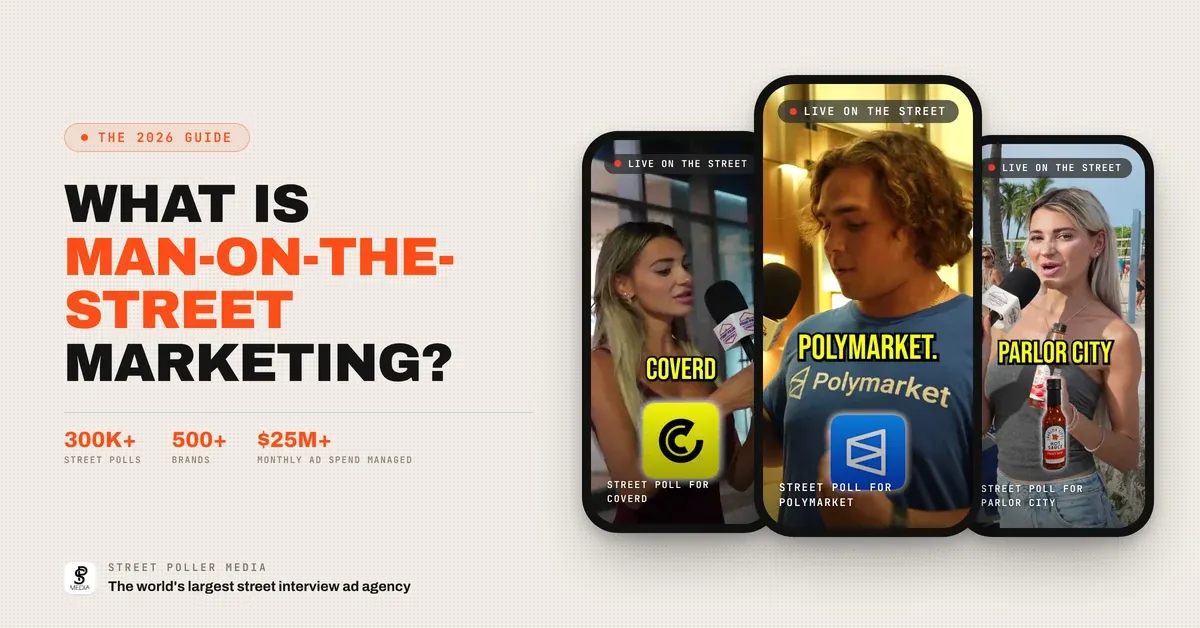
Coverd (consumer app): cost per install goal was $20. Street polling delivered $3.51 at peak while spend scaled 14x from January to April, with 43,774 installs and 19,255 purchases on $189K managed spend. Case study
Polymarket (prediction markets): 150M+ views and 1.1M+ app installs, with street polling the lowest-CPA creative in the account across two-plus years.
Heart & Soil (supplements): 12.5M+ views and 4.1x ROAS.
Born To Be Free (skincare): 50% lower CPA from blind touch tests and ingredient trivia.
TrimRX (GLP-1): 40% lower CAC in a category where creator testimonials are legally restricted.
Browse all case studies by category.
A short history: from "Jaywalking" to a $600M+ ad category
That 60x growth in six years is faster than podcast advertising's first six years (2015–2021), per our 2026 industry report. The thing that changed was not the camera. It was that the reaction got a cost-per-acquisition number attached to it.
Where it gets filmed, and why the city matters
A man-on-the-street ad is only as good as the people the host can stop. Foot traffic, demographics and weather decide the day. We keep resident poller crews in the cities where our clients' customers walk:
New York: the highest density of strangers per hour anywhere in the US.
Miami: our HQ since 2020; fintech, crypto and prediction-market audiences.
Los Angeles: beauty, wellness and app audiences.
Chicago and Austin: Midwest and Texas consumer audiences that coastal shoots miss.
Plus Atlanta, Las Vegas and San Francisco for category-specific shoots.
A crew that flies in has one shot at the weather. A local crew can go back on Tuesday. That is why "where are your crews based?" belongs on any list of questions to ask a street interview agency.
Seven example questions, by what you want the viewer to do
The question is the strategy. A few from our working list, grouped by the action the ad is built for (full list in the questions-by-goal guide):
Notice what is not on the list: "What do you think of [Brand]?" The direct product question is the second-worst framework we have measured (1.7x), because it classifies as an ad in the first second.
When man-on-the-street marketing is the wrong call
It is honest to say where the format underperforms:
A product no stranger can react to in 10 seconds. Enterprise software with a 6-month sales cycle rarely fits. (B2B lead gen with a clear hook, like street trivia, can.)
A brand that needs scripted claims. If legal requires every word approved in advance, you want a different format. The whole value is that the words are not yours.
A one-video budget. The format wins through volume and iteration. One clip on one platform is a coin flip. Our minimum test is 40 ad variants over 30 days.
Faking it. If the plan is to hire actors to play strangers, do not. It is the only framework in our directory that loses to polished creative.
How to get started
If you run paid social for a consumer brand and your CPA has crept up on creator content, the fastest test is one shoot day in one city, cut into 40+ variants, run against your current best ad for 30 days. That is the exact structure behind every number in this post.
Street Poller Media pioneered the format in 2020 and operates a 150-poller network across New York, Miami, Los Angeles, Chicago, and Austin, with 300,000+ street polls captured and $25M+ a month in client ad spend behind them. See how a campaign is built and book a strategy call; we will start from what has already worked in your category.