Key takeaways
The questions that matter are about releases, variant volume, CPA measurement, media buying and footage ownership, not showreels.
Any street interview ad agency should be able to tell you its median CPA by category and how it was measured. The 2026 category median is $8.60; worst-in-class in-house builds reach $34.20.
"Do you use actors?" is still the first question. The fake version of this format performs worse than a polished studio ad.
Why the usual agency questions don't work here
The standard "questions to ask a creative agency" lists ask about industry experience, points of contact and revision rounds. Fine, but none of them tell you whether a street interview agency can lower your CPA. This format has specific failure points: unsigned releases, fake strangers, one-video "tests", and pretty footage with no media plan behind it.
We have run 500+ brand campaigns and 300,000+ street polls since 2020. These are the questions we would want a buyer to ask us, and the answers that should make you walk away.
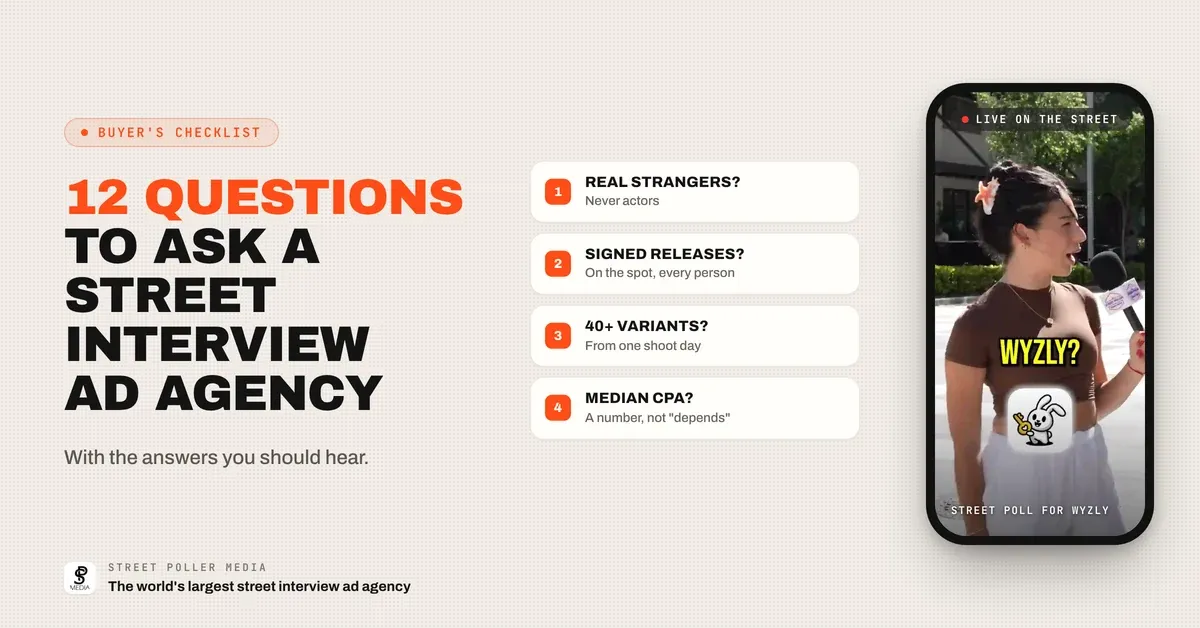
The 12 questions
1. Are the people on camera real strangers, or actors and creators?
Why it matters: Actors pretending to be passers-by is the only street interview framework in our CPA-ranked directory that performs worse than polished creative (0.9x). The algorithm detects the pretence within days, and so do viewers.
Walk away if: "We use a mix of real people and brand-aligned talent."
2. How do you handle releases?
Why it matters: Filming someone in public for editorial content and licensing their likeness for a paid ad are different things. If a release is missing, the ad that is finally working comes down.
Expect: A digital release signed on the spot by every participant before the crew moves on, stored and attached to the footage.
3. How many ad variants come out of one shoot day?
Why it matters: This format wins through volume and iteration. Meta's Andromeda ad-retrieval system favours accounts with many genuinely different creatives (Meta Engineering, "Meta Andromeda"). An agency that delivers "five hero videos" is selling you a studio shoot filmed outdoors.
Expect: 40+ variants from a shoot day. Our minimum test is 40 variants, $50K in spend, 30 days before we rank a framework.
4. Where does the question come from?
Why it matters: The question decides who stops, how long they stay, and when the product can enter. A question improvised on the day is a guess.
Expect: A library of past polls in your category and a rationale for each question tied to the campaign goal (awareness, lead, install, purchase). We pull from 300,000+ street polls before we film anything.
5. What is your median CPA by category, and how is it measured?
Why it matters: If an agency cannot answer this, it is not a performance agency.
Expect: A number, a definition (cost per intent action: add-to-cart, lead, sign-up, purchase), and a window. For reference, the 2026 category median is $8.60 across non-regulated categories, best-in-class $3.14, worst-in-class in-house $34.20 (2026 Industry Report).
6. Do you run the media, or hand over files?
Why it matters: A street interview without a media plan is a vlog. Creative-only agencies cannot see what converts, so they cannot iterate on it.
Expect: Either full media buying (we test 5–10 hooks per concept on Meta and TikTok, kill the losers, scale the winners), or a tight loop with your buyer where conversion data comes back to the editors weekly.
7. How fast can you re-cut a winner?
Why it matters: Creative fatigue is the main reason CPA creeps up. The agency that can ship a new hook on the same footage in two days beats the one that needs a new shoot.
Expect: New creative weekly; for a fresh shoot, a local crew on the street within 48–72 hours and edited creative live in 10–14 days.
8. Can you work in a regulated category?
Why it matters: GLP-1, sports betting, crypto, nicotine alternatives and financial services now put 40–60% of creative budget into street interviews because the compliance framework exists for strangers' reactions in a way it does not for creator claims. But only if the agency knows the framework.
Expect: Named work in the category (we run Polymarket in prediction markets and TrimRX in GLP-1) and a view on what the stranger can and cannot say.
9. Who owns the raw footage?
Why it matters: The footage is the asset. Coverd scaled spend 14x over four months on recuts of the same releases while cost per install fell to $3.51.
Expect: You own the delivered ads; be clear in the contract who can recut the raw footage, and for how long.
10. Which cities, and is the crew local?
Why it matters: A crew flying in for one day has one chance at weather, foot traffic and the right demographic. Local pollers can go back on Tuesday.
Expect: Named markets with resident crews. We run a 150-poller network across New York, Miami, Los Angeles, Chicago and Austin.
11. Show me a campaign where it didn't work. What did you change?
Why it matters: Every agency has a highlight reel. The useful information is in the iteration.
Expect: A story with a number. Ours: the Coverd objective moved from installs to purchases mid-engagement; we rebuilt the hooks around purchase intent and cost per purchase kept falling as spend grew.
12. What does the first 30 days look like, in numbers?
Why it matters: "We'll get to know your brand" is not a plan.
Expect: Shoot date, variant count, platforms, test budget, the CPA you are measured against and the day you review. If they cannot write it on one page, they have not done it before.
Questions to ask a creative agency of any kind (still worth asking)
Keep asking about the point of contact, reporting cadence and references. Just put them after the twelve above. Three that earn their place on any shortlist call:
"Who, by name, will be in the edit every week?" Agencies pitch with their founders and deliver with whoever is free. The person recutting your hooks on day 14 matters more than the person on the sales call.
"What did you stop doing last year, and why?" A performance agency retires frameworks when the data turns. (The Celebrity Substitute, for example, sits near the bottom of our directory at 1.4x: the novelty fades fast.) An agency that has never stopped doing anything is not measuring.
"Can I speak to a client whose first 30 days went badly?" References from happy clients are free. A client who stayed after a rough start tells you how the agency behaves under pressure. We have a separate guide on how to benchmark a creative agency's performance once you have one, and a candid comparison of an agency vs an in-house team.
Red-flag phrases, translated
You will hear these on discovery calls. Here is what they usually mean.
How to run a 30-day pilot between two agencies
If you are choosing between two shortlisted agencies, do not choose on the pitch. Run the same pilot with both:
Same product, same intent action, same CPA target, same city if possible.
Each agency delivers 40+ variants from one shoot day.
Each set runs in its own cold-traffic campaign in your account, same conversion event, same daily budget, 30 days.
Day 7: kill rule applied identically. Day 14: each agency recuts its top two hooks. Day 30: compare cost per intent action and the number of hooks under target.
Hire the one whose concept won, not the one with a single lucky ad.
The pilot costs the same as two months of guessing and ends the argument. The test structure in detail.
A request-for-proposal email you can paste
Subject: Street interview ad pilot — 30 days, [product]
We are evaluating street interview creative for [product], optimising for [install / lead / purchase] at a target CPA of $[X] on Meta and TikTok.
Please reply with: (1) confirmation that participants are unpaid strangers and how releases are collected; (2) the number of ad variants delivered from one shoot day; (3) your median CPA in [category] and how it is measured; (4) whether you buy media or work with ours, and the cadence; (5) your resident crews' cities; (6) who owns raw footage and for how long; (7) a one-page plan for the first 30 days with dates and budgets.
We will run shortlisted agencies head-to-head for 30 days in our own account.
The one-page scorecard
Street Poller Media pioneered street polling in 2020 and is the world's largest street interview ad agency: 500+ brands, 300,000+ polls, $25M+ a month in client ad spend. We are happy to be asked all twelve. See how we run campaigns and book a strategy call.