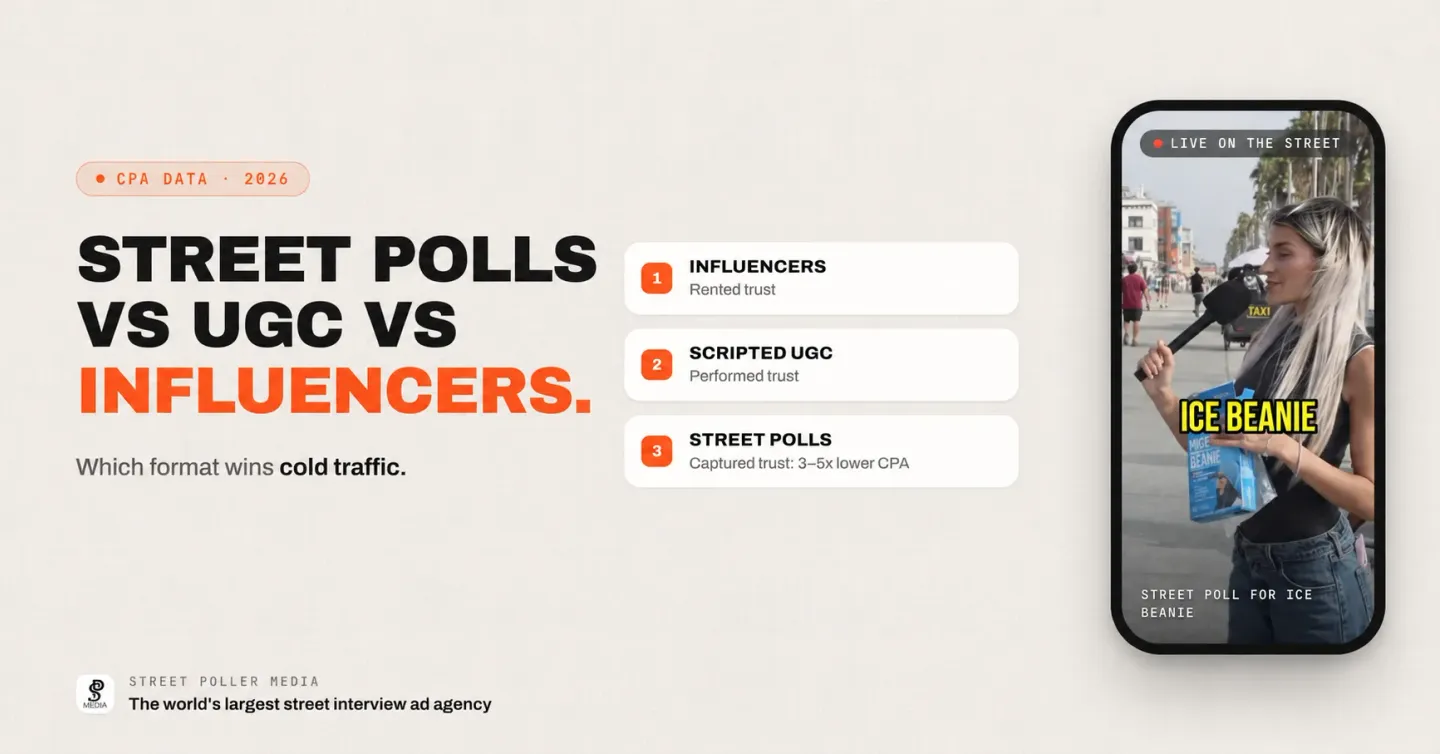
Quick answer. Street interview ads vs UGC vs influencers is not a beauty contest, it is a question of jobs. On cold traffic, street interview ads win on cost per acquisition by a median of 3–5x over UGC in every category we measured in 2026. UGC still wins for product demonstrations. Influencers still win for audiences you cannot target in Ads Manager. The rest of this post is the evidence, format by format, and a decision tree you can use in a planning meeting.
Key takeaways
Influencer content and UGC are not broken. They are being outperformed on cold traffic by a format that costs less to make and is harder to fake.
Across every category measured in 2026, unscripted street interview ads delivered a median 3–5x lower CPA than UGC ads.
The right answer is usually a mix: street interviews for cold reach, UGC for demonstrations, influencers for audiences you cannot buy.
Regulated categories (GLP-1, sports betting, crypto, financial services) have already made the choice: 40–60% of paid creative budget now goes to street interviews.
The three formats, defined properly
Marketers use "UGC" for everything filmed on a phone. The three formats are different products with different economics.
Influencer marketing. A creator with their own audience posts about your brand to that audience, usually with a usage window and a fee tied to their follower count. You are renting trust and distribution.
UGC (as the industry now uses the term). A paid creator makes a social-native video to your brief: unboxing, testimonial, demo, "three reasons". You run it as an ad in your own account. You are buying a performance. We wrote an honest breakdown of when UGC is still worth it.
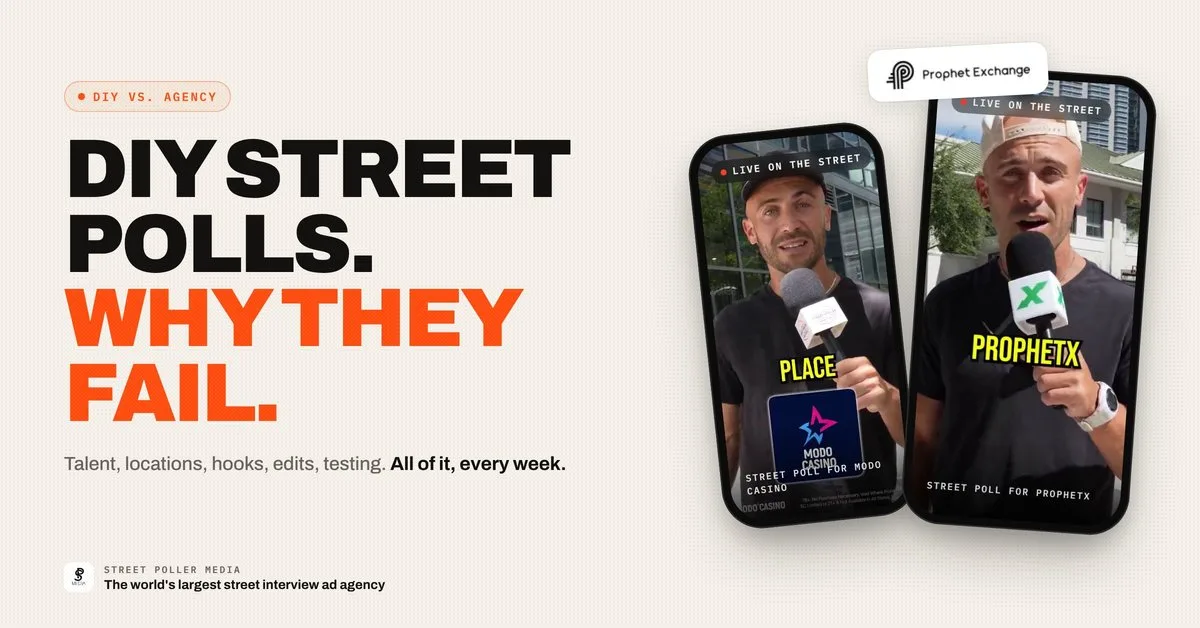
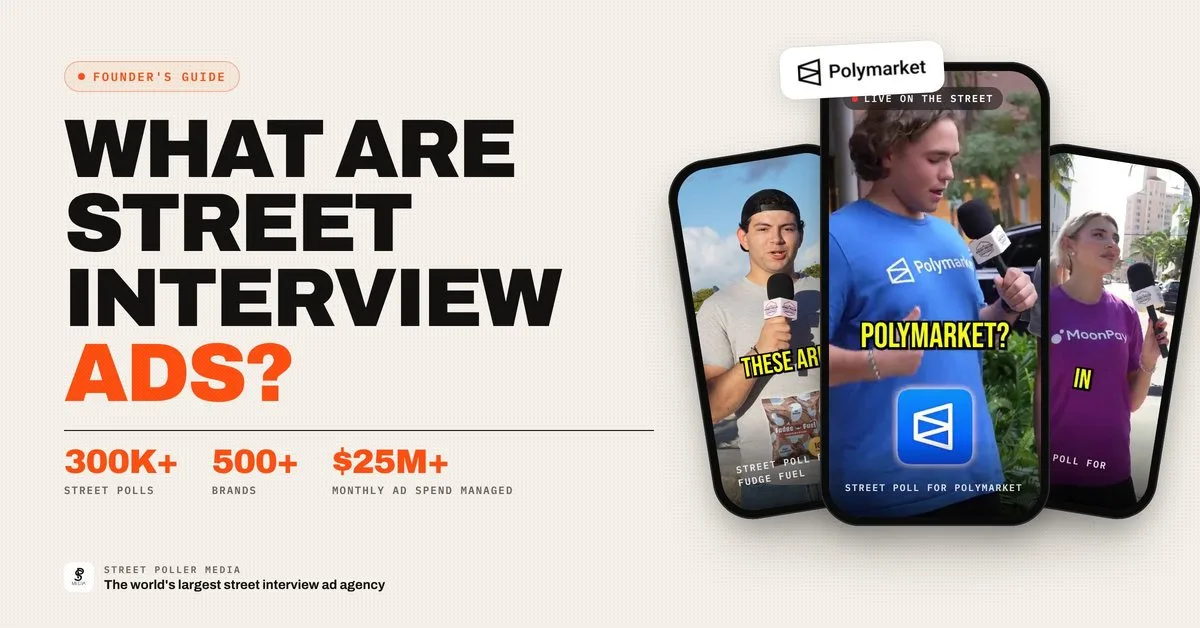
Street interview ads (street polling). A trained host stops real people in public, asks a question built from category data, and the unscripted reactions become the ad. Nobody on camera was briefed, paid to endorse, or knew the question was coming. Full definition here. The format grew out of man-on-the-street marketing.
Street interview ads vs UGC vs influencers: the seven things that decide performance
1. Cost per acquisition
This is the only comparison that pays the bills.
Source: The State of Street Interview Ads: 2026 Industry Report. All brand identities anonymised, metrics reviewed by an independent third-party auditor, presented in aggregate.
2. Trust
The viewer does a quick calculation in the first second: was this person paid to say that?
Influencer: obviously yes, and the viewer knows roughly how much.
UGC: yes, and the viewer has seen the script template fifty times today ("I was skeptical, but...").
Street interview: no. The person on screen is in a parking lot in a hoodie. They might hate the product. That possibility is the whole reason the viewer keeps watching.
That is the trust gap in one line: a paid endorsement asks the viewer to believe someone with a reason to say yes. A street reaction does not.
3. Hook rate and the algorithm
Meta's Andromeda ad-retrieval system, rolled out across Advantage+ through 2025, considers far more ads per person than before, which favours accounts that feed it many genuinely different creatives (Meta Engineering, "Meta Andromeda"). Meta’s own advertiser guidance makes the same point: “The biggest constraint you can put on your Meta strategy is the constraints you place on your creative process.” One street shoot day produces dozens of distinct openings: different people, different answers, different reactions. One UGC brief produces one video. One influencer post produces one post.
4. Compliance
This is where the comparison stops being close for regulated brands.
An influencer or UGC creator saying "this helped me lose 20 pounds" is a brand claim with the brand's name on it. The FTC is explicit that the advertiser carries that risk: “Your company is ultimately responsible for what others do on your behalf.” Its guidance for creators says they “can’t make up claims about a product that would require proof the advertiser doesn’t have.”
A stranger on the street saying "I'd try that" is a reaction. Compliance frameworks exist for street interviews that do not exist for creator content, which is why GLP-1, nicotine alternatives, sports betting, crypto and financial services now allocate 40–60% of paid creative budget to the format. TrimRX cut CAC 40% in GLP-1 this way.
5. Production cost and speed
Influencer: fee scales with audience size; weeks of negotiation; one post.
UGC: a few hundred to a few thousand dollars per video; days to weeks; one video.
Street interview: one crew, one day, one city produces 40+ ad variants. A local crew can be on the street within 48–72 hours of approval. The unit cost per ad is what makes testing possible.
6. Reuse rights
Influencer content is usually usage-limited. UGC is one video. Street interview footage with signed releases is yours to recut into new hooks for months. The Coverd campaign scaled spend 14x from January to April on continuous recuts, and cost per install fell as spend grew, finishing at $3.51 against a $20 goal.
7. Fakeability
Here is the number nobody else publishes. Of the 13 street interview frameworks we have tested at scale, the one that loses to polished creative is "The Fake Man-On-Street" (actors pretending to be strangers): 0.9x, worse than a studio ad. The algorithm detects the pretence within days. You cannot shortcut this format with UGC creators pretending to be passers-by. It is also a legal exposure: the FTC’s final rule on fake reviews and testimonials, in force since October 2024, bans testimonials that misrepresent who is giving them. See the full CPA-ranked directory.
So which one should you run?
Honest answer: all three have a job. The mistake is using one for the other's job.
Where the money is moving
The clearest signal is budget, not opinion. The street interview ads category grew from an estimated $10M in annual creative spend in 2020 to $600–900M in 2026, roughly 60x in six years and faster than podcast advertising's first six years. Over the same period, Meta's Andromeda retrieval system made creative variety a bigger lever in delivery. Brands did not stop buying creator content (US influencer spend passed $10 billion in 2025, per EMARKETER); they stopped using it as the cold-traffic workhorse.
Three category patterns from our 500+ campaigns:
Apps and fintech moved first. Install campaigns live or die on cold reach, and a stranger's reaction to a price or a feature is the cheapest reach there is. Polymarket: 150M+ views and 1.1M+ installs. Revo Madic: 500K+ installs.
CPG and DTC followed with blind tests. A product the stranger can taste, smell or touch on camera turns the reaction into the demo. Heart & Soil (12.5M+ views, 4.1x ROAS), Born To Be Free (−50% CPA), Parlor City (ROAS from 1.5x to 4.5x on blind taste tests).
Regulated categories went furthest. With creator claims legally restricted, GLP-1, betting and crypto brands now commit 40–60% of creative budget to the format.
How to brief each format (so the comparison is fair)
Most "UGC lost to street interviews" stories are really "a vague UGC brief lost to a sharp street question". Brief all three properly before you compare them.
Then run them in separate ad sets, cold audiences, same conversion event, 30 days. The format with the lowest cost per intent action at the end wins the cold-traffic budget. The exact Meta test structure we use.
A decision tree you can use in a planning meeting
Is the audience cold? Yes → street interview ads. No → go to 2.
Does the product need a demo to be understood? Yes → UGC. No → go to 3.
Does a specific community decide purchases in this category? Yes → influencers, whitelisted for paid. No → street interview recuts leading with the product reaction.
Is the category regulated? Yes → street interview ads for everything cold; legal reviews the question, not the answers.
What "being outperformed" looks like in an account
Brands that moved cold-traffic budget from creator content to street polling, from our case studies:
Revo Madic: 500K+ app installs and CPA down 76% ($15.40 to $3.60) on street interview creative.
Seed Oil Scout: 3.8x ROAS and a viral cultural moment from one question.
Wyzly: 40% lower CPA on app installs.
Formulation Factory: 4x ROAS by tapping internet culture in the question.
BeReal: 10M+ views and 45K+ organic installs, with no creator fee behind any of it.
The bottom line
Influencers rent trust. UGC performs trust. Street interviews capture it. On cold traffic, in 2026, captured trust is 3–5x cheaper per customer than the performed kind. Keep UGC for demos and influencers for reach you cannot buy, and put the cold-traffic budget where the CPA is.
Street Poller Media runs street polling for 500+ brands with $25M+ a month in ad spend behind it. See how a campaign is built and book a strategy call.